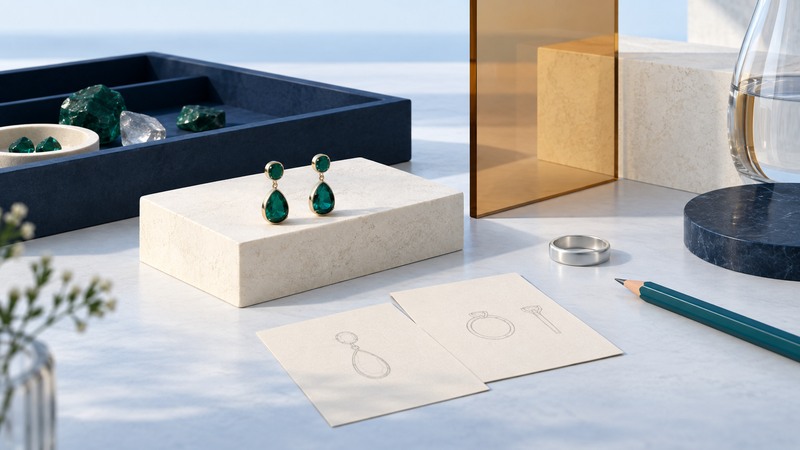
A successful conversation with a jeweler starts with the effect you want and the conditions in which you will wear the piece. Bring inspiration, then turn it into decisions about scale, materials, construction, and budget. A clear written brief helps both sides recognize the finished result.
Translate the photograph into design choices
Red-carpet jewelry is often photographed at a distance under powerful lighting. An oversized colored stone, long articulated earring, or broad polished cuff can read clearly in that setting. For your own piece, identify the feature that matters: color, movement, outline, surface, or proportion.
H.Stern offers a useful example of this approach. The jeweler describes music, dance, fashion, and architecture as sources for its collections. Its work provides a starting point for discussing how an idea becomes a form in metal and stone. Use references to describe a visual intention and ask the jeweler to develop a design appropriate to your needs.
- Shape: rounded, geometric, long and narrow, clustered, or open and airy?
- Movement: a fixed stud, a swinging drop, a flexible chain, or a rigid bangle?
- Color: one dominant hue, a contrast, or a subtle tonal range?
- Surface: high polish, brushed texture, visible setting detail, or mostly stone?
- Scale: the overall dimensions on the wearer, including thickness and projection?
Choose two or three reference images and add a sentence to each: “I like the outline,” “this drop is too long,” or “this surface looks right.” Conflicting references become useful when you explain which element of each you mean.
Define the use before selecting stones
Tell the jeweler whether the piece is for occasional evenings, daily wear, a particular neckline, or a ring worn beside an existing band. Mention skin sensitivities, clasp preferences, and activities that affect comfort or wear. Bring the adjacent jewelry or clothing when practical.
Scroll horizontally to see all columns.
| Preference | Decision to make together | Useful verification |
|---|---|---|
| Long earrings | Total drop, joint placement, closure, and acceptable weight. | Try a comparable sample and check movement, comfort, and contact with clothing. |
| A prominent ring | Finger size, top dimensions, setting height, and relationship to another band. | Inspect a model from the side and try the proportions on the hand. |
| A broad cuff | Inner dimensions, opening or hinge, edge shape, and fit. | Check how it goes on and whether it presses into the wrist during movement. |
| A colored-stone focal point | Identity, treatment, dimensions, hue, and care requirements. | View the proposed stone in different ordinary lighting before approving it. |
The gemology guide explains why hardness, toughness, and stability are different properties. A stone can resist scratches yet remain vulnerable to impact or a cleaning process. Ask the jeweler to explain the material and setting together, including how the piece can be repaired later.
For pearl designs, consider attachment, friction against other stones, and future restringing; the pearl guide provides relevant buying and care questions. For a diamond center, compare the actual stone and its report using the lab-grown diamond checklist where applicable.
Choose a jeweler whose process you understand
Jewelers of America recommends professional jewelers as a source of product knowledge and service. Ask to see work comparable in construction and materials to your project. A beautiful display of finished pieces is helpful; a clear explanation of design review, fabrication, fitting, and aftercare is equally useful.
Establish who will do the work, which steps are performed elsewhere, and who will be responsible for your item throughout. For an inherited stone, request an intake description and photographs before it leaves your possession. Clarify the risk assessment for removing it from its current setting and how unexpected findings will be handled.
Discuss budget as a total in a named currency, including tax, design fees, stones, metal, fabrication, and expected fitting. Ask which choices most affect cost. A smaller stone, a different setting, or a simpler articulated structure may preserve the intended look; ask to compare those options before authorizing fabrication.
Worked example: an evening earring brief
Open the printable jewelry design brief. It includes space for the intended use, dimensions, materials, budget, approvals, and unresolved questions. Fill it in before the consultation and revise it together afterward.
Approve a concrete scope and check delivery
Before paying a deposit or authorizing work, obtain the agreed design version, materials and stone descriptions, dimensions, price, payment stages, estimated completion date, and change-approval process. Specify what happens if the chosen stone becomes unavailable or the proposed construction changes.
Ask about cancellation, returns for custom work, resizing, warranty, future repair, and responsibility for customer-supplied stones. The answers depend on the agreement and jurisdiction; keep the actual written terms with the brief. U.S. readers can use the FTC Jewelry Guides as a reference for product-description language.
At collection, compare the delivered piece with the approved specification. Check fit, closure operation, symmetry or intentional asymmetry, finishing, and the supplied documentation with the jeweler. Obtain care instructions and record any final adjustment. If insurance is needed, ask the insurer which documentation it requires and use the appraisal preparation guide to organize the next step.