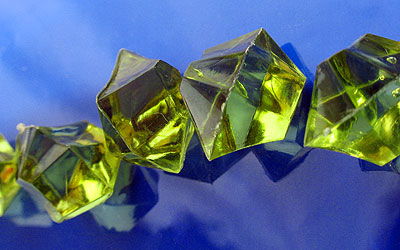
 These transparent green gemstones have been faceted into geometric forms that redirect light through polished surfaces. Their shared color and appearance do not establish that they are the same material: identification requires measurements and observations rather than visual resemblance alone.
Gemology is the science and practice of identifying gemstones and evaluating the qualities that affect their beauty, durability, rarity, and value. A gemologist may determine what a stone is, whether it formed in nature or in a laboratory, whether it has been treated, and whether a claimed geographic origin is supportable. Depending on the assignment, the gemologist may also describe or grade its quality.
The work combines mineralogy, optics, chemistry, careful observation, and knowledge of the gem trade. It also requires restraint. A professional conclusion should reflect what the evidence supports, including “inconclusive” when different possibilities cannot be separated reliably.
What makes a material a gemstone?
Most gems are minerals: naturally occurring solids with characteristic chemical compositions and crystal structures. Diamond is crystalline carbon; ruby and sapphire are color varieties of corundum; emerald and aquamarine are varieties of beryl. Other gem materials are rocks, mineraloids, or organic products. Lapis lazuli is a rock, opal lacks a conventional crystal structure, and pearl, amber, and coral are made by or derived from living organisms.
Beauty and rarity matter, but so do durability and the ability to be fashioned. Transparent material is often faceted to control the path of light. Opaque, translucent, or phenomenal material may be cut as a cabochon, bead, carving, or inlay. A gem can also be prized for an optical effect such as asterism, chatoyancy, adularescence, play-of-color, color change, or iridescence.
Species, varieties, and trade names
A mineral species is defined principally by chemistry and crystal structure. A variety is a recognizable form within a species, often distinguished by color or an optical effect. Ruby is red corundum; all other gem-quality colors of corundum are sapphires. Emerald is green beryl colored primarily by chromium, vanadium, or both; aquamarine is blue to greenish blue beryl. Garnet and tourmaline are groups containing multiple mineral species, not single minerals.
Commercial names can be useful, poetic, regional, or misleading. “Precious” and “semiprecious” are traditional labels, not scientific rankings. A rare spinel, garnet, tourmaline, or jadeite can be more valuable than a mediocre stone from the traditional “precious” group. Modifiers such as “AAA,” “investment grade,” and “museum quality” usually reflect a seller’s own system; they are not universal gemological grades.
| Material or group | Well-known gems | Mohs hardness | Useful context |
|---|---|---|---|
| Diamond | Colorless and fancy-color diamond | 10 | Hardest natural gem, but it can chip or cleave |
| Corundum | Ruby and sapphire | 9 | Durable; heat treatment is common |
| Chrysoberyl | Alexandrite and cat's-eye chrysoberyl | 8.5 | Known for color change or chatoyancy |
| Spinel | Red, pink, blue, and other spinels | 8 | A distinct mineral historically confused with ruby |
| Beryl | Emerald, aquamarine, morganite | 7.5–8 | Emerald often has clarity enhancement and needs special care |
| Topaz | Imperial, pink, yellow, and blue topaz | 8 | Hard but vulnerable to cleavage |
| Tourmaline group | Rubellite, indicolite, Paraíba-type tourmaline | 7–7.5 | Complex chemistry produces a broad color range |
| Quartz | Amethyst, citrine, ametrine, agate | 7 | Abundant and widely treated or synthesized |
| Garnet group | Pyrope, almandine, spessartine, tsavorite, demantoid | 6.5–7.5 | A family with overlapping compositions and many colors |
| Feldspar group | Moonstone, sunstone, labradorite | 6–6.5 | Valued for distinctive light effects |
| Jade | Jadeite and nephrite | 6–7 | Two different materials, both notably tough |
| Opal | Precious and common opal | 5–6.5 | Heat, dryness, and impact can cause damage |
| Organic gems | Pearl, amber, coral | About 2.5–4.5 | Generally softer and more sensitive to chemicals |
The Mohs scale measures resistance to scratching, not resistance to impact. Its steps are also unequal: diamond at 10 is many times harder than corundum at 9. A full durability assessment considers hardness, toughness, and stability. GIA explains these three properties in its durability guide.
How gem identification works
Identification is a process of converging evidence. No responsible gemologist identifies an unknown stone from color or a photograph alone. Color overlaps widely: a red stone might be ruby, spinel, garnet, tourmaline, glass, or a laboratory-grown material. Mounted stones and unusual cuts can restrict which tests are possible, and valuable objects should be examined with the least destructive methods available.
Observation and standard instruments
- Loupe and microscope: reveal inclusions, growth structures, surface features, facet wear, assembled construction, and clues to treatment or laboratory growth.
- Refractometer: measures refractive index, one of the most useful properties for separating transparent gem species.
- Polariscope: shows how a stone interacts with polarized light and helps determine whether it is singly refractive, doubly refractive, aggregate, or anomalous.
- Dichroscope: separates pleochroic colors visible in many doubly refractive gems.
- Hand spectroscope: displays absorption features produced by coloring elements or structural defects.
- Specific-gravity measurement: compares density with water and helps narrow the possibilities.
- Ultraviolet light: reveals fluorescence or phosphorescence patterns that may support identification or raise questions about treatments and growth origin.
Standard tools remain fundamental, but some natural-versus-laboratory-grown determinations and modern treatments cannot be resolved with them alone. GIA's current gem-identification curriculum, for example, teaches the use of the microscope, refractometer, polariscope, dichroscope, spectroscope, and related equipment while also teaching when a stone should be sent to a laboratory. See GIA's description of practical gem identification.
Advanced laboratory analysis
- FTIR spectroscopy measures infrared absorption associated with atomic bonds and defects. It can help distinguish natural from laboratory-grown material and detect treatments in diamond, corundum, emerald, jade, quartz, and other gems.
- UV-Vis-NIR spectroscopy records absorption in ultraviolet, visible, and near-infrared wavelengths, helping explain color and separate some natural, treated, and synthetic materials.
- Raman spectroscopy provides a structural “fingerprint” for a gem or an inclusion and is valuable when refractive-index testing is impractical.
- Photoluminescence spectroscopy examines light emitted after laser excitation and is central to detecting many CVD and HPHT laboratory-grown diamonds and post-growth treatments.
- X-ray fluorescence and mass spectrometry measure major, minor, and trace elements. Chemistry can support identification, treatment detection, natural-versus-synthetic separation, and some colored-stone origin opinions.
- X-ray imaging and diffraction can reveal internal structures or identify crystalline phases when other tests are insufficient.
Modern laboratories combine these results rather than relying on one instrument. GIA's 2024 review describes how microscopy, FTIR, UV-Vis-NIR, Raman, photoluminescence, X-ray fluorescence, and trace-element analysis fit into a working laboratory. Read the laboratory-analysis overview.
Natural, laboratory-grown, imitation, and assembled
These terms answer different questions and should not be used interchangeably.
- Natural: formed without human manufacture, although it may later have been cut or treated.
- Laboratory-grown or synthetic: manufactured material with essentially the same chemical composition, crystal structure, and optical and physical properties as its natural counterpart. A laboratory-grown ruby is ruby; its growth origin is different.
- Imitation or simulant: material that resembles another gem but does not share its defining composition and structure. Cubic zirconia and moissanite can simulate diamond but are not diamond.
- Assembled stone: two or more joined components, such as a doublet or triplet. The layers may be natural, synthetic, imitation, or a combination.
Laboratory-grown diamonds are commonly made by high-pressure, high-temperature growth (HPHT) or chemical vapor deposition (CVD). Their visual quality can equal that of natural diamonds, so reliable separation may require spectroscopy and specialized imaging. In the United States, the Federal Trade Commission says laboratory-created diamonds must be clearly described in a way that communicates that they are not mined, while simulated diamonds must be disclosed as imitation or simulated. Review the FTC's jewelry-advertising guidance.
Gemstone treatments and why disclosure matters
Treatment is not automatically deceptive. Many accepted processes improve color, clarity, or durability and make gems more available. The problem is nondisclosure, because treatment can change value and care requirements. A report should describe detected treatments with language appropriate to the material and the certainty of the evidence.
- Heating: widely used for ruby and sapphire and also encountered in aquamarine, tanzanite, zircon, tourmaline, and other gems. Results are often stable under normal wear.
- Fracture filling: oils or resins reduce the visibility of fissures in emerald; glass may fill fractures in ruby; glass or resin can fill diamonds and other stones. Heat, solvents, pressure changes, or cleaning can affect some fillers.
- Irradiation, often followed by heating: creates or modifies color in blue topaz, some diamonds, quartz, and other gems. Properly processed material is generally stable in ordinary use, although stability varies by material and treatment.
- Diffusion: introduces coloring elements at or beneath a stone's surface, most notably in sapphire. Repolishing can change shallow treated color layers.
- Dyeing and bleaching: alter color in porous gems and organic materials including jade, turquoise, coral, pearl, agate, and lapis lazuli.
- Impregnation: wax, resin, or polymer enters porous material to deepen color, improve polish, or increase stability, as commonly seen in some turquoise and jade.
- Coating: a thin surface film changes color, luster, or apparent interference effects and may be vulnerable to abrasion or chemicals.
- Laser drilling: reaches dark inclusions in diamond so they can be removed or made less visible.
FTC guidance calls for treatment disclosure when a process is not permanent, creates special-care requirements, or significantly affects value. The exact requirements depend on jurisdiction, but full disclosure is good practice everywhere. GIA's treatment guide explains common processes, detectability, stability, and care.
Grading diamonds and evaluating colored stones
The familiar diamond 4Cs are color, clarity, cut, and carat weight. For unmounted diamonds in the normal D-to-Z color range, established laboratory systems provide repeatable language for these qualities. Carat is a unit of weight equal to 0.2 gram; it does not describe face-up size by itself. Cut grade is not the same as shape: “round brilliant” is a shape and cutting style, while a cut grade evaluates proportions and finish within a defined system.
Colored stones also have color, clarity, cut, and weight, but they are not graded as if they were diamonds. Color is usually the dominant value factor and is described through hue, tone, saturation, and distribution. Acceptable clarity depends on the material: inclusions expected in emerald would be judged differently from inclusions in aquamarine. Cutters may balance color, optical performance, weight retention, and the shape of rare rough. Origin, treatment, rarity, size, fashion, and market demand can strongly affect price.
There is no single universal “AAA” system for colored stones, and a laboratory identification report does not usually state a retail price. GIA's colored-stone value guide discusses color, origin, size, clarity, shape, and cutting.
Reports, appraisals, and origin opinions
A laboratory report records findings such as identity, natural or laboratory-grown origin, detectable treatments, measurements, weight, and—in services where it applies—quality grades or an opinion about geographic origin. A report is not a guarantee of future value, proof of ownership, or a complete account of the supply chain.
An appraisal assigns a monetary value for a stated purpose and date, such as insurance replacement, estate distribution, charitable donation, or fair-market sale. It requires market research and appraisal methodology in addition to gemological knowledge. GIA does not appraise jewelry and cautions that a Graduate Gemologist diploma is not, by itself, appraisal training. Independent appraisal organizations provide additional education and professional standards. See GIA's explanation and directory of appraisal associations.
A colored-stone geographic-origin opinion compares inclusions, spectra, and trace-element chemistry with reference samples from known deposits. It is an expert opinion, not a GPS record. Deposits cross political borders, separate deposits can produce overlapping material, and some stones yield inconclusive results. Diamond mine origin generally cannot be determined from finished-stone gemological testing alone. Read about the limitations of colored-stone origin determination.
How to buy a gemstone intelligently
- Ask for the complete identity. Natural or laboratory-grown? Species and variety? Solid or assembled? Do not rely on color or a trade name.
- Request treatment disclosure in writing. Ask whether the treatment is stable, whether it affects value, and whether it changes cleaning or repair procedures.
- Use an independent report when the risk justifies it. High-value, unusual, or treatment-sensitive stones deserve evaluation by a laboratory with appropriate expertise and advanced instruments.
- Verify the report. Use the issuing laboratory's report-check service and confirm that measurements, weight, photograph, and inscription correspond to the actual stone.
- Compare appearance, not labels alone. View colored stones in different lighting. Examine face-up color, extinction, windowing, zoning, clarity, polish, symmetry, and setting security.
- Keep price and quality separate. A grading report describes a gem. An appraisal estimates value for a specific purpose. The seller's asking price is a third thing.
- Get the return and upgrade policies in writing. Allow enough time for independent examination before the return period ends.
- Save documentation. Keep the invoice, disclosures, report, appraisal, provenance statements, and clear photographs together.
Responsible sourcing and traceability
Gemological identity and ethical provenance are related but different questions. Spectroscopy may identify a sapphire and sometimes support a country-of-origin opinion, but it usually cannot document every transaction between mine and store. Traceability instead depends on records, segregated custody, audits, warranties, and credible supplier due diligence.
The Kimberley Process Certification Scheme regulates international trade in rough diamonds under a specific definition of “conflict diamonds”: rough diamonds used by rebel movements or their allies to finance conflict against legitimate governments. It is important, but it is not a comprehensive certification of labor conditions, environmental performance, human rights, cutting and polishing, or a finished diamond's individual mine. Buyers seeking broader assurance should ask what standard a claim uses, what stages of the supply chain it covers, who verified it, and whether evidence is available. The Kimberley Process FAQ explains the scheme and its scope.
Care: identify before you clean
Warm water, mild soap, a soft brush, and careful rinsing are the safest general approach for many—but not all—gem-set jewels. Never assume that an ultrasonic or steam cleaner is safe. Fracture-filled emerald, glass-filled ruby, opal, pearl, turquoise, amber, coral, and many assembled or coated stones can be damaged by heat, vibration, chemicals, dryness, or sudden temperature change.
- Remove jewelry before sports, heavy work, swimming, or using household chemicals.
- Apply perfume, hairspray, cosmetics, and lotion before putting on pearls or other porous gems.
- Store pieces separately so harder stones do not scratch softer ones.
- Do not expose opal to prolonged heat or very dry storage.
- Tell a jeweler about known treatments before sizing, soldering, repolishing, or cleaning.
- Have prongs, settings, clasps, and restringing checked periodically.
When identity or treatment is uncertain, stop and consult a qualified jeweler or gemologist. Cleaning advice should be specific to the gem, its treatments, inclusions, mounting, and condition.
Studying gemology and building a career
Professional gemology requires hands-on practice with real stones and instruments. Useful programs combine mineralogy and optics with repeated identification exercises, diamond and colored-stone evaluation, treatments and synthetics, report interpretation, ethics, and the commercial supply chain.
GIA's Graduate Gemologist program covers diamonds and colored stones, practical identification, grading, laboratory-grown materials, treatments, and market context. The Gemmological Association of Great Britain offers Foundation and Diploma study leading eligible graduates toward FGA membership. Both organizations offer current on-campus and distance-learning routes with required practical components. Review GIA's Graduate Gemologist program and Gem-A's current gemology education.
Career paths include laboratory identification and grading, retail and wholesale buying, auction and estate work, manufacturing quality control, jewelry sales, education, research, museum collections, and independent consulting. Appraisal, bench jewelry, gem cutting, auction practice, and forensic or research work each require skills beyond a general gemology diploma. Because treatments and growth technologies continue to change, continuing education is part of the profession rather than an optional extra.
Reliable starting points
- GIA Gem Encyclopedia — properties, buying factors, research, and care for common gems.
- Gems & Gemology — peer-reviewed research and laboratory notes.
- FTC Jewelry Guides — U.S. guidance on truthful description and disclosure.
- CIBJO Blue Books — international industry nomenclature and standards.
- Gem-A knowledge resources — gemology articles and educational material.