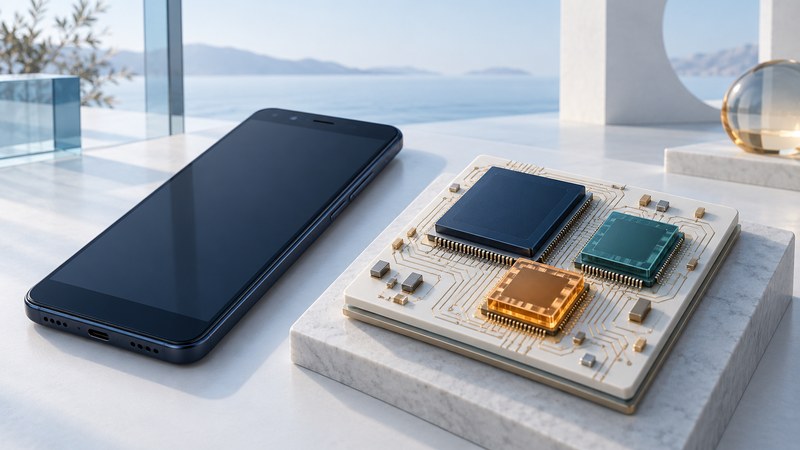
The Huawei Mate 10 and Mate 10 Pro made dedicated neural-network processing a prominent part of a phone launch in 2017. Their Kirin 970 is a useful case study in how to read an “AI processor” claim: identify the accelerated task, the comparison baseline, the measurement conditions, and the software that turns hardware into a feature.
Place the Mate 10 in its 2017 context
Huawei introduced the Kirin 970 at IFA on September 2, 2017, then announced the Mate 10 series on October 16. The chip announcement emphasized a dedicated neural processing unit, or NPU, alongside CPU and GPU resources. The Mate 10 launch tied that hardware to EMUI 8.0, camera scene/object recognition, and an accelerated translator.
Those are historically specific features and claims. Reading them in their original context helps distinguish the period's image-recognition workloads from later conversational and image-generating systems. Hardware built to accelerate one set of neural-network operations needs compatible software, models, memory, and numerical formats to handle another.
The important design idea is specialization: move a suitable computation to an engine designed to perform it efficiently. The value to a person using the phone comes from the complete feature, including its accuracy, responsiveness, and availability.
Follow the work through the system
Scroll sideways for all columns. Keyboard users can focus the table and use the arrow keys.
| Component | Broad role | Question for an AI feature |
|---|---|---|
| CPU | Runs general-purpose program logic and coordinates work. | What still executes on the CPU? |
| GPU | Handles graphics and suitable parallel computation. | Does the software use it for this workload? |
| NPU | Accelerates supported neural-network operations. | Which model, operations, and numerical formats are supported? |
| Memory and software | Hold data and models and schedule execution. | Can the full workload fit and run efficiently? |
This is a conceptual explanation, not a map of the Kirin 970 die. A feature may cross several engines and include image preparation, model execution, and result handling. Timing only one stage can give a different answer from timing the user's complete task.
The mobile-memory guide explains why working memory, storage, and bandwidth matter. A chip capability also depends on the app's implementation; an NPU specification alone cannot establish which current apps an older phone can run.
Interpret the 25× and 50× figures carefully
Huawei’s launch material compared the Kirin 970's AI-related performance with four Cortex-A73 CPU cores, claiming 25 times the performance and 50 times the energy efficiency. Its footnote identifies Huawei laboratory testing. The IFA release also reported 2,000 images per minute in an image-recognition benchmark. These are attributed vendor results; Yenra has not reproduced them.
The releases leave parts of the test recipe unspecified, including the full model, input, precision, accuracy, software, and power-measurement details needed for reproduction. Treat the figures as historical workload claims. Whole-phone responsiveness and battery runtime require their own measurements.
Ask for equal output quality as well as timing. A faster result with a different model or lower accuracy may be a useful tradeoff, but that tradeoff belongs in the comparison.
Use the same questions for another AI claim
- Name the task. Is it classification, transcription, translation, image generation, or something else?
- Define the measurement. Is the result latency for one input, throughput for a batch, peak operations, or energy per completed task?
- Check the baseline. Identify hardware, model, precision, software, input size, and accuracy target on both sides.
- Locate processing. Establish which stages run on the device, which use a server, and what requires connectivity or an account.
- Check support. Confirm the exact device, OS, app version, language, region, and subscription conditions for the feature being discussed.
- Try representative inputs. Evaluate useful outputs and failure cases, not just a smooth demonstration.
Offline operation can be a useful observed behavior, while privacy also depends on stored results, logs, backups, and later synchronization. Check those paths separately. For related practical tasks, see phone dictation and app evaluation and permissions.