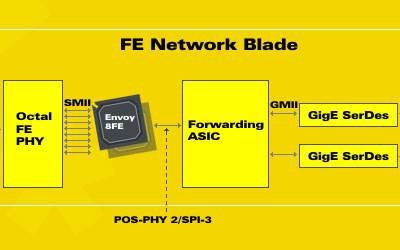
In 2003, TranSwitch Corporation demonstrated a turnkey reference design for Fast Ethernet routing and switching platforms using its Envoy-8FE Octal Fast Ethernet Controller with Intel's IXP2400 network processor. The package targeted Layer 2 and Layer 3 switches and routers for metro, access, and enterprise networks, giving system vendors a faster path to products with eight Fast Ethernet interfaces and programmable packet-processing capabilities.
That announcement belongs to a period when 100 Mbps Ethernet still mattered deeply at the network edge. Gigabit Ethernet was spreading, 10 Gigabit Ethernet was entering the core, and service providers were experimenting with Ethernet as a metro access technology. Fast Ethernet was no longer the newest Ethernet speed, but it was economical, well understood, and dense enough for many enterprise access, customer-premises, and embedded routing designs.
What Fast Ethernet Is
Fast Ethernet is the family of 100 Mbps Ethernet physical layers introduced in the mid-1990s under IEEE 802.3u. It preserved Ethernet's familiar frame format and operating model while increasing the nominal data rate from 10 Mbps to 100 Mbps. The most common variant became 100BASE-TX over twisted-pair copper, while 100BASE-FX served fiber links and specialized environments.
That compatibility was the genius of Fast Ethernet. Network operators could keep Ethernet as the common LAN technology while upgrading hubs, switches, network interface cards, and wiring closets in stages. For enterprises that had standardized on Ethernet, Fast Ethernet made switching practical at the desktop and helped accelerate the move away from shared collision domains toward full-duplex switched LANs.
The TranSwitch And Intel Reference Design
The original reference design combined TranSwitch's Envoy-8FE media interface device with Intel's IXDP2400 development platform and IXP2400 network processor. The promised package included schematics, a bill of materials, configuration notes, FPGA and CPLD code, drivers, and documentation through Intel's IXA Software Developers Kit.
That sort of design kit mattered because networking equipment vendors were racing to ship routers, switches, customer-premises equipment, and metro Ethernet devices without building every board, driver, and forwarding path from scratch. A reference platform let them focus on product differentiation: port density, software features, QoS, management, enclosure design, service-provider requirements, and certification.
The IXP2400 also illustrates the pre-merchant-silicon era of many edge systems. Network processors gave vendors programmable packet handling for classification, forwarding, policing, traffic engineering, and protocol features. Today, many functions that once required a network processor are handled by switch ASICs, SoCs, SmartNICs, DPUs, virtual routers, or programmable pipelines, but the design tradeoff is familiar: fixed-function performance versus programmability.
Routing Versus Switching
Fast Ethernet appeared in both switches and routers, but the job was different:
- Layer 2 switching: forwarding Ethernet frames by MAC address, separating collision domains, supporting VLANs, and improving desktop or access-layer performance.
- Layer 3 routing: forwarding IP packets between subnets, applying access policies, participating in routing protocols, and connecting LANs to WAN or metro services.
- Metro access: handing off Ethernet service to a customer, aggregating lower-speed links, and enforcing service policy at the provider edge.
- Customer-premises equipment: combining Ethernet interfaces, WAN uplinks, firewalling, VPNs, and management in compact branch devices.
In 2003, a box with multiple Fast Ethernet ports and programmable packet processing could be useful at several points in the network. It might be a small enterprise router, a Layer 3 access switch, a metro Ethernet demarcation device, or an embedded module inside a larger chassis.
Why Fast Ethernet Still Appears
Fast Ethernet is legacy in most new enterprise designs, but it has not disappeared. It still appears in industrial controls, building systems, point-of-sale devices, printers, management ports, out-of-band interfaces, low-cost appliances, IP cameras, embedded boards, and equipment that values low power and long lifecycle over bandwidth.
That creates a practical problem for modern networks. A site may have 10G uplinks, multi-gigabit Wi-Fi access points, and cloud-managed switches, while still needing to support 100 Mbps endpoints that negotiate slowly, require old duplex behavior, or cannot tolerate aggressive power-saving features. Network refresh plans should account for those endpoints rather than assuming every device can move cleanly to 1G or faster.
When 100 Mbps Is No Longer Enough
Fast Ethernet becomes a bottleneck when endpoints carry video, backups, imaging, large file transfers, Wi-Fi backhaul, virtualization traffic, storage, or modern software updates. It is especially constraining for access points, uplinks between switches, server connections, and any shared path that aggregates many users.
For new cabling and switching, 1G is a basic access speed, 2.5G and 5G are common for newer access points over existing copper, 10G is a practical uplink and workstation speed, and 25G/100G are normal in many data-center designs. Fast Ethernet should therefore be treated as an accommodation for specific legacy endpoints, not as a default design target.
Design Guidance For Mixed-Speed Networks
Networks that still contain Fast Ethernet should be designed deliberately:
- Inventory 100 Mbps devices and identify which ones are lifecycle constraints.
- Disable or isolate half-duplex and hub-era assumptions wherever possible.
- Check auto-negotiation behavior before blaming cabling or switch hardware.
- Keep Fast Ethernet endpoints off shared uplinks that carry latency-sensitive or high-volume traffic.
- Use VLANs, access control, and monitoring to contain legacy industrial, facilities, and embedded systems.
- Budget for replacements when 100 Mbps links block security updates, telemetry, remote management, or application performance.
- Confirm fiber type and optics before replacing 100BASE-FX links; physical plant details often drive the real migration cost.
Historical Importance
Fast Ethernet helped make Ethernet the default access technology. It carried organizations from shared 10 Mbps LANs into switched full-duplex networks, supported the first broad wave of IP-based applications, and gave metro Ethernet vendors a practical service speed for early deployments. The TranSwitch and Intel reference design captured the hardware side of that moment: dense media controllers, programmable network processors, and turnkey development kits for vendors trying to build packet platforms quickly.
In 2026, Fast Ethernet is mostly a legacy edge and embedded speed. Its larger legacy is architectural. It proved that Ethernet could evolve by preserving operational continuity while increasing speed, a pattern repeated at 1G, 10G, 25G, 100G, 400G, and beyond.
References
- IEEE 802.3-1998: Ethernet standard including 100BASE-T and Gigabit Ethernet PHYs
- IEEE 802.3 Ethernet Working Group
- EDN: Ethernet transport ICs interface with Intel IXP family
- EE Times: TranSwitch Ethernet controllers for metro applications
- Intel: IXP2400 family product discontinuance notice
- Cisco: Ethernet technology overview