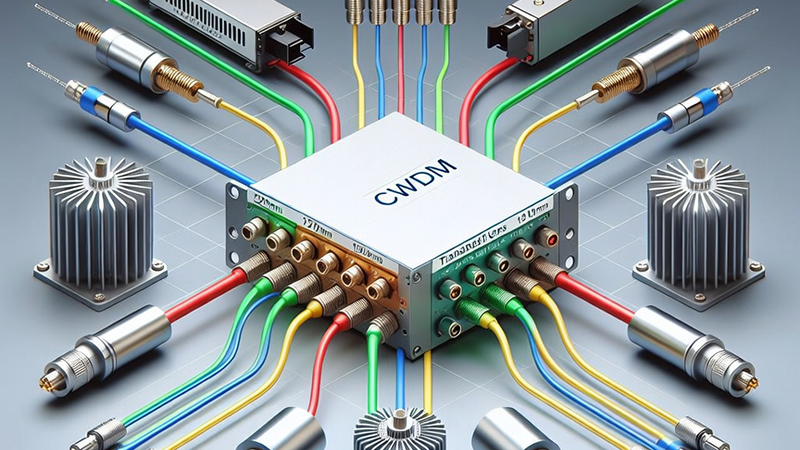
Coarse wavelength division multiplexing (CWDM) lets multiple optical signals share the same fiber by assigning each signal a different wavelength, or color, of light. In 2003, Sorrento Networks announced that Dutch Internet service provider BIT had built a three-city regional backbone using Sorrento's JumpStart CWDM system. BIT used the platform to connect major router points of presence, carry Gigabit Ethernet traffic, and form a regional ring of about 260 km using a working fiber plus protection fiber for redundancy.
That deployment captured why CWDM became attractive in metro and access networks. It increased fiber capacity without requiring the complexity and cost of dense wavelength division multiplexing (DWDM), optical amplifiers, tightly controlled lasers, or a full carrier transport platform. For many enterprise, utility, ISP, campus, and metro Ethernet applications, a passive CWDM multiplexer and tuned pluggable optics could be enough.
How CWDM Works
Wavelength division multiplexing combines independent optical channels onto a single fiber pair or single fiber. A multiplexer places each wavelength onto the fiber, and a demultiplexer separates those wavelengths at the far end. CWDM uses widely spaced channels, which relaxes laser stability and filter requirements. That is the main reason CWDM systems can be simpler and less expensive than DWDM systems.
The ITU-T G.694.2 CWDM grid defines wavelengths across a broad range, commonly described from 1270 nm to 1610 nm with 20 nm channel spacing. In practice, usable channels depend on the fiber plant, distance, optical budget, connector loss, splice loss, filter insertion loss, and whether the fiber has high attenuation around the water peak. Many common CWDM deployments use fewer than the full theoretical channel set, often choosing channels in bands with lower loss and readily available optics.
The 2003 BIT Backbone
The original BIT deployment used Sorrento's JumpStart CWDM equipment in a regional backbone. The network was expanded from an earlier September 2002 installation to add a third city, forming a ring and supporting Gigabit Ethernet services for enterprise customers. Infraconcepts, Sorrento's Northern European distribution partner, supported the design and implementation.
For a business ISP, the value was straightforward: light intercity fiber links between router locations, add redundancy, provision services without a large optical engineering burden, and keep costs aligned with revenue. That is still one of CWDM's strongest use cases. It is often the right tool when the fiber is scarce enough to multiplex but the capacity requirement is not yet large enough to justify a full DWDM or coherent transport design.
CWDM Versus DWDM
CWDM and DWDM solve related problems with different tradeoffs:
- Channel spacing: CWDM uses wide wavelength spacing, while DWDM uses a much tighter frequency grid defined by ITU-T G.694.1.
- Capacity: DWDM supports many more channels and higher aggregate capacity, especially with coherent optics.
- Reach: DWDM systems can use optical amplification, dispersion management, ROADMs, and coherent transmission for long-haul and high-capacity metro networks.
- Cost and simplicity: CWDM can be passive, compact, and inexpensive, especially for a small number of channels over moderate distances.
- Operations: DWDM usually demands more planning around channel power, amplification, OSNR, fiber characteristics, and management systems.
A good shorthand is that CWDM is for simple capacity relief on fiber that is already good enough for the planned span, while DWDM is for high capacity, long reach, dense channel counts, or networks that need active optical-layer control.
Where CWDM Still Fits
In 2026, CWDM is mature rather than obsolete. It still appears in several practical roles:
- Metro Ethernet: adding multiple 1G, 10G, or selected higher-speed services over a limited fiber path.
- Enterprise and campus fiber: carrying separate data center, security, storage, voice, or building-system links over an existing fiber route.
- Service-provider access: connecting customer sites or aggregation nodes without consuming a dedicated fiber pair per service.
- Mobile fronthaul and backhaul: multiplexing wavelengths where reach and channel count fit the optical budget.
- Utility and industrial networks: using passive optical multiplexing for substations, plants, transportation corridors, and field sites.
- Backup and out-of-band paths: keeping management, monitoring, or protection links separate by wavelength.
CWDM is especially attractive when a network operator controls dark fiber and wants to avoid active equipment at intermediate sites. Passive filters have no power draw and little software complexity, but they do introduce insertion loss. The optical budget must be calculated before assuming that a link will work just because the fiber distance looks reasonable.
Modern Optics Considerations
Modern pluggable optics make CWDM easier to deploy, but they also create new choices. SFP, SFP+, SFP28, QSFP, and QSFP28 form factors may be available with CWDM wavelengths depending on speed and vendor. Higher speeds can use single-wavelength optics, parallel optics, bidirectional optics, or coherent modules, and not every transceiver type is compatible with a passive CWDM filter plan.
Designers should check wavelength, reach, launch power, receiver sensitivity, dispersion limits, DOM support, temperature rating, vendor coding, and whether both ends of a service use the intended wavelength pair. Single-fiber CWDM designs require paired transmit and receive wavelengths in opposite directions, while dual-fiber designs usually use the same wavelength plan in both directions.
Planning A CWDM Link
A CWDM design should start with a simple engineering worksheet:
- Fiber type, route distance, splice count, connector count, patch panels, and measured loss.
- Number of channels needed now and the expected growth over the next refresh cycle.
- Required speeds, protocols, and whether each service can use standard Ethernet optics.
- Optical budget after mux/demux insertion loss and any add/drop filters.
- Protection design, including diverse paths, ring behavior, or router-level failover.
- Monitoring plan, including transceiver optical levels, alarms, and service impact during patching.
- Spare wavelengths and spare optics for recovery.
Channel labels and documentation matter more than they seem. A CWDM shelf with several colored wavelengths can be easy to patch incorrectly if the fiber trays, patch cords, transceivers, and diagrams are not kept in sync. Good labeling prevents long outages caused by simple optical mix-ups.
When To Choose Something Else
CWDM is not ideal for every optical problem. Choose DWDM or coherent transport when channel count, reach, amplification, optical-layer restoration, or total capacity are the primary requirements. Choose a leased wave or managed service when operating the optical layer would distract from the business. Choose a routed design with more fiber pairs when simplicity and failure isolation matter more than conserving strand count.
The continuing value of CWDM is that it gives network teams an elegant middle path. It is more efficient than one service per fiber pair, but simpler than a dense optical transport system. That is why the 2003 BIT example still reads as a useful pattern: use CWDM to turn scarce metro fiber into a practical multi-service backbone, while keeping the design understandable and cost-effective.