Dense wavelength-division multiplexing, or DWDM, is the optical networking technique of carrying many light channels over the same fiber at the same time. Each channel uses a different wavelength, or more precisely a different optical frequency. A multiplexer combines those channels onto one fiber, and a demultiplexer separates them again at the other end.
DWDM became essential because installing more fiber is expensive and slow, while lighting more wavelengths on existing fiber can add capacity quickly. A fiber pair that once carried a single 2.5G, 10G, or 100G signal can instead carry dozens of independent wavelengths, each operating as a separate service, client, or coherent optical carrier.
How DWDM Works
DWDM systems place optical carriers on a standardized frequency grid. ITU-T Recommendation G.694.1 defines the spectral grids for DWDM applications, including fixed spacing such as 100 GHz, 50 GHz, 25 GHz, and 12.5 GHz, as well as flexible-grid operation. Older systems often used fixed 100 GHz or 50 GHz channels. Modern coherent networks increasingly use flexible spectral slots so higher-capacity signals can occupy the bandwidth they need.
The most common operating window is around the C-band near 1550 nm because erbium-doped fiber amplifiers can amplify many wavelengths there at once. Some systems also use the L-band to add more spectrum. A DWDM line system may include multiplexers, amplifiers, dispersion compensation or compensation-free coherent designs, ROADMs, wavelength selective switches, optical channel monitors, transponders, muxponders, and coherent pluggable modules.
DWDM Versus CWDM
Coarse wavelength-division multiplexing, or CWDM, also puts multiple wavelengths on one fiber, but its channels are spaced much farther apart. CWDM optics and filters can be simpler and cheaper, making CWDM useful for shorter metro, enterprise, and access links with a modest number of channels. DWDM packs wavelengths more tightly and is used when operators need more total capacity, longer reach, amplification, ROADMs, or coherent transport.
- CWDM: fewer, wider-spaced channels; simpler optics; often shorter reach; useful where cost and simplicity matter.
- DWDM: many closely spaced channels; amplifier-friendly; supports high-capacity metro, long-haul, submarine, DCI, and carrier networks.
- Flexible-grid DWDM: allocates spectral slots based on signal requirements, improving efficiency for coherent high-baud-rate channels.
Coherent Optics Changed DWDM
Early DWDM systems were often built from relatively simple intensity-modulated channels. Modern DWDM relies heavily on coherent optics, digital signal processing, advanced modulation, forward error correction, and tunable lasers. Coherent receivers can recover phase and polarization information from the light, allowing much higher spectral efficiency and better tolerance of fiber impairments.
That shift is why today's DWDM conversations include 100G, 200G, 400G, 800G, and 1.6T wavelengths rather than only banks of 10G channels. Ciena's WaveLogic 6 family, for example, is described as supporting 100 Gb/s to 1.6 Tb/s per wavelength solutions, including 800G pluggables and 1.6T coherent-lite options for data-center applications.
400ZR and OpenZR+
One of the biggest recent changes is the arrival of coherent DWDM optics in router and switch pluggable form factors. OIF published the 400ZR implementation agreement in 2020 to support interoperable 400G coherent interfaces for cloud-scale data-center interconnect, especially amplified point-to-point links up to about 120 km. This moved coherent DWDM closer to the IP layer: a QSFP-DD or OSFP module can plug directly into compatible routing or switching equipment.
OpenZR+ extends that idea for broader reach and service-provider use cases. The OpenZR+ MSA specification supports multi-rate coherent operation, commonly 100G through 400G modes, in high-density form factors such as QSFP-DD and OSFP. The practical result is more IP over DWDM designs, fewer separate transponder shelves in some applications, and simpler high-capacity data-center interconnect.
ROADMs and Flexible Optical Networks
Reconfigurable optical add-drop multiplexers, or ROADMs, let operators route wavelengths through optical networks without manually repatching every site. Wavelength selective switches can add, drop, pass, or redirect channels remotely. Modern colorless, directionless, and contentionless ROADM designs make it easier to turn up services, restore traffic, and operate mesh optical networks.
Flexible-grid ROADMs are especially important as coherent channels grow wider. A 400G or 800G coherent carrier may not fit cleanly into an old fixed 50 GHz channel plan at the desired reach and modulation. Flex-grid operation lets the optical layer allocate spectrum more efficiently while still keeping enough guard band to avoid interference.
The 2005 Sun and Luxtera Demonstration
Sun chose Luxtera as a technology partner to develop high-bandwidth, low-latency dense wavelength-division-multiplexed optical interconnects for future terabit links in Hero, Sun's high productivity computing systems program.
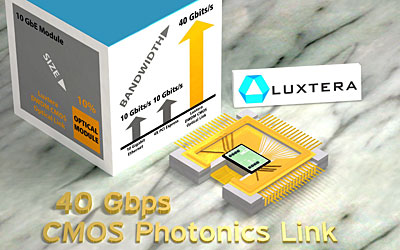
Sun and Luxtera demonstrated a working 40 Gbit/s optical link based on DWDM. The link used four 10 Gbit/s wavelengths and nanophotonic DWDM transceivers built in a standard silicon CMOS production process using Luxtera's CMOS Photonics technology. At the time, this was framed as a path toward terabit bandwidth on a single fiber with low latency and long reach.
"Silicon based photonics shows great promise for building balanced ultra scale systems such as those requested by DARPA under the HPCS program," said Sun CTO Greg Papadopoulos. "With Luxtera, we have a partner with the unique ability to integrate this level of performance in CMOS and with a technology roadmap that scales up to terabits of bandwidth on a single fiber with great reliability."
Luxtera's CMOS Photonics technology promised the scalability of DWDM on a silicon chip while retaining the manufacturing advantages of standard CMOS fabrication. That was the larger significance of the work: it showed how optical networking ideas from telecom could move into computing systems and short-reach interconnects.
"Our working relationship with Sun has been outstanding," said Luxtera CEO Alex Dickinson. "We have a partner that is committed to innovation and understands the importance of silicon photonics. Our DWDM-on-a-chip technology is now operating at 40Gbit/s, which is just the first milestone on a path that will deliver huge bandwidth using the natural scalability of DWDM."
What Happened Next
The companies in the original announcement changed, but the technical direction endured. Oracle announced its agreement to acquire Sun Microsystems in 2009 and completed the acquisition in 2010. Cisco completed its acquisition of Luxtera in 2019, describing Luxtera as a silicon-photonics company whose integrated optics would support webscale, enterprise data-center, and service-provider markets.
The 2005 40 Gbit/s link now looks small beside 400G coherent pluggables and 1.6T coherent roadmaps, but its logic was prescient. High-performance computing, data centers, AI clusters, and transport networks all need more bandwidth per fiber, lower power per bit, smaller optical assemblies, and closer integration between electronics and photonics.
Planning a DWDM Link
- Confirm the fiber route, loss budget, connector condition, patching plan, and available fiber count before choosing optics.
- Choose CWDM, passive DWDM, amplified DWDM, coherent DWDM, or a managed ROADM system based on channel count, reach, capacity, and operational needs.
- Check wavelength grid, tunability, channel spacing, spectral width, modulation, FEC, and line-system compatibility.
- For 400ZR and OpenZR+, verify host support, thermal limits, CMIS management, optical power, amplification requirements, and vendor interoperability.
- Plan monitoring: optical power, OSNR, pre-FEC and post-FEC error rates, chromatic dispersion, polarization effects, alarms, and remote diagnostics.
- Keep fiber cleaning and inspection discipline high. DWDM systems can be limited by small connector and patch-panel problems.
DWDM's core idea has not changed: put more independent optical channels onto the same glass. What has changed is how much intelligence now rides with each wavelength. Modern DWDM combines photonics, coherent DSPs, software-controlled line systems, pluggable modules, and routing integration to turn fiber spectrum into a programmable transport resource.