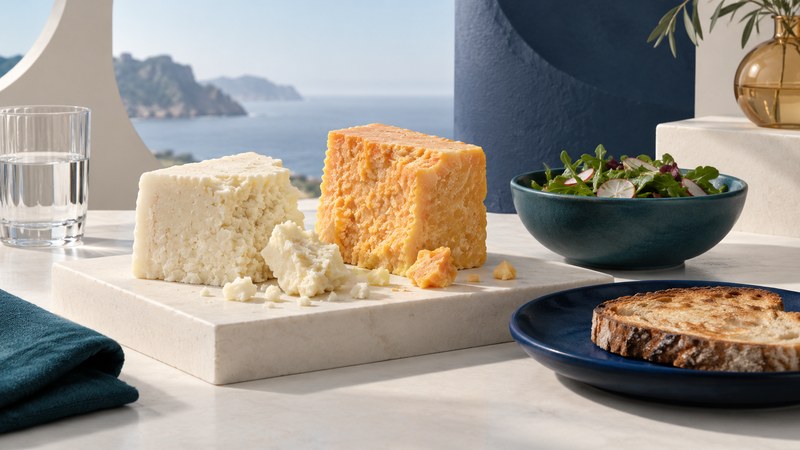
Choose Cheshire when you want a crumbly cheese that can be scattered, tucked into a sandwich or used on toast. Compare the actual producer, texture and ingredients, then buy a portion with two or three uses already in mind.
Compare White and Coloured Cheshire
Belton Farm’s White Cheshire is described as light and crumbly with a citrus character. Belton Farm’s Coloured Cheshire uses annatto, a plant-derived coloring, to give its version an amber appearance. The producer describes a similar crumbly texture and lists pasteurized cow’s milk, salt, starter culture, annatto and rennet in the coloured cheese.
Those are examples from one maker, not a specification for every Cheshire on sale. Compare products of similar age and form if you want color to be the main difference. Ask about the precise cheese when the counter also offers matured or blue versions; a new style may change flavor and texture as well as appearance.
On a narrow screen, focus the table and use the arrow keys to scroll.
| Detail | Check | Why it matters |
|---|---|---|
| Named style | White, coloured, or another specifically named version | Sets up the right flavor comparison |
| Texture | How readily the actual piece crumbles or cuts | Helps choose a salad, filling or topping |
| Ingredients | Milk, coloring and rennet information on the label | Supports dietary and preference decisions |
| Portion | Weight you will use across planned meals | Keeps a crumbly block from becoming an unplanned leftover |
Let the texture determine the preparation
Use a clean board and knife to break off manageable pieces. For a salad, crumble them to a size that stays noticeable among the leaves or vegetables. For a sandwich, distribute small pieces evenly instead of forcing a fragile slab to remain intact. Assemble over the board so loose crumbs can be gathered into the filling.
Belton’s serving suggestions include sandwiches, salads and toast. Begin with bread and accompaniments you know. Apple, a little pickle or a simple salad lets you adjust sweetness and acidity to your own taste. Add salty accompaniments cautiously and taste the assembled bite before seasoning the whole dish.
Give one piece three jobs
Illustrative plan for 180 g of cheese: allocate 60 g to two sandwiches at 30 g each, 60 g to a two-person salad at 30 g each, and 60 g to a toast topping. The total is 180 g. These are planning portions to adjust for the rest of the meal and your appetite, not a tested recipe or fixed serving requirement.
Keep the cheese for later meals wrapped in the refrigerator, rather than preparing all three dishes at once. Write down those meals when shopping. If the smallest available pack is larger, identify a fourth use or choose a counter-cut portion.
Try a small toast before adapting a recipe
Belton describes its coloured cheese as a topping that stays on toast rather than flowing over the edges. That makes the actual product worth trying on one small piece of bread before you use it across a tray. Watch how it softens, how the surface colors and whether the bite gives you the result you wanted.
A crumbly topping and a smooth sauce are different goals. For a sauce, follow a measured method intended for the cheese or a carefully justified substitute. The cheddar guide covers that separate task. For a baked dish, retain the recipe’s liquid and thickener proportions on the first attempt; changing cheese type and the rest of the method together makes troubleshooting harder.
Handle the block and prepared crumbles appropriately
Follow the label’s refrigeration and opened-storage directions. FDA refrigerator guidance recommends keeping the refrigerator at 40°F (4°C) or below. Use clean utensils, cover the cut surface and retain product details.
Once cheese is crumbled, its handling category changes: USDA guidance on molds and cheese advises discarding moldy crumbled, shredded or sliced cheese. The hard-block trimming rule cannot be carried over to a bowl of prepared crumbs. For a tasting alongside other styles, use the board guide to plan quantities and time out of refrigeration.