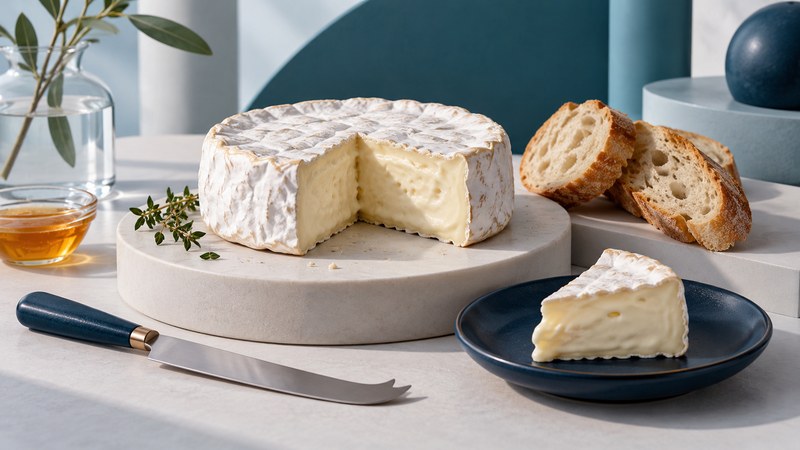
Choose Camembert for the day and the way you intend to serve it. For a board, ask for a wheel ready to eat; for baking, choose the size and product specified by a reliable recipe. Keep the label so you can check milk treatment, storage and cooking instructions.
Read the full name
Camembert de Normandie AOP identifies a particular protected-origin cheese. INAO’s Camembert de Normandie description describes it as a soft cheese with a bloomy rind, made exclusively from raw milk in its defined Normandy area. The more general name Camembert appears on cheeses made elsewhere and by other methods. For example, Président’s U.S. Camembert description identifies an 8-ounce product made in the United States.
When comparing packages, read the country of production, milk treatment, wheel weight and storage directions. Origin labels explain a production tradition; they do not tell you whether a particular cheese suits every guest’s dietary or health needs.
Ask for the texture you want
Tell the cheesemonger when you will eat the cheese and whether you want neat wedges or a softer, more yielding center. Ripening changes flavor and texture, while refrigeration keeps the food under controlled storage conditions. A best-before date alone gives less information about eating texture than the producer’s guidance and the condition of the actual wheel.
On a narrow screen, focus the table and use the arrow keys to scroll.
| Question | Why it helps | What to do with the answer |
|---|---|---|
| Is this ready for tonight? | Connects the purchase to your serving date | Buy a suitable wheel rather than guessing how to mature it at home |
| Will it slice or spread? | Clarifies the desired texture | Choose a knife and serving plate accordingly |
| Is this the product and weight for my recipe? | Cooking time depends on size and product | Follow the matching recipe or package directions |
Brie is another bloomy-rind cheese worth comparing. Use the actual products’ labels and textures when substituting: a Brie wedge and a small intact Camembert wheel have different shapes and may need different serving dishes. Try equal bites if flavor is the deciding factor.
Serve a small wheel simply
Place the cheese on a plate with room to cut wedges from the center toward the edge. Each wedge then includes both rind and interior. Offer baguette or plain crackers, with fruit or preserves alongside. A thin soft-cheese blade can make cleaner cuts through the sticky center.
The normal white bloomy rind is part of the cheese. USDA guidance on mold and cheese says to discard soft cheeses such as Camembert when mold appears that is outside the intended manufacturing process. Consult the producer about an unfamiliar change; a soft center or strong smell alone neither proves spoilage nor establishes safety.
Use a recipe matched to the wheel
Président’s baked Camembert with honey and rosemary specifies an 8-ounce Camembert, ¼ cup honey and one rosemary sprig, baked at 375°F for 8–10 minutes. Its stated yield is six appetizer servings. That timing belongs to that product and size.
Remove retail wrapping and place the cheese in a suitably sized oven-safe dish. Use a wooden box in the oven only when the manufacturer explicitly permits it. Follow the selected recipe, check the center’s softness and serve the hot dish on a trivet with a serving utensil. Warm, softened cheese is a culinary endpoint; it is not proof that a raw-milk product has reached a pathogen-control temperature.
Plan for the people at the table
CDC safer food choices advises people at increased risk to avoid unheated raw-milk cheeses and offers safer alternatives such as pasteurized hard cheeses. Choose an appropriate product from the outset. Keep refrigerated Camembert at 40°F (4°C) or below following FDA refrigerator guidance, retain the package instructions, and put away usable portions promptly. The cheese-board guide provides a small-portion serving schedule.