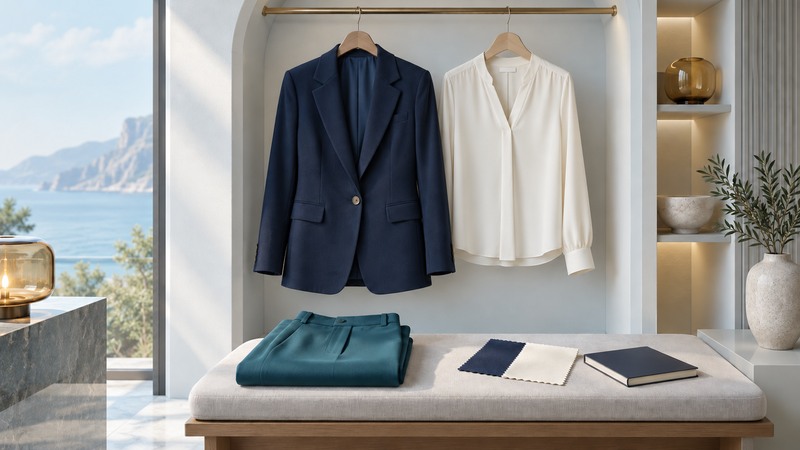
A useful Ann Taylor work wardrobe begins with the clothes you actually need for your week: something comfortable at a desk, a layer for meetings, or separates that travel well. Choose each piece by its measurements, movement and care requirements, then try it with clothes you already own. A matching brand label alone cannot make two pieces work together.
Bring your usual work shoes and an appropriate underlayer when trying on clothes. For online shopping, keep a soft measuring tape and one well-fitting garment nearby. Record the style number, color, size type and size; that small record makes comparisons and reorders much clearer.
Use the product page as a fitting brief
Ann Taylor product pages distinguish fit, rise, length, fabric and care. For example, the Straight Pant in Seasonless Stretch, style 612800 describes a mid-rise, straight-leg shape and a polyester/viscose/spandex blend that is machine washable. Those facts apply to that style, not every garment with the same fabric-family name.
Start with the size chart attached to the exact item. Establish whether its numbers are body measurements or finished-garment measurements before comparing them. Petite, classic and tall describe proportion choices; choose among the options offered for the particular style. Ann Taylor’s product guidance suggests petite for heights 5 feet 4 inches and below and tall for 5 feet 9 inches and above, but your torso, arms and legs still need individual checks.
A curvy option, where offered, changes the fit relationship around the waist and hip. Try it when a waist fits differently from the seat, instead of repeatedly buying a larger regular size. Treat LOFT, outlet and resale listings as their own product records: confirm the actual label and chart rather than transferring a remembered size.
Test sitting, reaching and walking
On small screens, scroll the table horizontally. Keyboard users can focus the table area and use the arrow keys.
| Piece | What to try | What the result tells you |
|---|---|---|
| Blazer | Button it over your intended top; reach toward an imaginary keyboard. | Pulling across the back or chest deserves another size or cut before tailoring. |
| Trousers | Sit, stand and walk in the intended shoes. | Check waistband comfort, pocket flare, seat movement and hem clearance. |
| Blouse | Reach forward and raise your arms comfortably. | Watch the placket, shoulder area and how much the hem lifts. |
| Dress or skirt | Sit and take a normal stride. | Check waist placement, lining movement, opening/slit and your preferred coverage. |
A garment can look tidy while standing and feel restrictive after an hour. Keep tags attached during a clean indoor try-on and follow the seller’s return conditions. If one area pulls while another has excess fabric, a different cut may solve the problem more cleanly than another size.
Read construction and care together
Look inside the garment. Check whether there is a lining, how the pockets sit, whether seams lie smoothly and whether the closure operates without strain. Inspect light fabrics in ordinary daylight over the underlayer you plan to wear. A fabric percentage describes composition; it does not establish opacity, wrinkle behavior or comfort by itself.
Follow the sewn-in care label for that item. Include cleaning time, drying space and any professional-care cost in your decision. Two pieces can share a color name while differing in sheen, weave or shade; compare the actual garments together if you want a suit-like result. Keep matching suit pieces on a compatible care schedule according to their labels.
Build combinations before adding quantity
For each candidate, name two existing pieces it can accompany and the occasions when you would choose it. Check whether your bag strap, coat and usual shoes work with it as well. The best addition may be a replacement for an uncomfortable staple rather than an entirely new outfit.
For alterations, ask a tailor to inspect the garment before committing to a final-sale purchase. A hem adjustment and a shoulder reconstruction are different jobs. Obtain the actual quote, then compare purchase price plus alterations and initial care with a piece that already fits.
Download the workwear fit and outfit notes to record the product, movement checks, combinations and costs. Use the result to decide keep, try another cut, ask a tailor, or return.