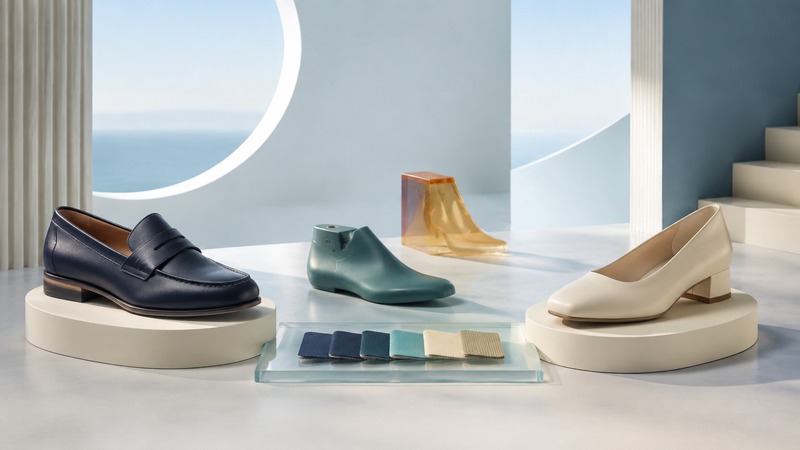
A designer name tells you something about the creative proposition. It does not tell you whether a shoe fits your foot, suits your walking routine, or can be repaired. Compare the particular pair in front of you, including the parts that are harder to photograph: the interior, sole, fastening, and aftercare.
Try the shoe for the day you will actually have
Start with the occasion and the movement it involves. A short indoor event, a standing workday, and a commute over wet pavements place different demands on footwear. Decide which compromise you can accept before a sale price or a collaboration name narrows your attention.
Try both shoes with the socks or hosiery you expect to wear. Stand, walk, turn, and notice pressure at the toes, sides, instep, and heel. Check whether the fastening holds the foot without forcing you to grip with your toes. A size label is not a guarantee of the same fit across shapes and brands.
The Royal Wolverhampton NHS guide to buying footwear (PDF) recommends fitting the larger foot and choosing shoes that are comfortable at purchase. Gradual initial wear is different from expecting a painful or cramped shoe to become the right size.
If you use prescribed inserts, bring them and check the combined fit with appropriate advice. Persistent pain, numbness, wounds, or an existing foot condition calls for a clinical assessment rather than a fashion guide. Do not assume that a higher price supplies a medical benefit.
For an online order, establish whether indoor fitting is permitted, how returns work, and whether sale or personalized items have different terms. Keep soles clean during an allowed try-on. A pair can look excellent in photographs and still be unsuitable after a few minutes of ordinary movement.
Ask what connects the upper to the sole
The upper surrounds the foot; the lining contacts it; the outsole meets the ground. A last is the form used to shape the shoe. Different lasts help explain why two pairs bearing the same nominal size may feel different. Ask for the materials of each part rather than accepting “leather shoe” as the complete specification.
On a small screen, scroll the table sideways to read all columns.
| Feature | What to inspect or establish | What it does not prove |
|---|---|---|
| Upper and lining | Material, seams, rough edges, and how the interior feels. | A prestigious material name does not guarantee comfort or durability. |
| Sole attachment | Whether the maker describes stitching, adhesive, or a combination. | Visible edge stitches alone do not establish how the entire shoe is assembled. |
| Outsole and heel | Surface, contact area, heel attachment, and intended conditions. | A textured sole is not proof of certified slip resistance. |
| Repair route | Whether this model can receive replacement soles, heels, or other parts. | A repairable design is not a guarantee that every worn pair can be restored. |
In Goodyear-welted construction, a welt forms part of the connection between the upper assembly and the outsole, allowing a route for resoling. Other constructions can also be repairable. The useful buying question is what a maker or repairer will do for this exact model, at what cost, and subject to what condition.
Allen Edmonds' recrafting service illustrates a manufacturer program associated with its welted footwear. It does not imply that every shoe from every brand—or every damaged pair—can receive the same work. Ask about eligibility before assuming a future resole.
A designer collaboration can provide a particular look at a different price point. Compare its materials and construction on their own merits. Likewise, hand-finishing, an unusual silhouette, and a familiar label may have aesthetic value without improving the specific practical feature you need.
Include care and repairs in the decision
Find the instructions for the exact finish. Smooth leather, suede, patent finishes, coated materials, and textiles should not automatically receive the same polish or cleaner. Clarks' shoe-care guide separates material-specific cleaning and protection. Check the instructions and test a permitted product discreetly before treating a visible area.
Remove loose dirt gently and avoid improvised soaking or direct heat unless expressly supported by the maker's instructions. Allow suitable drying time after wear. An expensive care kit is not useful if it contains the wrong treatment for the upper.
Have a repairer assess loose heels, separating soles, or damaged fastenings before continuing to use the pair. Ask whether the proposed repair changes the appearance, feel, or future repair options. Keep the quote alongside the original price when deciding whether to proceed.
Use cost per wear as a scenario, not a promise
Invented comparison: Pair A costs $120, receives $20 of care or minor repair, and is worn 70 times. Its cost per wear is ($120 + $20) ÷ 70 = $2.00. Pair B costs $300, receives $60 of care or repair, and is worn 180 times: ($300 + $60) ÷ 180 = $2.00.
Both results depend on the assumed wears. If Pair B is worn only 60 times, the same $360 total becomes $6.00 per wear. The calculation cannot make a poor fit economical, predict durability, or establish environmental impact. Future repair prices and actual use remain uncertain.
Download the cost-per-wear examples (CSV). They contain the three labeled scenarios and calculated values, with no macros or hidden formulas. For your own comparison, count the same kinds of costs and use a realistic range of wears. Do not count a hoped-for resale price as certain money recovered.
Before paying, summarize the decision in ordinary language: this pair fits, suits the intended use, has care requirements I can meet, and offers terms I understand. If those statements are not true, a designer label does not resolve the gap.
Related resources
- Comparing handbag materials, construction, and care
- How fashion launches and product claims work
- Explore all fashion resources
Researched and updated September 6, 2026. Sources are linked beside the relevant information. Brand examples illustrate specific features or care instructions; they are not product rankings.