Air traffic control gets stronger with AI when models are used to improve prediction, coordination, and decision support inside a rigorously safety-governed human system. In 2026, the most credible gains are not “autonomous control towers.” They are better trajectory prediction, earlier traffic-flow management, tighter runway and surface sequencing, weather-aware capacity decisions, and controller-facing tools that make complex traffic easier to manage without taking humans out of the loop.
That matters because the hard parts of ATC are not abstract optimization problems. They are time-critical tradeoffs among capacity, safety margins, weather, surface congestion, route structure, controller workload, and increasingly mixed fleets that include drones and advanced air mobility operations. AI helps most when it makes those constraints more legible and more forecastable instead of pretending they can be wished away.
This update reflects the field as of March 21, 2026. It focuses on the parts of the category that feel most real now: decision-support systems, time series forecasting, path planning, telemetry, anomaly detection, automatic speech recognition, and trajectory-based planning tools that fit within FAA, NASA, EUROCONTROL, and SESAR modernization work.
1. Predictive Traffic Flow Management
Predictive traffic flow management is strongest when AI identifies demand-capacity imbalances early enough for traffic managers to choose the least disruptive response. The real value is not a prettier forecast chart. It is earlier, more targeted use of reroutes, spacing, and ground-delay tools.

The FAA's NextGen flow-management stack increasingly depends on shared predictive services across TFMS, TBFM, and TFDM, while a 2025 Aerospace paper on the DMCSTN model showed materially better network-level airport arrival-flow prediction than simpler baselines, including a 12.6% MAE improvement at the first-hour horizon. Inference: the most credible AI gain in flow management is better network prediction feeding existing operational decision processes, not bypassing them.
2. Dynamic Airspace Configuration
Dynamic airspace configuration matters because traffic peaks, weather impacts, and controller workload do not respect static sector shapes. AI helps most when it supports configuration choices that can be justified operationally, not when it treats sector boundaries like a game board.
EUROCONTROL's Flow CONOPS explicitly frames Dynamic Airspace Configuration as part of the ATM timeline, and SESAR planning materials for the SMARTS line of work describe configuration processes that optimize both traffic-flow management and airspace use under uncertainty. Inference: dynamic sectorization is getting stronger where AI is used to support forecast-aware reconfiguration, but still inside structured network-management concepts rather than as unconstrained automation.
3. Automated Conflict Detection and Resolution
Automated conflict detection and resolution is strongest when AI acts as a tactical solver and option generator for controllers, not as an unbounded replacement for separation responsibility. The goal is earlier warning and better candidate maneuvers under pressure.

The 2023 Aerospace tactical conflict solver based on deep reinforcement learning resolved 87.1% of 1,000 test scenarios and still resolved 81.2% after traffic density was increased by 40%. In parallel, SESAR's JARVIS work is explicitly focused on trustworthy AI digital assistants for ATC rather than opaque automation. Inference: conflict-resolution AI is strongest where it is framed as controller support with explainability and bounded trust, not as autonomous control logic operating on its own authority.
4. Optimized Arrival and Departure Sequencing
Arrival and departure sequencing becomes much more valuable when AI aligns runway assignment, wake constraints, crossing movements, and arrival-manager intent in one operational view. The practical win is steadier runway throughput with fewer tactical surprises.

SESAR's TADA solution is designed to support approach controllers in sequencing arrivals aligned with AMAN, using AI-based algorithms to propose optimized trajectories inside the TMA. NASA's machine-learning runway-configuration decision-support work similarly focuses on helping operators anticipate configuration choices earlier. Inference: runway sequencing is getting stronger when AI helps controllers stay ahead of sequence drift rather than merely cleaning up after it happens.
5. Surface Movement Optimization
Surface movement optimization is strongest when gate, ramp, spot, taxi, and runway decisions are coordinated as one system. AI helps most by reducing avoidable waiting and stop-start taxi behavior, not by trying to fully automate a messy airport surface with weak context.
NASA's ATD-2 scheduler work was built around gate, spot, and runway integration, and the Schiphol multi-agent planning case study reported average taxi-time reductions of roughly two minutes per flight, or about 15%, under autonomous surface-movement planning concepts. Inference: AI surface optimization gets strongest results when it integrates departure queue management with ramp and gate controls rather than treating taxi routing as a standalone path problem.
6. Enhanced Weather Forecast Integration
Weather integration is strongest when AI converts storms, wind shear, and route blockage into operational capacity constraints controllers and traffic managers can act on. Raw weather graphics alone are not enough.
The FAA's NextGen Weather Processor now translates weather into route-blockage and airspace-capacity constraints up to eight hours ahead, while the Hong Kong wind-shear study showed a Bayesian-optimized XGBoost model reaching an R-squared of 0.859 for intense low-level wind-shear prediction. Inference: AI weather support is strongest when it turns specialized hazard forecasts into shared traffic-management guidance rather than leaving each stakeholder to interpret raw weather separately.
7. Trajectory-Based Operations (TBO) Support
TBO support matters because trajectory-based operations only work if predicted trajectories are accurate enough to be shared planning objects across facilities and stakeholders. AI helps most by making those trajectories more stable, more current, and more useful for metering.

The FAA describes TBO as moving from planning into implementation using a system-of-systems approach, and SESAR's TADA project is built around 4D proposed trajectories inside terminal airspace. Inference: TBO gets stronger when AI improves the quality and update rate of predicted trajectories in ways controllers can operationalize, rather than presenting 4D planning as a purely procedural concept.
8. Controller Decision Support Tools
Controller decision support tools are strongest when they explain options, confidence, and tradeoffs clearly enough to support fast human judgment. In ATC, trust is part of performance.

SESAR's 2025 JARVIS and TRUSTY work both emphasize trustworthy, explainable digital assistants for controllers rather than black-box automation. TRUSTY's validation involved 17 expert controllers in simulated remote-digital-tower settings, explicitly studying how transparency affects trust in AI support. Inference: the strongest controller-support tools in 2026 are not just optimizing traffic; they are being designed to make AI reasoning understandable enough to be usable in high-stakes operations.
9. Speech Recognition and Natural Language Processing
Speech and NLP tools are most useful in ATC when they reduce clerical friction, capture operational context, and support safer digital workflows around voice-heavy operations. The strongest use cases are transcription, extraction, and constrained language understanding, not free-form autonomous readback handling.
NASA's 2023 ATCSCC telecon transcription work created a domain dataset from about 20 hours of speech and achieved an average word-error rate of 6.81% after aviation-specific fine-tuning. NASA's 2024 NLU work on digitizing taxi instructions likewise framed ASR and intent extraction as a route to safer, more structured communication support. Inference: aviation speech AI gets strongest traction where it converts spoken operations into searchable, extractable decision data instead of trying to replace disciplined phraseology with conversational interfaces.
10. Noise and Emission Reduction
Noise and emissions reduction becomes more credible when AI is used to change actual timing, rerouting, and surface behavior, not just to post-process sustainability reports. The strongest gains come from removing avoidable inefficiency from daily operations.

NASA's collaborative digital departure rerouting work saved more than 24,000 pounds of jet fuel and avoided more than 77,000 pounds of CO2 after deployment in the Dallas area. SESAR's broader AI-in-ATM research agenda similarly treats trust, efficiency, and climate impact as linked outcomes rather than separate tracks. Inference: AI contributes most to greener ATC when it drives better departure timing, alternate routing, and queue management in live operations.
11. Unmanned Aerial Vehicles (UAV) Integration
UAV integration is strongest when AI is used inside structured UTM and U-space services that keep manned and unmanned traffic coordinated without forcing every drone interaction through traditional voice ATC.
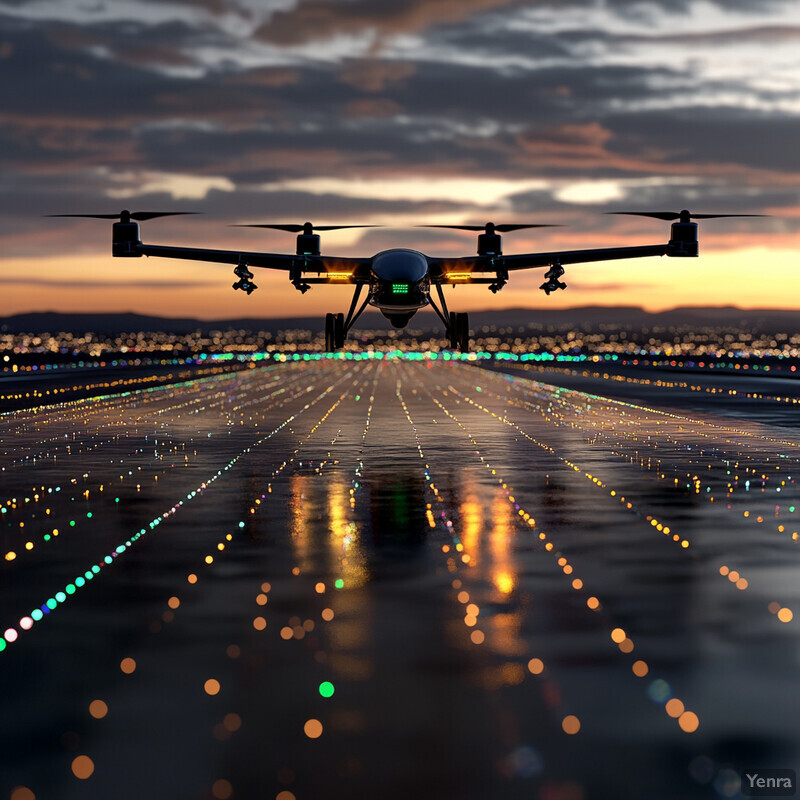
The FAA defines UTM as a cooperative ecosystem coordinated through highly automated API-based systems rather than voice communications, while SESAR's AURA validation demonstrated dynamic airspace management for manned and unmanned coexistence near Valencia airport. Inference: drone integration is strongest where AI supports delegated, automated coordination under clear airspace rules rather than trying to force drone traffic into unchanged legacy control methods.
12. Automation of Routine Tasks
Routine-task automation matters because towers and traffic managers still lose time to manual data handling, strip processing, and audio review that does not directly improve tactical control. AI helps most when it clears that operational underbrush safely.

FAA TFDM is explicitly designed to replace paper flight strips and improve electronic flight data exchange, while NASA's speech and NLU work turns audio-heavy planning and taxi-instruction workflows into digital inputs for downstream automation. Inference: routine-task automation in ATC is becoming more credible where structured data capture and structured speech workflows reduce manual handling without changing the human authority chain.
13. Air Traffic Flow Management Collaboration
Flow management collaboration gets stronger when airlines, ANSPs, airports, and automation systems work from the same live operational picture. AI adds most value here by making shared data more predictive and more usable, not simply by centralizing authority.

FAA TFDM is built to share electronic data among controllers, air traffic managers, aircraft operators, and airports across flight phases, and NASA's DIP is being used by airline partners in live operations to deliver traffic predictions, weather information, and in-time trajectory updates. Inference: collaborative flow management improves most when AI works through common operational data services instead of isolated local tools.
14. Adaptive Sector Complexity Management
Adaptive sector complexity management matters because traffic counts alone do not tell controllers where the real workload hotspots are. AI helps most when it forecasts complexity in time for supervisors and FMPs to do something useful with it.

SESAR's ASTRA project is specifically aimed at forecasting and resolving hotspot complexity, and its 2025 human-in-the-loop validation at Skyguide tested the AI solution with experienced operational staff under complex en-route scenarios. Inference: complexity management is becoming stronger because AI is moving from generic sector-load discussion into validated hotspot prediction workflows that supervisors can actually rehearse and evaluate.
15. Predictive Maintenance Scheduling Integration
Maintenance scheduling integration matters because ATC optimization is only as strong as the radars, telecommunications, automation systems, and tower tools it depends on. AI helps most when equipment-health and modernization constraints are treated as part of operational planning instead of as a separate maintenance back office.

FAA's 2025 modernization push explicitly targets replacement of core radar, software, hardware, and telecommunications infrastructure, and the NAS Safety Review Team highlighted how legacy sustainment pressures affect operational reliability. Inference: AI-assisted ATC will be strongest where maintenance windows, equipment condition, and modernization schedules are integrated into traffic planning instead of being handled as disconnected technical events.
16. Enhanced Arrival-Departure Rate Adjustments
Arrival-departure rate adjustments become more useful when AI predicts how runway configuration, weather, and queue structure will change throughput before the airport is already saturated. The real gain is smoother rate management, not just better post-hoc explanation of delays.

NASA's airport-throughput prediction work has long tied runway configuration to short-horizon capacity forecasting, and its newer runway-configuration decision-support research uses machine learning to help operators anticipate those choices earlier. Inference: arrival and departure rate adjustments get stronger when AI predicts runway-state changes and throughput together rather than tuning rates against yesterday's assumptions.
17. Intelligent Gate and Ramp Management
Gate and ramp management is strongest when AI coordinates pushback timing, spot release, taxi metering, and runway demand in one loop. The biggest value comes from avoiding unnecessary surface delay that begins long before an aircraft reaches the movement area.

NASA's ATD-2 work was explicitly built around gate-hold, ramp, and runway coordination, including ramp-controller decision-support tools and target-off-block timing. Inference: the strongest gate and ramp AI in 2026 is still the kind that coordinates local release decisions with downstream runway realities rather than optimizing gate usage in isolation.
18. Real-time Capacity Assessment
Real-time capacity assessment matters because airports and sectors do not have one fixed capacity number. AI helps by estimating what the system can actually support under current configuration, weather, and demand patterns.

The 2025 ST-GTNet work frames airport capacity prediction as a spatio-temporal learning problem rather than a static lookup, and EUROCONTROL's Flow CONOPS ties capacity assessment to dynamic airspace configuration and balancing actions across the ATM timeline. Inference: capacity assessment gets stronger when AI estimates usable capacity in real time and feeds that estimate into flow and configuration management before queues harden.
19. Safety Incident Prediction and Prevention
Safety prediction is strongest when AI is used to detect weak signals and near-misses earlier, not when it tries to replace procedural discipline. In aviation, strong safety AI usually looks like extra sensing, anomaly detection, and faster alerts around known hazard classes.

FAA's Surface Safety Portfolio now spans 77 airports and 50 towers with technologies such as Surface Awareness Initiative and Runway Status Lights, while recent flight-data-monitoring research showed self-organising maps can detect subtle anomalous approach patterns that threshold-only methods miss. Inference: safety AI is strongest where it augments existing safety systems by detecting precursor patterns, object conflicts, and unusual conditions earlier rather than by promising “autonomous safety.”
20. Continuous Learning and Adaptation
Continuous learning matters because no two airports, sectors, or operator mixes behave exactly the same way. AI becomes more operational when models can adapt to local conditions without requiring every site to start from zero.

Recent ATM trajectory-learning work shows transfer-learning and low-data adaptation can carry models across airports, with 2025 work reporting useful adaptation using as little as 5% of local data. SESAR's 2025 AI-assistant validations likewise emphasize iterative human validation in simulated and operational contexts. Inference: the strongest ATC AI systems in 2026 are not static models; they are models that can be adapted, validated, and revalidated against local operations with humans still in the loop.
Related AI Glossary
- Trajectory Prediction explains the forecasting layer underneath TBO, conflict probes, surface metering, and UAV integration.
- Decision-Support System covers the broader operating model behind controller-facing AI recommendations.
- Time Series Forecasting matters because demand, throughput, delay, and complexity all evolve over time rather than as static states.
- Path Planning helps frame taxi routing, conflict-avoidance logic, and mixed manned-unmanned traffic coordination.
- Beyond Visual Line of Sight (BVLOS) adds the operational context for drone traffic entering shared airspace at scale.
- Telemetry covers the live operational signals that feed runway, sector, and surface models.
- Sensor Fusion matters because stronger ATC support combines surveillance, weather, airport-surface, and communication data together.
- Anomaly Detection helps explain how unusual traffic, approach, or surface patterns are found before they become incidents.
- Automatic Speech Recognition (ASR) covers the speech-to-text layer behind ATC transcription and structured voice workflows.
Sources and 2026 References
- FAA NextGen.
- Aerospace (2025): A Dynamic Multi-Graph Convolutional Spatial-Temporal Network for Airport Arrival Flow Prediction.
- EUROCONTROL (2024): Flow CONOPS.
- SESAR: ATM Master Plan Workshop Pre-Read Material (2024).
- Aerospace (2023): Tactical Conflict Solver Assisting Air Traffic Controllers Using Deep Reinforcement Learning.
- SESAR JU (2025): JARVIS - Increasing the Trustworthiness of AI in Aviation.
- SESAR JU (2025): TRUSTY Project Validates Trustworthiness of AI for Digital Remote Towers.
- SESAR Solution: TADA! - Terminal Airspace Digital Assistant.
- NASA Ames (2024): Machine Learning Tools for Runway Configuration Decision Support.
- NASA (2019): ATD-2 Scheduler Overview.
- SESAR Innovation Days (2023): Multi-Agent Planning for Autonomous Airport Surface Movement Operations.
- FAA: NextGen Weather Processor (NWP).
- Atmosphere (2023): Time-Series Prediction of Intense Wind Shear Using Machine Learning Algorithms: A Case Study of Hong Kong International Airport.
- FAA: Trajectory Based Operations Focus Areas.
- SESAR Project: Terminal Airspace Digital Assistant (TADA).
- NASA (2023): Transcribing Air Traffic Control System Command Center Planning Telecons Using Cloud-Based Automatic Speech Recognition.
- NASA (2024): A Natural Language Understanding Approach for Digitizing Taxi Instructions.
- NASA (2023): Machine Learning Air Traffic Software Saves Fuel.
- SESAR JU (2025): AI-Based ATM Innovation - Read the Outcomes.
- FAA: Unmanned Aircraft System Traffic Management (UTM).
- SESAR JU (2022): Project Validates Dynamic Airspace Management Tool for U-space and ATM.
- FAA (updated 2025): What is TFDM?.
- NASA (2024): Cloud-Based Platform Could Help Streamline, Improve Air Traffic.
- SESAR JU (2025): AI-Enabled Solution ASTRA Enhances Air Traffic Complexity Management.
- SESAR JU (2025): Human-in-the-Loop Simulation Validates AI Solution for Managing Air Traffic Hotspots.
- FAA (2025): America's Brand New Air Traffic Control System.
- FAA (2025): National Airspace System Safety Review Team Report.
- NASA (2014): Airport Throughput Prediction Challenge.
- NASA (2020): ATD-2 Phase 3 Ramp Controller Decision Support Tools.
- Aerospace (2025): ST-GTNet - A Spatio-Temporal Graph Attention Network for Dynamic Airport Capacity Prediction.
- FAA Surface Safety Portfolio.
- The Aeronautical Journal (2025): Applying Artificial Neural Networks for Multidimensional Anomaly Detection Based on Flight Data Monitoring during Final Approaches.
- SESAR Innovation Days (2025): Learning to Land Anywhere - Transferable Trajectory Models in ATM.
Related Yenra Articles
- Autonomous Baggage Handling Systems extends airport coordination down to the surface logistics layer.
- Drone Technology adds the onboard autonomy, sensing, and UTM side of the uncrewed-aircraft stack entering controlled airspace.
- Drone Swarm Coordination adds the distributed-autonomy side of mixed airspace management.
- Traffic Management Systems provides a land-transport parallel for live capacity balancing and routing under congestion.
- Autonomous Container Terminal Operations offers a logistics-control analogue focused on ports and yards rather than airspace.
- Autonomous Ship Navigation gives a useful comparison for route prediction, collision avoidance, and supervised autonomy in safety-critical traffic systems.
- Drone Threat Detection extends the shared-airspace story into identification, conformance monitoring, and suspicious-track handling.