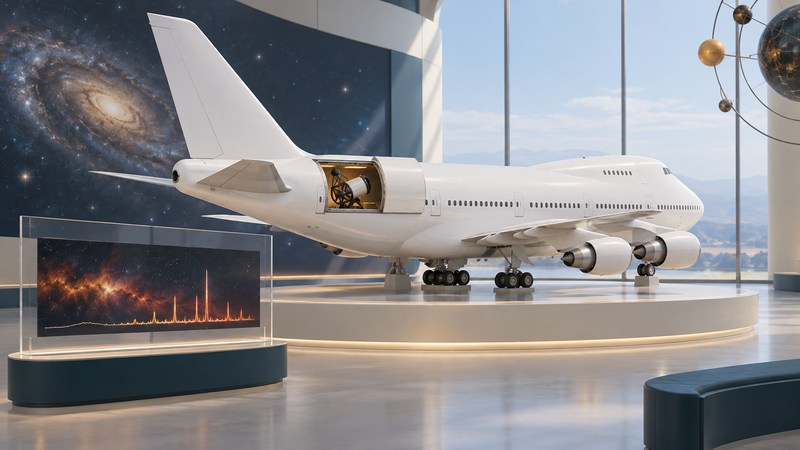
SOFIA carried a telescope above much of the water vapor that absorbs infrared light in Earth's atmosphere. Its science flights ended in September 2022, but its observations remain available for study. A useful first archive session connects a target to an instrument, a calibrated product and enough metadata to understand what was measured.
Why put a telescope in an aircraft?
SOFIA paired a modified Boeing 747SP with a 2.5-meter telescope. Flying high reduced atmospheric absorption in important infrared bands while allowing instruments to return to the ground for servicing. Pointing stability, vibration and airflow around the open telescope cavity were engineering challenges central to the mission.
NASA's engineering retrospective explains the platform and its stabilization. An airborne telescope still sees through some atmosphere, so calibrated spectra need to account for remaining terrestrial absorption. The infrared-telescope guide explains the broader wavelength and thermal-background tradeoffs.
NASA records the final science flight on September 29, 2022. Mission results ranged from star-forming regions and magnetic fields to water on the sunlit Moon. Read each discovery through its instrument and observing mode: imaging, spectroscopy and polarimetry constrain different properties.
Choose a product with the right processing level
The IRSA archive overview defines the levels and instrument-specific exceptions. Start with a calibrated product when available, then consult the instrument handbook before quantitative use.
| Level | General meaning | Reader's next check |
|---|---|---|
| 0 or 1 | Raw data. | Required reduction software and calibration. |
| 2 | Instrument effects corrected. | Remaining flux and atmospheric calibration. |
| 3 | Flux-calibrated, telluric-corrected data. | Units, uncertainty, observing mode and quality. |
| 4 | Products combining Level 3 data, such as mosaics. | Input observations, coverage and combination method. |
Telluric correction addresses absorption by Earth's atmosphere. A higher level describes processing, not universal suitability for every analysis. Some instruments lack particular levels, and some observations remain available only at a lower level.
Make a first search for a fixed target
- Open the SOFIA Science Data Archive. Try a documented name such as M17, and verify the resolved coordinates and object.
- Choose arcminutes as the radius unit, then enter 5 for an initial cone search. This is a search radius, not a guaranteed five-arcminute image. Observations intersecting the search region can cover different areas.
- Keep date and program constraints open initially. Run the search, then narrow by instrument and data level after inspecting what exists.
- Choose one science observation. Record its instrument, wavelength or spectral setting, Mission ID, AOR ID, date, level and product type.
- Inspect the available image or spectrum and its coverage. Download the relevant science product and associated uncertainty information for further analysis.
The search instructions explain coordinate conventions and filters. If a search is unexpectedly empty, clear old program, date and instrument constraints before widening the radius. A Moon or comet search needs the archive's appropriate moving-target options instead of assuming a fixed sky coordinate.
Read the returned file before making a claim
The results documentation explains the observation tables and file views. A displayed plot may be an extracted view of a larger file. Keep the original file and its header when preserving evidence.
Record the axis quantities and units. An image pixel, a spectral channel and a polarization vector encode different measurements. Before comparing two products, check resolution, aperture or beam, calibration and coordinate alignment. Color stretch can change how prominent a feature looks without changing the underlying measurement.
The SOFIA archive reading note preserves search settings, file identifiers and interpretation. For a scientific application with careful limits on what the observation establishes, continue with the Moon-water evidence guide.