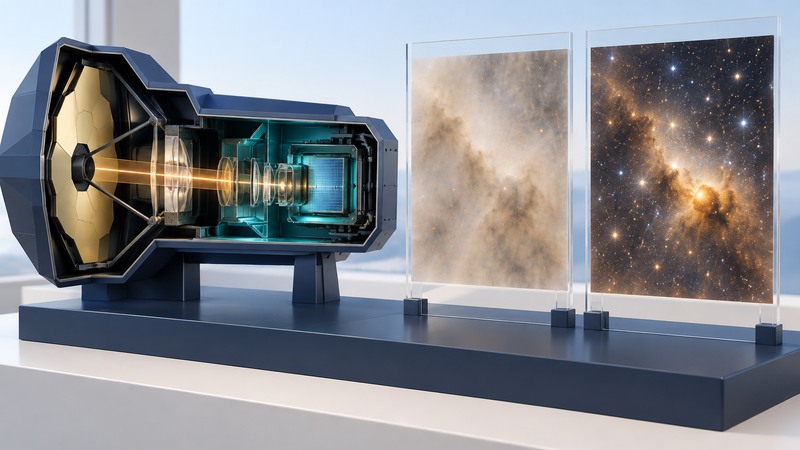
An infrared telescope measures light at wavelengths longer than visible red. Depending on the band, it can reveal stars obscured by dust, emission from dust itself or spectral features that help identify material. Understanding the wavelength, background and instrument lets you compare observations without assuming one picture is simply a sharper version of another.
Begin with wavelength and the source of the light
Near-infrared observations often show starlight, including light that penetrates some dusty regions more effectively than visible light. At longer wavelengths, thermal emission from cooler material becomes increasingly important. Molecular bands and atomic or ionic lines add information about chemistry and physical conditions. The exact boundaries between infrared band names vary by convention; retain the instrument's actual wavelength range.
Dust both blocks and emits radiation. Whether a cloud becomes more transparent or more conspicuous depends on wavelength, temperature, composition and optical depth. The same dust can conceal a star in one image and glow strongly in another. ESO's VISIR explanation introduces these reasons for observing beyond visible light.
Why infrared observing needs thermal control
Earth's atmosphere absorbs some infrared wavelengths and emits its own radiation. A warm telescope and instrument also contribute background. Ground-based observers therefore use atmospheric transmission windows and methods that separate a faint target from changing sky and telescope emission.
Chopping alternates the line of sight between a target and nearby background by moving a mirror; nodding moves the telescope to help cancel residual differences. The strategy requires suitable background positions and attention to extended emission. It is part of the measurement, not merely a cosmetic cleanup after imaging. ESO's archived VISIR overview describes the differential method.
A space observatory avoids the atmosphere, while still needing control of its own thermal radiation and detector noise. Webb's MIRI has a dedicated cryocooler because its detectors require temperatures below 7 kelvin. NASA's cryocooler description explains why passive cooling alone is insufficient for that instrument.
Compare instruments using the same criteria
| Criterion | Why it matters | What to check |
|---|---|---|
| Wavelength coverage | Determines which emission or absorption features can be measured. | Filters and spectral range, including atmospheric gaps. |
| Angular resolution | Determines the scale of structures that can be separated. | Wavelength, aperture, optics and observing conditions. |
| Sensitivity | Determines how faint a signal can be detected under specified conditions. | Exposure, background, detection threshold and source extent. |
| Spectral resolution | Determines how finely nearby wavelengths can be distinguished. | Resolving power and the mode used, not just telescope diameter. |
| Field and observing mode | Determines which area and spatial information are recorded. | Image, slit spectrum or spectral cube; target and background coverage. |
Webb's instrument guide distinguishes imaging, spectroscopy and observing modes. A point-source sensitivity quoted for a long exposure cannot be applied unchanged to an extended nebula or a short observation.
Read two views of one nebula
Compare the official Tarantula Nebula NIRCam image with its MIRI view. In the longer-wavelength image, bright young stars become less dominant while glowing gas and dust stand out. First match the field, orientation and scale; then read each color key.
Describe the difference as a change in the relative prominence of components in specified bands. A star fading between the two displays does not by itself show that it varied in time. To investigate variability, compare observations in the same band with calibrated brightness measurements and appropriate timestamps.
Place VISIR in its historical context
VISIR began work at the Very Large Telescope in 2004 and combined mid-infrared imaging with spectroscopy. Its background-removal and cooling techniques remain useful examples of ground-based infrared observing. ESO reports that it was decommissioned from standard observations at the end of P116 in April 2026. Archived descriptions should therefore be read as capabilities of the instrument during its service, rather than current observing offers.
To interpret any infrared result, retain five details: instrument, wavelength, observing mode, calibration and exposure. Then connect the claimed physical property to the actual measurement. The Webb reading guide provides an image-notes template, and cosmological redshift explains another reason light originally emitted at shorter wavelengths arrives in the infrared.