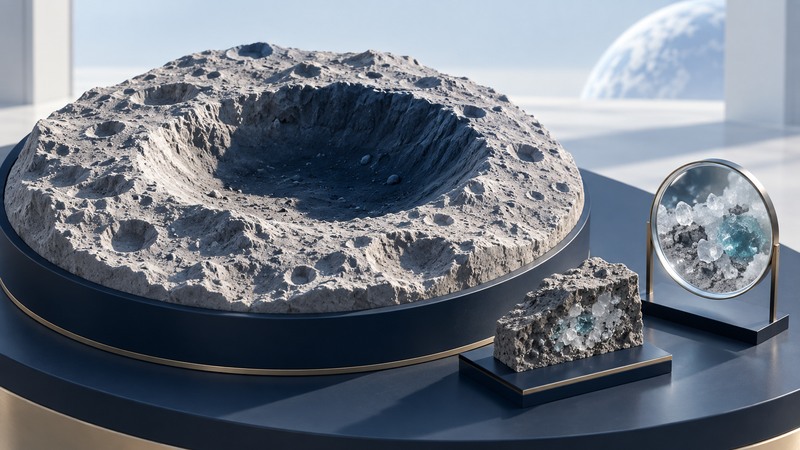
Water exists on the Moon in several settings, including polar ice and small amounts of molecular water associated with sunlit soil. The useful questions are where a measurement applies, what form of water it identifies and how much material it actually samples. Those distinctions let you evaluate both scientific discoveries and resource claims.
Separate ice, water molecules and hydroxyl
H₂O is a water molecule; OH is hydroxyl, an oxygen-hydrogen group. A broad hydration signal can arise from either, depending on the measurement. Water ice is a physical phase of H₂O. Finding a hydration signature in a surface spectrum establishes a different fact from detecting exposed ice or measuring water released from excavated material.
Early infrared observations around three micrometers could have difficulty separating H₂O from OH. SOFIA observations at six micrometers identified molecular water in sunlit terrain near Clavius, reported in 2020. The reported 100–412 parts per million applied to those observations, with uncertainty about how water was held in the soil. It was a finding about trace water in a particular setting. NASA's SOFIA announcement explains the distinguishing measurement.
Ask what each instrument can establish
| Evidence | What it contributes | Question still to ask |
|---|---|---|
| Hydrogen-sensitive neutron measurements | Identify regions enriched in hydrogen. | What chemical form holds the hydrogen, and how is it distributed within the footprint? |
| Diagnostic infrared absorption | Can distinguish surface ice using a combination of spectral features. | Does the measurement see exposed material, and what lies below it? |
| An impact plume | Reveals material excavated at a particular site. | How does the sampled volume compare with the surrounding terrain? |
| A water-specific molecular band | Helps separate H₂O from ambiguous hydration signals. | How much is present, how tightly is it bound, and does it vary with conditions? |
NASA's history of lunar water measurements connects the orbital and impact evidence. LCROSS deliberately observed material thrown out by an impact into Cabeus in October 2009. That experiment sampled a location in a permanently shadowed crater; applying its composition to all lunar soil would discard the experiment's geographic limits.
A 2018 analysis of Moon Mineralogy Mapper observations reported diagnostic absorption features of surface-exposed ice in lunar polar regions. The distribution was patchy. The study used several ice absorption bands together and considered the cold, shaded setting, illustrating why a single bright pixel is weak evidence on its own.
Why polar shadows matter
The Moon's small axial tilt allows some crater interiors near the poles to remain shaded. Cold traps can preserve volatile material for long periods, while illumination and temperature vary sharply across nearby slopes and ridges. A map of a polar region therefore needs topographic and thermal context, even when its average latitude sounds promising.
Sunlit-soil measurements and cold-trap ice measurements can coexist because they describe different environments. A visible-light image helps establish terrain and illumination; spectroscopy, temperature observations and other measurements address composition and stability. Read the historical account of lunar laser mapping for the measurement principle behind terrain maps.
Worked example: concentration versus recovery
Always retain the concentration basis. Parts per million by mass, volume fraction and an instrument's spectral band strength are different quantities. A reported average also needs the sampled depth, area and variability before it can become an inventory estimate.
Read a lunar resource claim in five passes
- Locate the actual measurement: named crater, coordinates, surface area and depth where available.
- Identify the substance and method: hydrogen, OH, H₂O, ice, or a model based on several datasets.
- Check concentration, uncertainty and spatial coverage. Keep an isolated sample separate from a regional estimate.
- Look for accessibility evidence: terrain, temperatures, power, excavation and processing requirements.
- Separate demonstrated extraction from proposed engineering. A useful deposit requires more than the presence of water.
After these checks, you should be able to state what was found, where it was found and which engineering question remains open. For comparison with liquid-water interiors on other worlds, explore Europa's ocean evidence and Enceladus's plume chemistry.