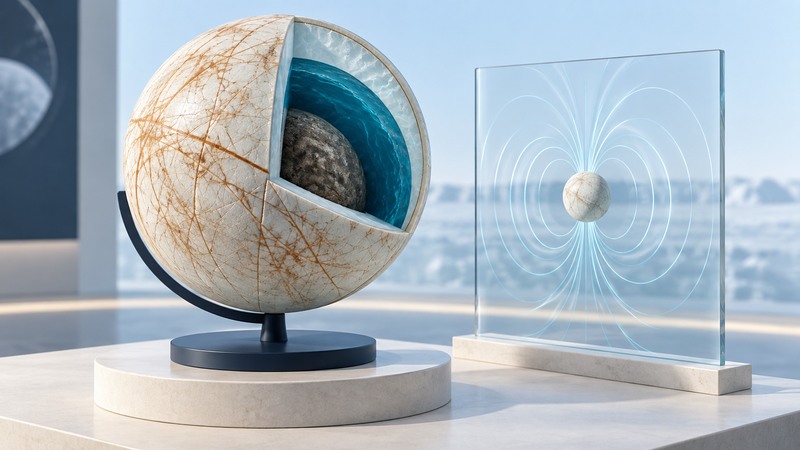
Europa is an ocean-world investigation built from several kinds of evidence. Its icy surface, geological structures and magnetic response strongly support a salty ocean beneath the crust. The ocean's properties and the thickness and behavior of the ice remain questions for measurements and models to resolve.
Follow the evidence from the surface inward
Voyager and Galileo images revealed long ridges, bands and disrupted terrain, with relatively few large impact craters. These observations suggest a surface that has been reworked. Some separated bands have matching edges, giving scientists clues about movement and material entering the gap.
Galileo also measured a magnetic response consistent with an electrically conducting layer inside Europa. A salty ocean is the leading explanation in the context of the moon's icy composition. This magnetic evidence strengthens the interpretation drawn from geology. NASA's ocean-evidence account explains how the observations fit together.
| Observation | Supported interpretation | Remaining uncertainty |
|---|---|---|
| Fractures, bands and disrupted terrain | The ice has moved and the surface has been renewed. | Which processes acted, when they acted and how deeply material travelled. |
| Induced magnetic response | A conductive interior layer, plausibly a salty ocean. | How conductivity, ocean depth and shell geometry combine to produce the signal. |
| Crater shapes and topography | The mechanical behavior of ice at depth affects the surface. | Impact conditions, temperature and model assumptions affect thickness estimates. |
Why ice thickness is a model-dependent answer
An icy shell can have a cold, strong outer portion and warmer ice that deforms more readily beneath it. A thickness inferred from crater mechanics can describe a different boundary from a thickness inferred by a magnetic or thermal model. Local pockets of liquid would add further structure.
For this reason, a number expressed in kilometers should arrive with a definition, location and method. Ask whether it describes the entire shell, a mechanically strong layer, a regional estimate or a global model. A precise-looking value alone cannot settle those distinctions.
NASA's gravity investigation explanation shows another way to constrain the interior: measure how Europa's gravity and shape respond to tides. Combining that response with other observations can reduce the range of interiors compatible with the data.
What Europa Clipper is designed to resolve
As checked in September 2026, NASA lists Europa Clipper as an active mission. It launched October 14, 2024; arrival at Jupiter is planned for April 2030. Its trajectory is designed for orbiting Jupiter and making repeated Europa flybys. Use NASA's mission page for current progress and schedule changes.
Each measurement addresses part of the interior puzzle. Radar will probe structures within the ice; cameras will map landforms; infrared spectroscopy will investigate surface composition. Magnetic measurements need plasma measurements to account for the surrounding charged particles that also affect the field. NASA's PIMS description explains that correction.
The instrument suite also includes gas and dust analyzers. Their samples need an origin: material ejected from the surface and material potentially supplied from deeper reservoirs carry different implications. Radar penetration and interpretability depend on ice properties; the instrument is a probe of the shell, not a guaranteed image of every boundary.
A worked test of an exciting claim
This approach applies equally to a claimed plume or an ice-thickness result. Identify the actual signal, the model that interprets it and an independent observation that could distinguish alternatives.
What habitability means here
Water, suitable chemistry and usable energy are conditions relevant to life as we know it. Their presence motivates investigation of a habitable environment. Establishing organisms requires further, specific evidence. Europa Clipper's stated objective is to assess conditions that could support life, and its payload is designed around that objective.
Connections between ocean and rock, and exchange between the surface and interior, matter because they can move chemicals and provide energy gradients. Compare this indirect investigation with Enceladus, where Cassini sampled ejected material. For the distinction between a water detection and an accessible resource, see water on the Moon.