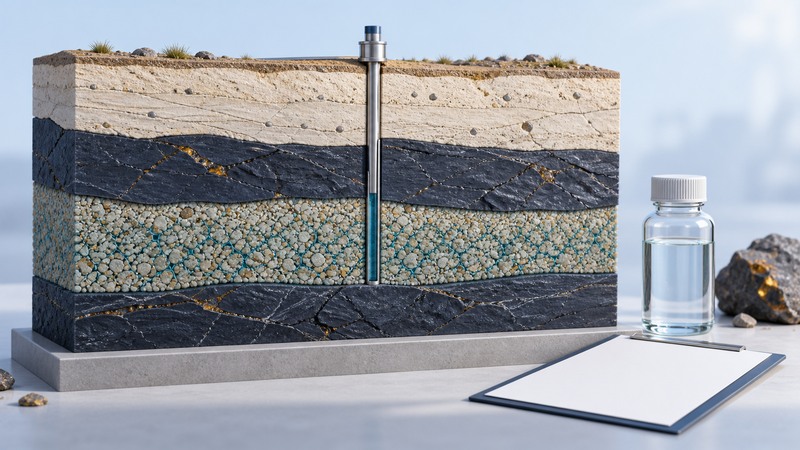
“Fossil groundwater” describes water recharged in the distant past, often under a different climate. Its age helps explain the water resource and replenishment question. Its suitability for drinking requires measurements of the water being supplied.
For a report mentioning radioactivity, start with the complete laboratory or utility record. Identify the isotope, unit, sample location, date and applicable standard. Those details are more useful than a percentage described simply as “above normal.”
Keep groundwater age and chemistry distinct
USGS explains groundwater age in terms of when water entered an aquifer and the tracers used to investigate it. A pumped sample can contain water from different flow paths and ages. An age estimate describes that hydrologic history within the dating method’s assumptions.
Radionuclides can occur naturally in aquifer materials. Water chemistry and contact with those materials affect what reaches a well. Ask the supplier or hydrogeologist which aquifer and well interval the sample represents, and whether the result describes raw source water or treated water delivered to consumers.
Recharge and extraction rates belong in the resource assessment. Isotope concentrations, other contaminants and treatment performance belong in the water-quality assessment. Evaluate each question with its own measurements and assumptions.
Read the result line by line
On a narrow screen, scroll the table sideways. Keyboard users can focus it and use the arrow keys.
| Report field | What to retain | Why it matters |
|---|---|---|
| Analyte | Radium-226, radium-228, uranium or the named screening measure. | Different measurements have different definitions and standards. |
| Unit | Activity, such as pCi/L; mass, such as µg/L; or a stated dose measure. | Convert comparable quantities to consistent units before combining them. |
| Sample | Location, raw or treated water, collection date and method. | A result applies to the sampled water. |
| Quality information | Detection limit, uncertainty and any laboratory qualifier. | A nondetect needs its reporting limit to be interpreted. |
| Comparison | Jurisdiction, standard and compliance procedure. | A single sample and a formal compliance determination differ. |
Keep the whole report, including footnotes. If an isotope is reported below a detection limit, retain the “less than” sign and limit. Ask the laboratory how to interpret a combined result when one component is a nondetect or carries a qualification; replacing it with zero may distort the comparison.
Use the appropriate drinking-water standard
For U.S. community water systems, EPA’s radionuclides rule summary lists a maximum contaminant level of 5 pCi/L for combined radium-226 and radium-228, and 30 µg/L for uranium. Gross alpha and beta/photon measures have their own definitions and standards. These figures are scoped to that U.S. rule; use the responsible authority’s requirements elsewhere.
Take the complete record to the right person
For a public supply, contact the utility with the report and ask which water was sampled, whether it represents your supply, how results are confirmed and what any notice requires you to do. Follow current utility and health-authority instructions if a notice has been issued.
EPA’s private-well guidance explains that private domestic wells are outside federal Safe Drinking Water Act regulation and that owners are responsible for their household supply. Ask the local health or well program which certified laboratory, analytes and sampling instructions apply to the aquifer.
Have treatment proposals assessed against the actual contaminants and water chemistry. Ask for evidence of performance, follow-up testing, maintenance and residual disposal. Obtain contaminant-specific advice from the responsible health authority before selecting a treatment method. Keep the monitoring guide nearby when planning the follow-up record.
Groundwater radionuclide report record
Groundwater radionuclide report record — plain-text download. Save a copy and fill it in with your own information. It includes instructions, example assumptions and source references.