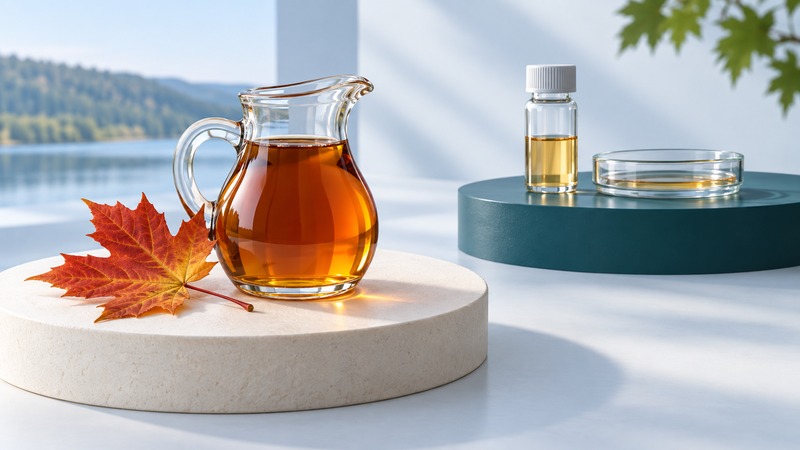
Quebecol is a compound associated with maple-syrup production that has attracted laboratory research into inflammatory signaling. To interpret that work, separate three subjects: the isolated compound used in an experiment, maple syrup as a whole food and the amount a person consumes. Evidence about one of these does not automatically establish the effect of the others.
What the quebecol experiment tested
Université Laval’s December 2015 research account describes quebecol as a molecule formed during the transformation of maple sap into syrup. The researchers synthesized it so they could study the compound. That experimental material differs from a spoonful of syrup containing many compounds and sugars.
The Cardinal and colleagues paper, published online in 2015 and in a 2016 journal issue, tested quebecol and related compounds in a stimulated macrophage cell model. The experiments examined inflammatory responses, including NF-κB signaling and cytokines such as IL-6 and TNF-α. Findings in this controlled cell system support further investigation of biological mechanisms.
A concentration placed directly onto cultured cells is an experimental exposure. Translating it into a food serving would require reliable information about quebecol content, digestion, absorption, metabolism and concentrations reaching relevant tissues. The study does not supply a validated “spoons of syrup” dose for treating inflammation.
Match the evidence to the question
Focus the table and use the arrow keys to scroll sideways.
| Question | Relevant evidence | What remains to establish |
|---|---|---|
| Can the isolated molecule influence a pathway? | A controlled cell experiment with specified concentration and exposure | Whether the effect occurs under relevant conditions in a living person |
| What happens when people replace another sweetener with maple syrup? | A human dietary trial comparing defined foods and amounts | Which ingredients or mechanisms explain the result, and whether it generalizes |
| Does quebecol itself improve a clinical outcome? | A suitable human trial of a characterized intervention | Dose, safety, meaningful endpoints and reproducible benefit |
When reading a headline, locate the experimental material first. Then identify the participants or cell model, the comparator, the exposure and the actual outcome. A change in a signaling pathway and a reduction in a person’s symptoms are different endpoints.
There is also research on whole maple syrup
A 2024 randomized crossover trial studied 42 adults with overweight and mild metabolic alterations. Participants replaced added sugars amounting to 5% of energy with either maple syrup or a flavored sucrose syrup for eight weeks per intervention. The authors reported differences in selected cardiometabolic measures, including the glucose response to an oral glucose test and systolic blood pressure.
This is human evidence about replacing one sweetener with another under a defined study design. The intervention was whole maple syrup. It therefore cannot identify quebecol as the cause of the observed differences, and its participants, duration and outcomes limit the conclusions. A small, short dietary trial also leaves questions about long-term clinical outcomes.
Read the full paper’s methods and disclosures along with its abstract when evaluating the finding. Keep the cell study and this food trial separate in your notes: they contribute different pieces of evidence, with no established serving-to-cell-dose conversion between them.
Use maple syrup as a sweetener
In the kitchen, choose maple syrup for its flavor and the role it plays in a recipe. Its sugars still count in the overall eating pattern. The FDA’s added-sugars guidance explains how pure syrups are handled on U.S. labels, including the special presentation allowed for single-ingredient products.
Measure the amount used and read the actual product’s serving size. For a recipe that serves four, 4 tablespoons total correspond to 1 tablespoon per serving if divided evenly. Use that product’s panel to calculate the sugars and calories; quebecol content cannot be inferred from the Nutrition Facts sugar value.
The research discussed here supports interest in the molecule and further dietary investigation. It does not establish maple syrup or isolated quebecol as an inflammation treatment. For practical substitutions and baking behavior, see the sugar-substitute guide; for another laboratory-to-food distinction, see food microencapsulation.