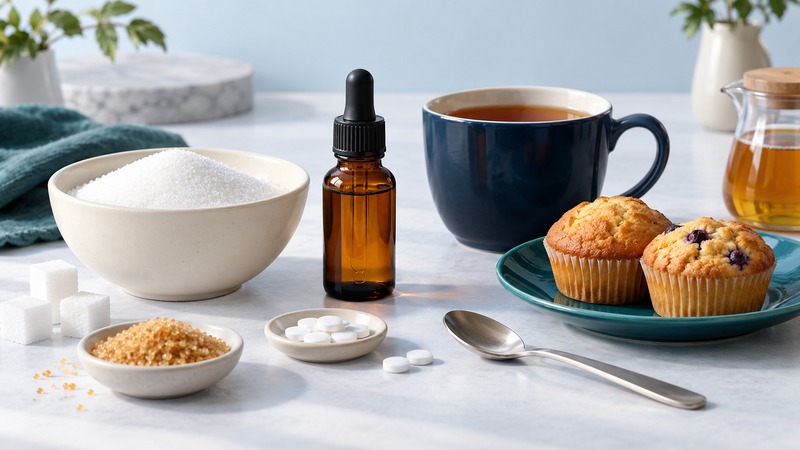
Start with the job sugar does in your food. Sweetening a cup of tea is a different problem from giving cookies their spread or helping a cake retain moisture. Choose the exact product and recipe together, then make a small trial before changing a full batch.
Choose the kitchen job
For tea, coffee or plain yogurt, start with the product’s labeled serving or sweetness conversion, stir thoroughly, taste and adjust. For baking, look for a recipe developed for that specific sweetener. Concentrated drops supply little of the volume that a cup of sugar contributes.
Focus the table and use the arrow keys to scroll sideways.
| Job | What matters | Starting approach |
|---|---|---|
| A drink or yogurt | Sweetness, aftertaste and ease of mixing | Use the exact package conversion; adjust one small serving |
| Muffins or simple cakes | Bulk, moisture, browning and rise | Use a recipe tested with that product |
| Cookies | Spread, crispness and chew | Make a small batch; compare after cooling |
| Caramel, candy or preserves | Sugar chemistry or a validated preservation process | Use a purpose-designed recipe rather than a general conversion |
The FDA sweetener overview distinguishes high-intensity sweeteners, sugar alcohols and other sugars. Stevia-derived ingredients and monk-fruit extracts can provide concentrated sweetness; erythritol is a sugar alcohol; allulose and tagatose belong to a different group. A large brand name on the front can describe only one ingredient in a blend.
Read the full product name and ingredients
Record the product name, form, country of sale, serving size and ingredients. A packet, a liquid and a granulated baking bag from the same brand can require different quantities. Read total carbohydrate as well as sugars when that information matters to your meal plan. “Natural” describes neither a universal baking ratio nor a personal health outcome.
For a concrete comparison, Splenda Original Granulated directions describe a cup-for-cup sweetness replacement. The manufacturer also describes changes in browning, texture and rise. Splenda Sugar Blend directions instead call for half the sugar’s volume and identify sugar plus sucralose in the blend. Those are product-specific instructions, checked in October 2026.
Thus, a recipe calling for ¾ cup sugar corresponds to ¾ cup Original Granulated for sweetness, but ⅜ cup Sugar Blend under its directions. Since ⅜ cup equals 6 tablespoons, the second measurement is straightforward. Neither calculation, by itself, establishes that the finished recipe will have the original structure.
Run a useful small trial
- Choose a manufacturer or recipe developer’s formula that names the product you have. Keep the pan size and batch size consistent with that formula.
- Write down the ingredient weights or volumes, oven setting and recipe’s doneness check. Follow any stated changes in liquid, timing or temperature.
- Compare the baked result only after the specified cooling period. Note color, height, spread, tenderness and any aftertaste.
- Change one supported variable next time. If the product gives sweetness but the cake is dry, adding more sweetener is unlikely to restore the missing moisture balance.
The manufacturer’s liquid-sweetener guidance explicitly distinguishes sweetening heated foods from replacing sugar’s volume and other functions. A liquid conversion is therefore a useful drink instruction, not a complete cake reformulation.
Match the choice to the person and the process
Some sugar alcohols can cause digestive discomfort, especially as intake rises; check the FDA overview and the exact package. If you manage diabetes or another condition, evaluate the whole recipe with your clinician or dietitian rather than treating a sweetener name as a treatment claim. People with phenylketonuria need to heed aspartame’s phenylalanine warning.
For shelf-stable preserves, follow a tested recipe that names an appropriate sweetener and pectin. The National Center for Home Food Preservation explains why sugar changes require attention to the recipe and processing method. Keep ordinary baking experiments separate from preservation instructions.
For another food-label exercise, compare white cranberry juice drinks or read what maple-syrup research actually tested.