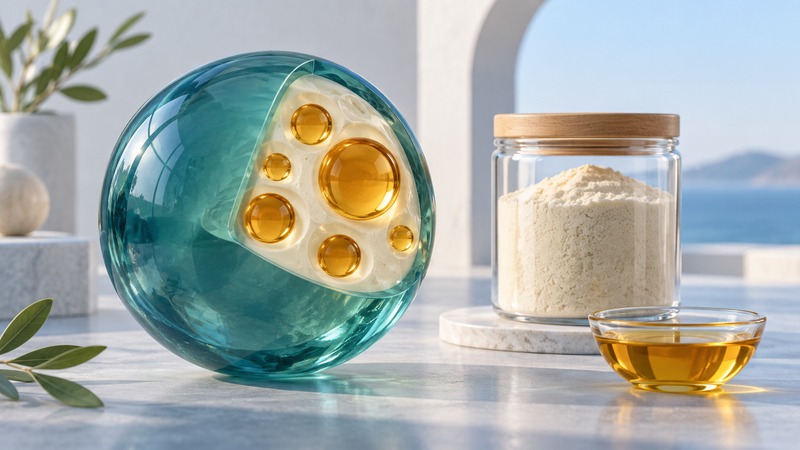
Microencapsulation packages an ingredient within a surrounding material or distributes it through a protective matrix. The useful question is what that arrangement accomplishes in a particular food: slower oxidation, less flavor exposure, easier handling or release under specified conditions. Each purpose needs its own measurement.
Identify the ingredient, wall and food
The ingredient being protected is often called the core or active material. The surrounding material can form a distinct shell, a matrix holding many droplets, or part of an emulsion. A neat sphere in a diagram is a conceptual model; a spray-dried food powder can contain irregular particles and multiple internal droplets.
For an oxidation-sensitive oil, researchers may disperse droplets in a wall-forming mixture and dry the dispersion. The resulting powder can make the oil easier to handle and mix into another food. Wall composition, exposed oil, moisture, processing temperature and oxygen access all influence the result. A formulation that works in dry powder still needs testing when incorporated into a drink or baked product.
Match the claim to the test
Focus the table and use the arrow keys to scroll sideways.
| Claim | Useful measurement | Essential context |
|---|---|---|
| The ingredient was encapsulated | Encapsulation efficiency and a stated method for measuring surface or free material | Definition of the calculation, ingredient loading and extraction method |
| It stayed stable | Retained ingredient, oxidation products or other relevant deterioration measurements over time | Temperature, light, oxygen, humidity, package, duration and an appropriate control |
| It masked an unwanted flavor | Sensory testing in the finished food | Dose, recipe, comparison, panel method and storage age |
| It released during digestion | Release or digestion measurements under defined conditions | Model fluids, enzymes, time and what was measured |
| People absorbed more | Human study measuring an appropriate absorption endpoint | Dose, food, participants, comparator and timing |
Bioaccessibility describes the amount made available for potential absorption during digestion. Bioavailability asks what is absorbed and becomes available in the body. A simulated digestion experiment can help screen formulations; a claim about absorption in people needs suitable human evidence.
See why one high number is insufficient
A 2024 fish-oil study by Yang and colleagues compared spray drying, spray freeze drying, freeze drying and microwave freeze drying. The reported encapsulation efficiencies were 86.98%, 77.79%, 63.29% and 57.89%, respectively. Although spray drying gave the highest efficiency, its oxidative stability was slightly lower than that of the other preparations under the study conditions. Ranking the powders by efficiency alone would therefore miss another important result.
Earlier research by Drusch and Berg, published in 2008 examined fish-oil microcapsules and concluded that extractable oil alone could not predict shelf life. These studies support a practical reading habit: find the measurement that matches the claim you care about, then check whether it was made in the intended food and storage conditions.
Illustrative evaluation: a supplier reports 90% encapsulation efficiency for a powder. Before selecting it for a refrigerated beverage, ask for stability and sensory results in a comparable beverage over the proposed storage period. Request the active amount at the beginning and end, the packaging and temperature, and the control formulation. The 90% figure describes one property of the starting powder; it does not supply those missing results.
Read a technical sheet in a useful order
- Identify the system. Record the active ingredient, wall materials, ingredient loading and intended food. Check the full ingredient and allergen information.
- Check the process. Note temperatures, drying method and handling requirements. Ask which conditions were used in the reported test.
- Inspect the comparison. Look for unencapsulated material or another relevant formulation at the same active dose. Equal powder weights can contain different amounts of active ingredient.
- Read the outcome and duration. A day-zero powder measurement, a storage study and a digestion experiment answer different questions.
- Define the remaining trial. Test the candidate in the actual food, package and processing sequence before making a product claim.
Microencapsulation is a formulation tool whose value depends on the intended use. For another example of matching a laboratory result to the claim, see quebecol and maple-syrup research.