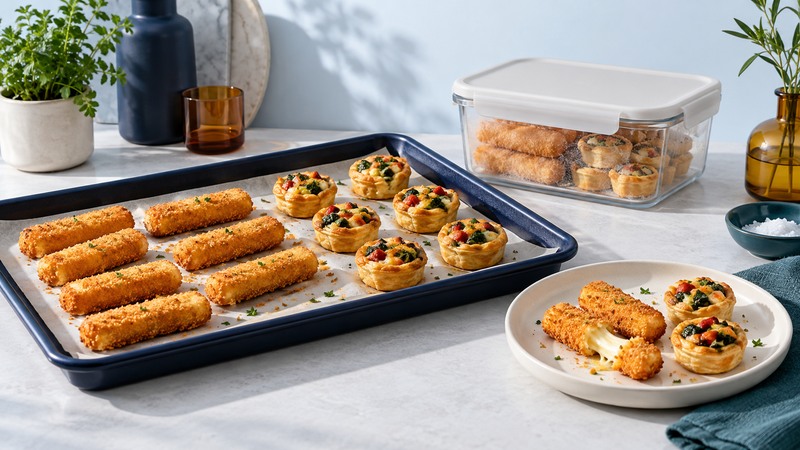
Start with the guests, the rest of the menu and the oven space. Then read each package for its exact quantity and appliance instructions. Two products that look similar can need different temperatures, times and center checks. A simple written schedule prevents the last tray from becoming an afterthought.
Count pieces in the context of the meal
For an illustrative eight-person gathering with dinner to follow, plan six small bites per person: 8 × 6 = 48 pieces, split between two foods at 24 pieces each. This is a starting menu decision; large filled pastries, young children, a long event or an appetizer-only meal need a different plan. Include a clearly identified option for each guest’s dietary needs.
Read piece count as well as bag weight. If one bag has 30 pieces and you need 24, cook the 24 and keep the remainder frozen. If packages list approximate counts, allow for variation. The serving on a nutrition label is a reference amount for its numbers; it does not decide how much your guests will eat.
Copy the directions for the exact package
Scroll the table sideways. With a keyboard, focus the table and use the arrow keys.
| Field | Why it matters | What to write |
|---|---|---|
| Product and package size | Different sizes can have different batch directions. | Name, weight and the package’s version of the instructions. |
| Appliance and temperature | Conventional, convection, toaster oven and air fryer are separate methods. | The method your equipment actually supports. |
| Quantity, layer and rack | Time depends on the stated loading. | Pieces or fraction of package, single-layer rule and rack. |
| Time and doneness | Browning alone may hide a cold center. | Time range, internal-temperature requirement and any standing time. |
| Ingredients and allergens | Fillings and sauces may differ from the outer appearance. | Keep packaging available; use separate serving utensils. |
A real example checked September 9, 2026: Farm Rich’s Breaded Mozzarella Sticks preparation panel lists 450°F in a conventional oven and 9–10 minutes for half of its 22-ounce box. Its 66-ounce Party Size panel lists 10–11 minutes for half of one inner bag at the same temperature. Both specify a single layer, keeping the product frozen until preparation, and cooking to 155°F for 15 seconds. Those are product-specific directions; use your actual package if it differs.
Fully cooked ingredients inside an appetizer do not establish that the assembled product is ready to eat. Follow all required cooking steps. If the coating darkens before the center reaches its required endpoint, review the quantity, appliance setting and exact directions. Avoid improvising a microwave or air-fryer conversion for a product whose instructions do not support it.
Work backward from serving
Illustrative two-tray schedule: suppose each selected package permits a 24-piece batch on your tray, both call for a 425°F conventional oven, and both take 12–15 minutes. You have room for only one tray. These are fictional planning inputs, not instructions for the mozzarella sticks above or any other product.
Scroll the table sideways. With a keyboard, focus the table and use the arrow keys.
| Time | Action | Decision |
|---|---|---|
| Before 5:30 | Check labels, tray fit, serving dishes and thermometer. | Choose staggered service; keep uncooked products frozen. |
| By 5:40 | Preheat oven completely to the example’s 425°F. | Allow more time if your oven heats slowly. |
| 5:45–6:00 | Cook batch A; check at 5:57 and complete its required endpoint. | Serve only when fully cooked; allow any required standing time. |
| About 6:00–6:15 | Put batch B in after removing A. | Let the oven recover; use the package’s time and center check. |
| After serving | Track time and refrigerate suitable leftovers promptly. | Discard food beyond its safe holding window. |
If all food must arrive together, choose compatible equipment with enough capacity and manufacturer-supported loading, or add a cold dish prepared ahead. Stacking trays or squeezing more food onto a sheet changes the cooking conditions. Half the quantity also does not automatically mean half the time.
Use the printable appetizer oven planner to record your real labels and batch sequence; a plain-text version is available for editing.
Serve in small, clearly timed batches
Keep hot foods at 140°F or above and cold foods at 40°F or below. Refrigerate perishables within two hours, or one hour above 90°F. Discard food that exceeds those limits. FDA’s buffet guidance explains portioning and temperature control. A covered platter on the counter is not controlled hot holding.
Use a clean serving plate for each refill, allow molten fillings to cool as the package directs and retain ingredient information for guests. For later meals, reheat properly refrigerated leftovers to 165°F and follow any additional package instructions.