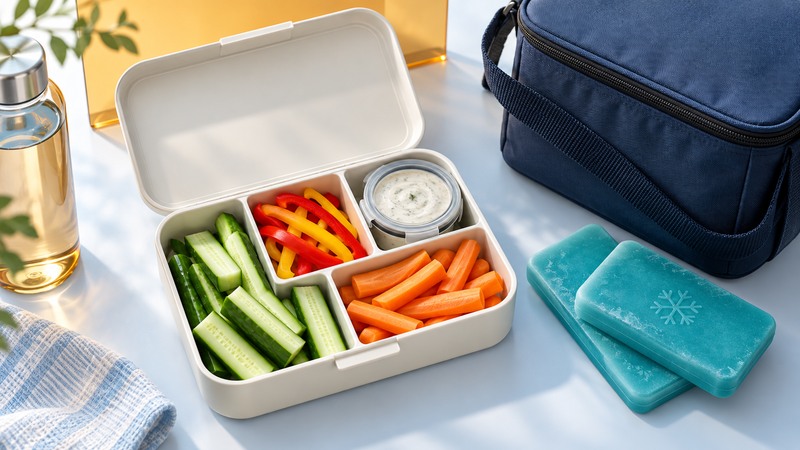
A useful vegetable snack fits the child’s chewing skills, stays cold when needed and is easy to open. Start with a small amount of one familiar vegetable and add variety gradually. Ready-packed portions can save preparation time; home packing gives you more control over texture, quantity and waste.
Choose texture before packaging
For school-age children who comfortably chew raw vegetables, thin cucumber or bell-pepper pieces may be convenient. Tailor them to the individual child. Babies and toddlers need preparation suited to their development: hard raw carrot pieces and whole small tomatoes can be choking hazards. Cook firm vegetables until soft and prepare their shape and texture according to CDC’s guidance for introducing solid foods. Packaging marked “for kids” does not establish that a food is suitable for every age.
Have children eat seated upright with attentive adult supervision. Keep snack time calm and allow enough time to chew. For infants and toddlers, avoid eating while walking or riding in a car or stroller. CDC’s choking-hazard guidance explains the importance of texture, shape and the eating setting.
Prepare a small batch
- Wash your hands and use a clean board and knife. Keep raw meat and its equipment away from produce.
- Rinse vegetables under running water and dry with a clean towel. Skip soap, detergent and produce washes. Produce labeled ready-to-eat or prewashed can be used as directed without another wash.
- Prepare the child’s suitable texture, then pack a modest portion in a clean, easy-open container. Put dip in its own sealed cup to keep the vegetables crisp.
- Refrigerate cut vegetables and perishable dips promptly. Label containers with the preparation date and keep package instructions when using purchased foods.
These washing and refrigeration steps follow FDA’s produce handling guidance. When buying precut vegetables, choose products displayed under refrigeration or on ice. Inspect the package and date and take them home promptly.
Pack for the actual trip
Prepare food ahead and keep it in the refrigerator; assemble the lunch bag at departure. For perishable food, use an insulated bag and at least two cold sources, such as two frozen gel packs or a gel pack and a frozen water bottle. Position cold sources around the food. Refrigerate the bag on arrival if possible, opening it so cold air can circulate. USDA’s packed-lunch instructions call for keeping perishables at 40°F or below.
If the school has no refrigerator, trial the bag and cold packs over a comparable time and check the food temperature with a thermometer. Plan a different snack or better cooling if it fails to stay cold. Perishable food has a two-hour limit outside temperature control, or one hour above 90°F. A cool-feeling bag alone cannot verify the food temperature. Discard leftover perishables from the lunch bag when safe handling cannot be established.
Three adaptable snack combinations
- Crunchy school snack: cucumber and bell pepper with a small sealed dip cup, for a child who handles those textures well. Keep the dip and cut produce chilled.
- Soft vegetable snack: cooked, cooled carrot or broccoli prepared in the child’s developmentally suitable texture. Pack chilled and supply an appropriate utensil.
- Low-preparation morning: use refrigerated, ready-to-eat vegetables, checking texture yourself. Repack only the amount likely to be eaten and keep the rest refrigerated.
Check school food restrictions and every dip label. Milk, sesame or other allergens may be present, and a homemade container needs enough ingredient information for the caregiver. Let the child practice opening it at home; a snack left unopened saves neither time nor money.
Compare the portion that gets eaten
Scroll the table sideways. With a keyboard, focus the table and use the arrow keys.
| Option | Purchase and usable yield | Cost per portion |
|---|---|---|
| Ready-packed vegetables | Four 75 g packs cost $4.80 | $1.20 per 75 g |
| Home-packed vegetables | $3.00 buys 500 g; trimming leaves 450 g | Six 75 g portions: $0.50 each |
| Same home purchase, only three portions eaten | 225 g eaten; the rest unused | $1.00 per eaten portion |
Add dip, bags or containers, then consider preparation time and actual waste. The home-packed example saves $0.70 per portion only if all six portions are used. Start with a small purchase and note what comes back. A smaller ready-packed quantity may suit an unpredictable week better than a large bag that goes unused.