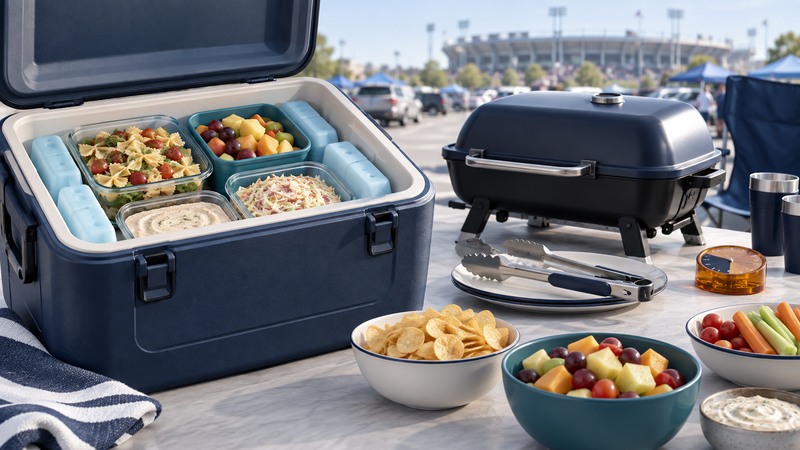
Build a tailgate menu around the equipment you can bring and the time food will be served. A cooler, a thermometer and a definite cleanup time are as important as the recipe. Check the venue’s rules for grills, fuel, glass, alcohol, parking and disposal before buying food.
Choose an equipment plan
Scroll the table sideways. With a keyboard, focus the table and use the arrow keys.
| Your setup | A workable menu | What must be controlled |
|---|---|---|
| Cooler, no cooking | Chilled bean salad, cut vegetables, bread and whole fruit | Keep perishable dishes at 40°F or below; bring utensils and a handwashing setup. |
| Cooler and permitted grill | Beef burgers, chilled sides and fruit | Separate raw meat, measure every patty’s temperature and use clean serving tools. |
| Reliable permitted hot holding | Chili prepared at home, bread and toppings | Keep hot food at 140°F or above throughout transport and service; verify with a thermometer. |
USDA specifies cold holding at 40°F or below and hot holding at 140°F or above. Pack enough ice or frozen packs to maintain temperature through the outing, and keep the cooler shaded and closed between uses. A separate drinks cooler reduces repeated opening of the food cooler. USDA’s tailgating questions and answers covers transport, serving and leftovers.
Plan quantities for six people
Illustrative lunch: six quarter-pound beef patties (1½ pounds total), six buns, six cheese slices, six portions of chilled bean salad, cut vegetables, six pieces of whole fruit and drinks. Adjust to appetites, dietary needs and the length of the event. Ask guests about allergies before settling on the menu and retain ingredient labels. Use the cheeseburger method and temperature check; its four-patty recipe scales to six by multiplying ingredients by 1.5.
A single small cooler may fit this menu poorly once ice, containers and raw-meat separation are included. Load the actual empty containers before shopping. If they leave inadequate space for cooling, reduce the menu or bring another cooler.
Prepare, transport, serve and clear
- The day before: prepare sides and chill them in shallow containers. Freeze cold packs, check thermometer operation and pack separate utensils for raw and cooked food.
- At departure: load food straight from the refrigerator. Seal raw meat in leakproof wrapping and keep it apart from ready-to-eat food. Record the cooler reading.
- At arrival: set up soap, potable running water from a spigoted container, paper towels and a wastewater catch container. Assign a clean serving area. Check food temperatures again.
- At service: bring out small batches and keep reserves under temperature control. Record the time each batch leaves the cooler or hot holding. Use clean platters for cooked food.
- Before entering the stadium: discard food that has exceeded its time limit and secure remaining food under verified temperature control. Follow venue instructions for fuel and waste.
Use temperatures for cooking and a clock for serving
Scroll the table sideways. With a keyboard, focus the table and use the arrow keys.
| Food | Minimum internal temperature | Extra instruction |
|---|---|---|
| Ground beef patties | 160°F | Check each patty in its center from the side. |
| Chicken or turkey, including ground poultry | 165°F | Check thick portions with a food thermometer. |
| Whole beef steaks or chops | 145°F | Rest at least 3 minutes after cooking. |
| Previously cooked leftovers | 165°F when reheating | Then maintain at least 140°F for hot holding. |
Perishable food outside safe hot or cold holding has a two-hour limit, shortened to one hour when the outdoor temperature exceeds 90°F. Count time during transport and serving together; returning food to a cooler does not erase earlier time. If you cannot establish its handling history, discard it. These limits and cooking endpoints follow USDA’s tailgate guidance.
Clock example: on a 75°F day, a salad spends 20 minutes being packed without cooling, then 50 minutes on the table. That is 70 minutes outside temperature control, leaving at most 50 minutes of the two-hour allowance. Keeping it properly chilled from the start is simpler than managing a shrinking allowance.
Pack the checklist
Open the printable tailgate checklist and temperature log. Write the menu, departure and serving times, venue constraints and assigned food handler. The sheet carries the key temperatures and time limits so it can travel with the cooler.
Bring soap, water, towels, bags for waste, food and cooler thermometers, ice, clean serving utensils and leakproof containers. Choose a menu you can keep controlled until cleanup; a late return after the game requires the same temperature checks as the initial trip.