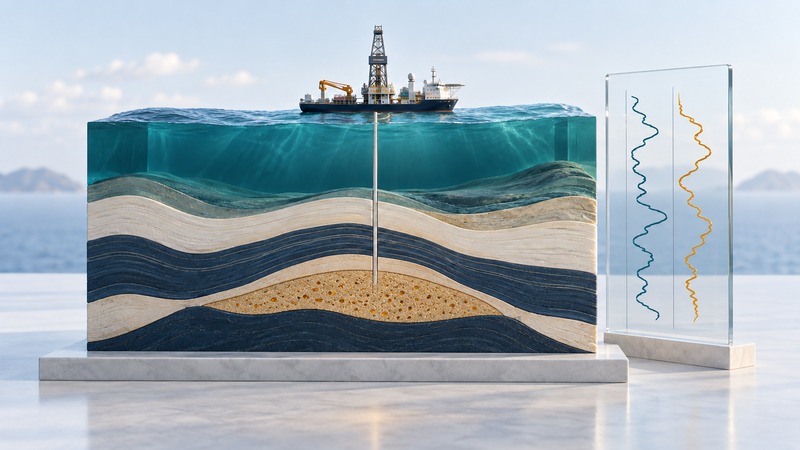
A discovery announcement combines observations, interpretations and forecasts. Diega’s 2008 oil test offshore Equatorial Guinea is a useful example: a measured test rate and a modeled development-well rate appeared together, but they answer different questions. Read each number with its date, well and evidence type.
Separate the reported test from the modeled completion
Noble Energy’s August 28, 2008 announcement, reproduced by Gulf Oil & Gas reported an oil-zone test of 2,700 barrels of oil per day and 2.7 million cubic feet of gas per day. It separately described modeling of development completions at approximately 10,000 barrels of oil per day plus associated gas. The announcement’s test and model figures should remain labeled as such.
A short test examines flow under its particular completion, pressure and surface-handling conditions. A development estimate depends on an assumed completion and reservoir model. Neither figure by itself establishes a sustained field rate, recoverable volume or commercial return.
Follow the dated appraisal record
Noble’s 2012 annual report identified Diega as a 2008 condensate and oil discovery on Block I and described ongoing appraisal and evaluation of regional development scenarios. The 2014 annual report still described regional development evaluation and additional seismic work for the grouped discovery record.
The naming and block descriptions evolve across these filings: the 2014 table labels a combined entry “Diega (Block O) and Carmen (Block I).” Preserve the filing’s wording, year and grouped scope rather than treating every later use of the name as the identical 2008 well. This case study follows those dated records through 2014. Present-day production and final development outcomes require a later, verified operator record.
On a narrow screen, scroll the table horizontally. Keyboard users can focus the table and use the arrow keys.
| Stage | Evidence | What remains to establish |
|---|---|---|
| Discovery | Well logs, samples and reported hydrocarbon intervals | Extent, connectivity and recoverability |
| Flow test | Measured rate, pressure, duration and completion | Sustained behavior and scale-up assumptions |
| Appraisal | Additional wells, seismic interpretation and models | A supported development concept and economics |
| Development and operation | Approved commitments, facilities and production records | Actual delivery, decline and performance over time |
Keep rate, duration and volume separate
Fictional volume example: a well flowing steadily at 2,000 barrels per day for six hours produces 500 barrels during that interval: 2,000 × (6 ÷ 24). Multiplying that test rate by 365 instead would describe a full year of uninterrupted operation at the same rate—an assumption the six-hour observation has not demonstrated.
For oil and gas, retain their separate units unless a stated conversion is necessary for the question. A gas rate in million cubic feet per day cannot be added directly to an oil rate in barrels per day. A net-pay thickness measures a reservoir interval and also cannot substitute for recoverable volume.
Ask for the test duration, pressure behavior, water production, restrictions and the boundary of the quoted rate. If the announcement omits those details, record the omission; avoid filling it with an assumed operating condition.
Build a traceable project history
Use a record with columns for document date, well or field name, block, observation, forecast and next verified milestone. Keep gross field quantities separate from a company’s working interest or entitlement. Ownership and names can change over time, so copy them only with a dated source.
When a later report groups several discoveries, compare its footnotes and project descriptions before merging the history. If a sanction date or first-production record cannot be established, leave that milestone unresolved. This produces a useful account of the available evidence without converting a forecast into an outcome.
The oil-exploration guide explains discovery, appraisal and reserves terminology. The offshore pipeline guide covers the separate question of capacity and delivery to market.
Explore more energy guides and case studies.