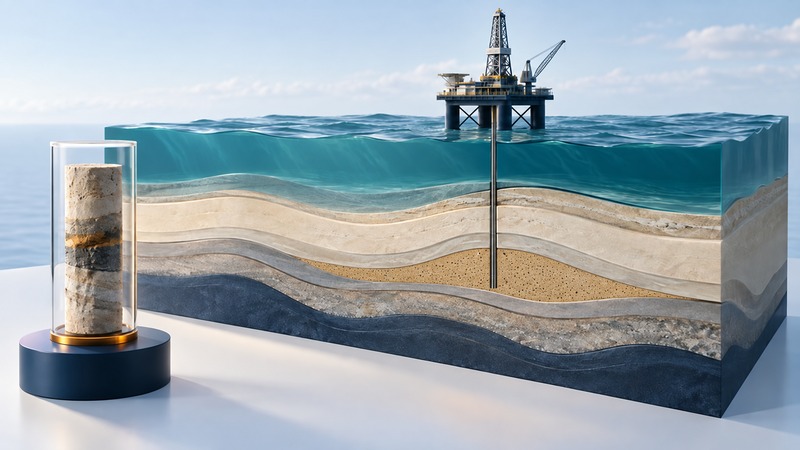
An exploration announcement is a report about evidence gathered at a particular stage. Read it by asking what was observed, how much remains estimated and what must happen before hydrocarbons can be produced commercially.
Offshore oil and gas projects make the distinction especially visible: a successful well may still need appraisal, engineering, approvals, financing and a route to market. Keep a dated record of those milestones instead of treating a discovery headline as a production forecast.
Separate observations from estimates
Logs, cores, fluid samples and pressure or flow tests answer different questions. Logs help interpret formations near the well; cores provide physical rock samples; fluid and pressure data help characterize what the reservoir contains and how it behaves. Ask which measurements support the announced conclusion and how widely they represent the field.
On a narrow screen, scroll the table horizontally. Keyboard users can focus the table and use the arrow keys.
| Stage or claim | Evidence to look for | What remains to establish |
|---|---|---|
| Exploration prospect | Geological interpretation and mapped objectives | Whether drilling confirms the expected accumulation |
| Discovery | Well observations and identified hydrocarbons | Extent, connected volume and recoverability |
| Appraisal | Additional wells, samples and reservoir studies | A supported development concept and commercial case |
| Development | Approved plans, commitments and facility construction | Completion, startup and sustained performance |
A thick interval interpreted as hydrocarbon-bearing is one input to an estimate. Area, porosity, fluid saturation, connectivity and recovery assumptions also matter. A short flow test should be reported with its duration and conditions; it does not by itself establish a long-term production rate.
Read resource and reserve labels in their framework
BOEM's classification and reserves methodology distinguishes discovered volumes by evidence and commercial maturity, and describes analog, volumetric and performance approaches. Its discovered-resources overview explains that estimates are revised as exploration, development and production supply new information.
When reading a report, record the named classification system and its definitions. Prospective resources concern undiscovered accumulations; contingent resources concern discovered quantities subject to unresolved development conditions; reserves require a commercial recovery basis under the applicable framework. Uncertainty categories and project maturity answer different questions.
Keep oil and gas units explicit. Barrels of oil equivalent combine quantities using a stated conversion convention; they do not establish equal revenue or identical processing needs. Likewise, gross field quantities, working-interest shares and net entitlement describe different boundaries.
Follow a discovery beyond its first announcement
The Spiderman project provides a dated example. A 2005 Spinnaker release filed with the SEC described a completed development plan, subsea connection to Independence Hub, construction activity and an expectation of first production in 2007. That document records a plan and commitments at that time.
BOEM's deepwater field history subsequently lists Spiderman/Amazon as a subsea development tied to Independence Hub, with first production in September 2007. Reading the two records together distinguishes a forecast from a later operating milestone. These historical records do not establish the field's current production or ownership.
Keep rate, volume and ownership separate
Fictional announcement
A hypothetical report gives a gross recoverable estimate of 50 million barrels and a company working interest of 20%. Simple multiplication gives 50 × 0.20 = 10 million barrels on a working-interest basis. It establishes neither net revenue entitlement nor a booked reserve without the applicable commercial and reporting information.
A separate 5,000-barrel-per-day test is a rate under test conditions. Multiplying it by an assumed operating life would introduce an unsupported production forecast.
For each announcement, save the document date, well or field name, evidence stage, units, gross/net basis, uncertainty range and next milestone. Revisit the record when an appraisal result, development decision or production filing arrives. Use pipeline capacity and connections to examine market access and U.S. production-data interpretation for reported output.
Discovery evidence record
Download the discovery evidence record (plain text). Save a copy and fill it in with your own evidence. Instructions, units, assumptions and the fictional example are included.