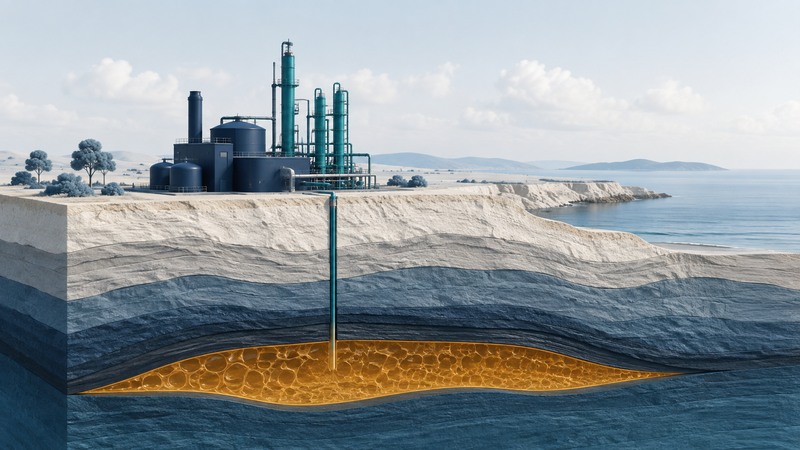
A carbon capture and storage assessment follows carbon dioxide from its source through capture, transport and permanent geological storage. Ask how much reaches storage, what emissions remain across the full system and what useful output the project supplies. A capture percentage becomes meaningful when its denominator and operating period are stated.
Begin with the named facility, development stage, emissions inventory, capture process and storage destination. Keep planned performance, commissioning results and sustained operation in separate fields.
Follow the complete capture and storage chain
NETL’s carbon-management overview describes capture from industrial or power sources, conditioning and compression, transport and storage or use. Capture equipment separates a carbon-dioxide stream; transport and the receiving site need compatible specifications, capacity and operating schedules.
Geological storage places CO₂ in an appropriately characterized deep formation. NETL’s transport and storage program covers these elements as distinct research and deployment needs. Request the proposed route, storage agreement, injection capacity, monitoring plan and contingency for a capture or storage outage.
Carbon utilization has a different fate depending on the product: some uses re-release CO₂, while others may retain it for longer periods. Direct-air capture takes CO₂ from ambient air. Point-source capture, atmospheric removal and product utilization should each state the origin of the carbon, storage duration and lifecycle accounting.
Identify what has actually been demonstrated
Use documents that match the claim’s stage. A design study helps establish technical options; an operating record demonstrates performance under recorded conditions. Ask whether the announced storage and transport arrangements are already available when capture starts.
On a narrow screen, scroll the table sideways. Keyboard users can focus the table region and use the arrow keys.
| Stage | What it can establish | Next evidence to seek |
|---|---|---|
| Capture-ready or feasibility study | Space, integration and possible design pathways | Selected design, energy supply, finance and storage route. |
| Permitted or under construction | Specific approvals or physical progress | Remaining permits, commissioning plan and counterparties. |
| Commissioning | Initial performance under test conditions | Sustained operation including starts, stops and off-design periods. |
| Operating with storage | Measured capture, transfer and injection over a period | Reconciled mass balance, monitoring reports and whole-system emissions. |
Retain the document date, responsible entity and reporting period. A nameplate annual capacity describes a design throughput; annual captured and stored mass also reflects downtime and actual operation.
Separate capture rate from avoided emissions
Capture rate usually compares CO₂ captured with CO₂ entering a specified capture system. Avoided emissions compare the complete project with a reference supplying the same useful product. Energy for capture and compression, uncaptured streams, transport and storage operations can change that result. The IPCC special report on capture and storage, particularly Chapter 3’s comparison method, explains this boundary distinction. Its historical cost figures should be kept separate from a current project estimate.
Fictional equal-output comparison: a reference plant emits 1,000 tonnes of CO₂ to supply a stated amount of useful product. A capture-equipped case supplying the same product sends 1,200 tonnes into its capture system because its assumed energy use is higher. At 90% capture, it captures 1,080 tonnes and releases 120 tonnes from that stream.
Assume another 80 tonnes of CO₂ emissions elsewhere inside the declared project boundary, with all captured CO₂ reaching verified storage. Project emissions are 120 + 80 = 200 tonnes. Avoided emissions are 1,000 − 200 = 800 tonnes, or 80%, despite the 90% capture rate.
The figures are invented to demonstrate the accounting. A real lifecycle comparison must include the reference’s corresponding upstream emissions, all project streams, storage losses if any, other greenhouse gases and uncertainty on a consistent basis.
Request both tonnes captured and tonnes verified stored, plus emissions per unit of useful output. Reconcile any difference in the mass balance and identify whose inventory records the result.
Read the permit and long-term obligations
In the United States, EPA’s Class VI framework addresses wells used for geological CO₂ sequestration, with requirements protecting underground drinking-water sources. It includes site characterization, well construction, monitoring, financial responsibility and post-injection care. Use the actual permitting authority’s documents for the specific well and jurisdiction.
Look for the area of review, other wells that could provide pathways, monitoring of plume and pressure movement, corrective-action plans and the criteria for site closure. Identify the party responsible for reporting, remediation and financial assurance over each phase. A permit is an important authorization; ongoing monitoring supplies operating evidence.
Build the assessment around the whole chain’s weakest unresolved commitment. Capture capacity with an unconfirmed storage destination leaves a delivery question. A favorable capture test with missing full-year emissions leaves an accounting question. For electricity projects, compare useful output alongside wind generation and other feasible system options using consistent services and costs.
Carbon capture project evidence record
Carbon capture project evidence record — plain-text download. Save a copy and fill it in with your own information. The file includes instructions, assumptions and references so it can be used independently.