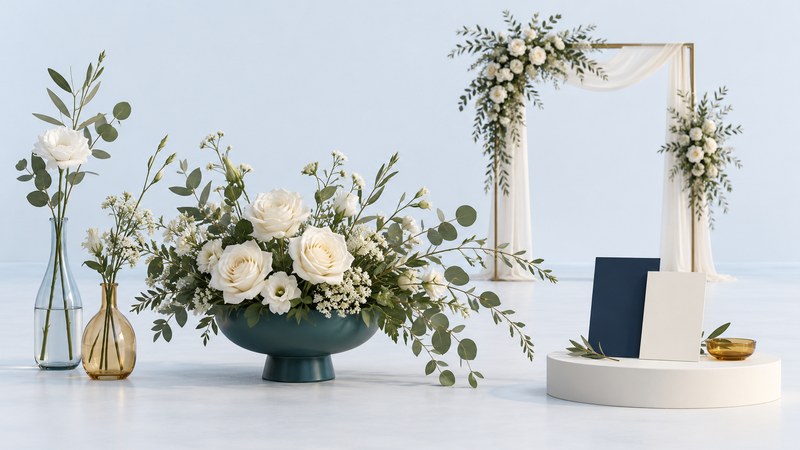
A useful wedding flower plan connects a visual idea to a list of arrangements, delivery locations and people responsible for moving them. Start with the rooms and moments you want flowers to shape, then ask florists to price the same brief.
Give the florist priorities they can design around
Bring the date, venue addresses, ceremony and reception times, estimated table count, available setup window and a spending ceiling. Include installation, delivery, rental vessels, collection and any applicable taxes or fees within that ceiling. A proposal becomes easier to adjust when the florist knows the whole amount available.
Choose a small set of reference images and explain what you like about each: an airy shape, a mostly green palette, a low profile or an abundance of one flower. Label the photographs as inspiration. Identify two or three priorities and the places where you welcome a simpler treatment. For example: “We care most about the ceremony backdrop and dinner tables; the welcome desk can use a small arrangement.”
Ask the venue about attachment methods, access, open flames, permitted installation areas and the time everything must be removed. Give those requirements to the florist before approving a design. Discuss carried bouquets separately from room arrangements, while including their quantities in the overall order.
Agree on substitutions in advance
The Society of American Florists’ supply-chain guide describes natural variation and disruptions that can lead to substitutions. Ask which parts of the design the florist will preserve if a flower becomes unavailable: palette, shape, scale, texture or a particular focal flower. Record any flowers you want excluded and how a substantial change will be approved.
A brief such as “ivory and green, loose shapes, low enough for conversation, with these two flowers excluded” gives the florist several ways to achieve the effect. If one particular flower is essential, ask what happens to the design and price if it cannot be obtained.
Count arrangements by location and moment
Use a room plan to label every destination. Count tables from the current seating layout and distinguish guest tables from the couple’s table, bar, welcome desk and service stations. Mark provisional quantities so the florist can give you a final-count deadline.
| Location | Quantity and design question | Handoff to settle |
|---|---|---|
| Ceremony entrance | Two arrangements; confirm footprint and vessel | Who places them before guests arrive? |
| Ceremony backdrop | One installation; florist and venue agree its design and support | Who installs, inspects and removes it? |
| Dinner tables | Ten low arrangements; confirm table dimensions and other settings | Who supplies vessels and sets each table? |
| Welcome desk | One small arrangement with room for guest materials | Does it stay here or move later? |
These quantities describe an invented event, not a recommended minimum. Review the table arrangement alongside plates, glasses, stationery and any lighting. A mock-up or annotated photograph can settle dimensions, sightlines and available space before the full order is made.
Compare complete proposals
Ask each florist to separate arrangements, installation labor, delivery, rental items and collection. Check the quantity, approximate scale and included vessel for every item. A lower total may cover fewer pieces, smaller arrangements or a different labor commitment.
- Design: palette, reference images, scale, important flowers, exclusions and substitution process.
- Money: payment schedule, applicable fees, change deadlines and cancellation terms.
- Access: loading location, setup period, venue restrictions and a contact available on the day.
- Property: ownership of flowers, rented vessels, damage terms and the return or collection arrangement.
When adjusting the budget, ask for a revised scope with the same level of detail. Reducing the number of decorated locations may preserve the effect of your priority arrangements. Compare the revised total and the new arrangement list together.
Plan reuse as a timed job
Moving ceremony arrangements to the reception can work when the florist confirms they are suitable to move and someone has the time, access and equipment to do it. Give the move a named owner, an earliest release time and a destination. Include any extra labor charge. Guests, photographs and room turnover may occupy the same space, so coordinate the timing with your planner.
For example, two entrance arrangements might move beside a reception doorway after ceremony photographs finish. The brief should identify who releases them, who moves them and who confirms the doorway remains usable. Let the florist and venue resolve installation and access requirements.
Finish with an end-of-evening plan: which flowers guests may take, which containers must remain, who collects rentals and what happens if collection runs late. Arrange any donation directly with a willing recipient in advance. For flowers near food, have the baker approve the cake decoration plan.
Download the editable florist brief. Fill it in before consultations, then use the agreed version for the final handoff.