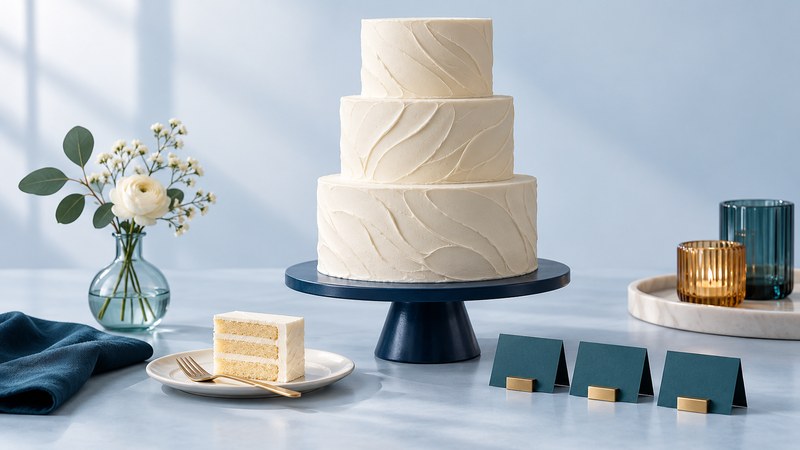
Order a wedding cake by agreeing what guests will receive, how the cake will arrive and who will serve it. A beautiful design becomes a workable order when the baker, venue and caterer share the same portion count and handoff.
Start with the dessert plan
Decide whether cake will be the main dessert, one option on a dessert table or a small ceremonial cake with other portions served from the kitchen. Tell the baker how many guests you expect, whether vendor meals include dessert and whether you want extra portions. Ask when the final count becomes binding.
Ask the baker to define a serving and show how the proposed design produces the required number. Wilton’s wedding cake guide treats serving numbers as a guide; the actual order needs the baker’s portion assumptions and cutting plan. Tier count alone gives you too little information to compare cakes of different dimensions or construction.
A serving discussion you can adapt
For an invented reception with 80 guests, the couple asks for 80 agreed dessert portions plus eight extras: 88 portions in total. The baker proposes a display cake and additional kitchen cake that together yield 88 portions using the agreed cut. The caterer confirms that this plan fits its plating and service. These numbers illustrate the conversation; your baker should specify the dimensions and yield.
If some guests need a separate dessert, agree whether those portions replace cake portions or are additional. Record how they will be identified and served. This prevents a guest requirement from getting lost between the final headcount and the kitchen’s service list.
Use the tasting to resolve choices
Bring a short list of flavors you enjoy and ask to taste complete combinations of cake, filling and finish. Note the texture and sweetness together. Ask whether the sample represents the final recipe and presentation, and whether different tiers can use different combinations within the proposed price.
Give the baker guest dietary requirements early and describe the requirement precisely. Ask what ingredients and preparation arrangements the baker can confirm, including how they handle cross-contact concerns. Pass the baker’s actual response to the affected guest so they can decide whether the offering meets their needs. Agree on a separate option when the bakery cannot meet a requirement.
For the design, identify the features you most want: shape, finish, color, decoration or a particular silhouette. Share photographs with notes about those features. Ask what a sketch, sample or mock-up includes and when the design is considered final. Confirm the dimensions of any topper and who provides it.
Coordinate flowers with the baker
Have the baker approve any flowers and other materials that may contact the cake. University of Illinois Extension’s edible-flower guidance emphasizes correct identification and flowers grown as a food crop. The appearance of a flower does not establish its suitability for food use. Let the baker and florist agree on the decoration and placement method before delivery.
Put the complete order in writing
| Part of the order | What the written confirmation should resolve |
|---|---|
| Portions | Total agreed yield, portion definition, extra kitchen cake and separate desserts |
| Recipe and design | Flavors, fillings, finish, dimensions, decorations and approved reference |
| Full price | Cake, delivery, setup, stand rental, applicable taxes and separately charged service |
| Changes | Final-count date, design deadline, payment schedule and cancellation terms |
| Handoff | Delivery window, named recipient, storage/display instructions and cutting responsibility |
Check the venue or caterer’s proposal for cake-cutting, plating or service charges. Identify who supplies plates, forks, napkins and the cake stand. A rented stand also needs a return deadline and a person responsible for it.
Walk the cake through the day
Give the baker the delivery address, access instructions and an on-site contact. Ask the venue to approve the display location and support surface. Request written storage and display instructions for the actual recipe and conditions; fillings, finishes and the venue setup can affect the plan. Share those instructions with the person receiving the cake.
Build a sequence with named owners: receive the delivery, check it against the order, follow the baker’s handling instructions, bring the couple over for the cutting, move the cake for portioning and serve guests. Confirm whether the baker supplies a cutting diagram or explains which structural pieces must be removed by the server.
Allow the photographer and music provider time to prepare for a planned cutting. Keep any announcement brief and agree who gives the cue. If timing changes, one coordinator should update the baker’s receiving contact, caterer and photo or video team as needed.
Before the event, decide who may take leftovers and who supplies suitable containers. Ask the baker for recipe-specific storage and use instructions, and give those to the recipient. The final check is practical: every transfer has an owner, and the people serving the cake can find the portion plan and handling instructions.