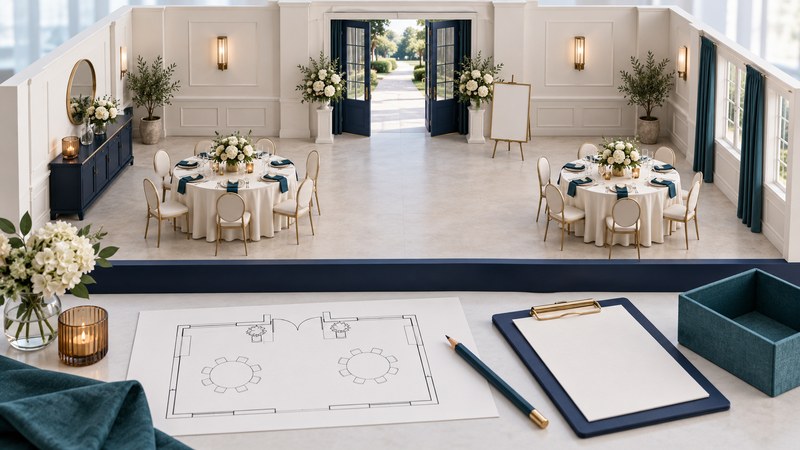
Plan wedding decorations around the room, the movement of guests and the time available to install and remove everything. A small, complete scheme is easier to deliver when every item has a location, an owner and a collection plan.
Walk through the space as a guest
Begin at the arrival point and follow the route to the ceremony, refreshments, seating and facilities. Note where people need directions, where they will pause and which existing features already create atmosphere. Ask the venue for a current room plan and details of furniture, lighting and decorations included in the booking.
Choose two or three visual priorities. You might concentrate on a welcoming entrance, the ceremony backdrop and a coherent dining table. A plan with clear priorities makes it easier to remove an expensive detail while keeping the feeling you want.
Review the proposed layout with the venue before buying or hiring anything. Confirm required routes, access arrangements, exits, service areas and space for people using mobility aids. Agree where installations can go and who approves attachments, electrical equipment, flames and temporary structures. Use the venue and qualified suppliers for site-specific requirements.
Make one sample before multiplying it
Limit the main palette and repeat a few shapes or materials. Gather photographs that show the feature you mean: the height of an arrangement, the texture of a cloth or the softness of the lighting. Label each reference with what you like so a supplier can interpret it.
Mock up one table using the actual or agreed substitute pieces. Include plates, glasses, water, menus and any shared food, then sit down and look across it. Check that the arrangement leaves the intended space for service and conversation. Photograph the agreed version from above and from a seated position, and record quantities for each table type.
For candle-like lighting, consider battery-operated LED candles and check the effect in the venue’s light. The NFPA’s home candle safety sheet recommends flameless candles. For an event, obtain the venue’s own approval and operating requirements for the chosen lighting. Ask who supplies, checks and switches it on.
| Zone | Define the item | Confirm the handoff |
|---|---|---|
| Arrival | Welcome display, directions and approved location | Who places it before guests arrive? |
| Ceremony | Backdrop, aisle details and weather alternative | Who installs, approves and removes it? |
| Dining | Table plan, linens, vessels and place details | Who counts items and checks the sample? |
| Shared areas | Gift table, refreshments and seating accents | Who keeps working surfaces usable? |
| Collection | Containers, labels, packing and rental returns | Who remains until everything is accounted for? |
Compare hiring, buying and making at full cost
Request quantities and itemized prices, including delivery, collection, installation, removal, tax and any cleaning or replacement terms. For purchases, add transport, storage, packaging and the work of dealing with the items afterward. For handmade pieces, include materials, tools, a trial and the time needed to repeat the result.
An illustrative vessel comparison
For 12 tables, hiring vessels at $8 each costs $96. Add $50 delivery and collection and $24 cleaning: $170 before tax. Buying vessels at $10 each costs $120; $30 transport and $20 packing also total $170 before tax. The purchase plan still needs storage and an agreed next destination. These example prices show how to compare scope; request actual quotes for your event.
List any refundable deposit separately from the expected cost, because it affects the money needed at booking and the amount at risk. Record what triggers a loss or extra fee. Assign the same responsibilities in both options before deciding which is better for you.
Use the wedding flower guide for floral quantities, proposals and reuse. If decorations move between ceremony and reception, name the person doing the move, confirm permission and leave enough time before the next area opens.
Write an installation and removal schedule
Start with the venue’s access and departure deadlines. Work backward from the time each room must be ready, allowing for delivery, installation, checks and a buffer. Share the sequence with suppliers so one job does not block another. Put the venue contact and the person authorized to make decisions at the top of the plan.
Pack by destination and label each box with its contents, quantity and placement photograph. Separate items that return to a hire company from things going home. Record who brings the packing materials and whose vehicle or collection service takes each group away.
For outdoor elements, agree the alternative location and the time a weather decision must be made. Ask the venue and installer how weather changes the suitability of the installation. Keep the alternative practical within the same access window and staffing plan.
Hand over a plan another person can use
Download the editable decoration setup brief. Complete the room inventory, assignments, access times and return instructions. Attach your approved photographs and venue plan separately.
Before the event, have the setup lead explain the plan back to you: what arrives first, which choices are already approved, where a missing item is recorded and who checks the room before guests enter. Finish with the person responsible for the final sweep and returns. Connect these tasks to the wider wedding planning schedule.