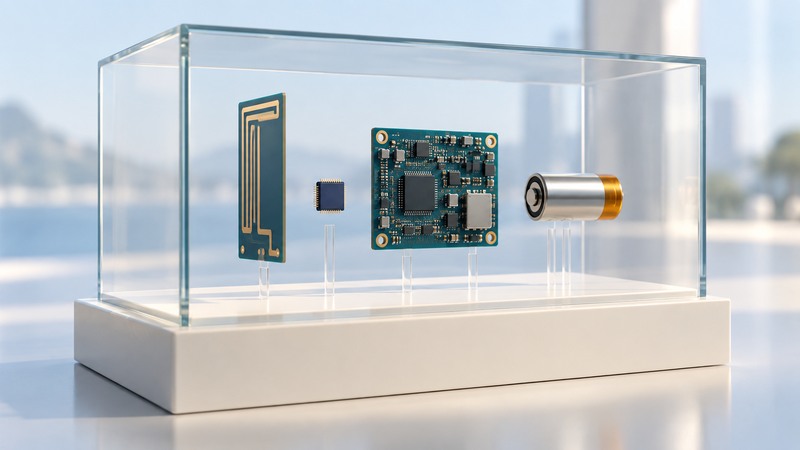
A very small radio chip is one part of a wireless device. The practical size and usefulness of the complete node also depend on its antenna, power source, timing reference, sensor, packaging and the equipment communicating with it. Read a miniaturization claim by identifying exactly what was made smaller and what the experiment demonstrated.
On a narrow screen, swipe a table sideways or focus it and use the arrow keys.
What the 2004 on-chip antenna result established
In May 2004, a University of Florida research report described an antenna less than one-tenth of an inch long integrated on a chip and communication across at least 16 feet in free space. The report identified miniaturizing the crystal oscillator as a next step toward a more complete tiny radio.
That result demonstrated progress in integration and a stated communication range. The report’s proposed sensing applications were future possibilities. It did not demonstrate a deployed population of complete autonomous sensors, each with a proven battery lifetime and rugged environmental packaging.
The distinction remains useful: a research milestone answers a bounded technical question. A finished device has to satisfy that question and the surrounding system requirements at the same time.
Draw the boundary around the size claim
| Object being measured | What may sit outside it | Evidence to request |
|---|---|---|
| Semiconductor die | Antenna, package, battery, clock and board | Die dimensions and external-component list |
| Packaged radio chip | Matching parts, antenna and power supply | Package dimensions and reference circuit |
| Radio module | Battery, enclosure and sometimes antenna | Module drawing and integration requirements |
| Complete sensor node | Gateway or power transmitter elsewhere | Whole-node size, power source and measured operating conditions |
Ask whether the photograph shows the working assembly or a bare component. Include connectors, antenna clearance, mounting and enclosure when estimating the final space required. A small chip can be valuable even when the battery dominates the finished device; its contribution should be described at the right level.
The CC1101 reference circuits and package information (PDF) offer a conventional example of how a transceiver IC fits into a larger radio assembly. Use a reference circuit to count required functions, not just to admire the central package.
Treat antenna size and surroundings as design inputs
An antenna’s electrical behavior depends on wavelength, its geometry and nearby materials. A smaller physical antenna can involve tradeoffs in efficiency and bandwidth. Its placement relative to a ground plane, metal enclosure, battery or body can change the result, so a bench test should be followed by testing in the intended assembly.
Free-space wavelength is approximately 300 divided by frequency in MHz, giving meters. At 915 MHz, that is about 0.328 m; a quarter wavelength is about 82 mm. At 2,400 MHz, it is about 0.125 m; a quarter wavelength is about 31 mm. These are reference dimensions, not mandatory antenna lengths or predictions of useful range.
A folded, loaded or integrated antenna can be physically shorter. Evaluate its documented efficiency, matching and installed behavior. “Smaller antenna” by itself does not tell you whether more transmit power or a more capable receiver was needed in the experiment.
For the underlying tradeoff, TI’s ISM-band antenna application note (PDF) relates antenna dimensions, bandwidth and efficiency. Its discussion helps explain why installed measurements matter alongside a size comparison.
Count the energy required between messages
A sensor may spend most of its time asleep, but listening, startup and communication can dominate its energy use. Compare a complete repeating cycle: sleep, wake, sense, process, transmit, receive an acknowledgment and retry if necessary.
Wireless power changes the system boundary. A 2018 Stanford report on miniature-device wake-up research distinguishes a wirelessly powered radio’s proximity requirements from a battery-powered ultrasonic wake-up receiver. Energy delivery and communication range must both be specified; removing an onboard battery moves a requirement elsewhere.
Use five questions to assess the next claim
- What dimensions were measured: die, package, module or complete node?
- What powers the device, and where is any external power source or gateway?
- What data rate, packet size and delivery success were demonstrated at the stated distance?
- What antennas, orientation, surroundings and test equipment were used?
- Which results are measured, which are modeled and which remain proposed applications?
For a useful comparison, put two studies or products under the same headings before comparing their numbers. A one-meter laboratory link at a high data rate and an occasional sensor message over a longer distance answer different needs. A longer range may also rely on a larger antenna or more capable equipment at the other end.
The best interpretation states the achievement precisely and preserves its conditions. That makes small-radio research easier to follow and gives a product designer a concrete list of integration questions to resolve.