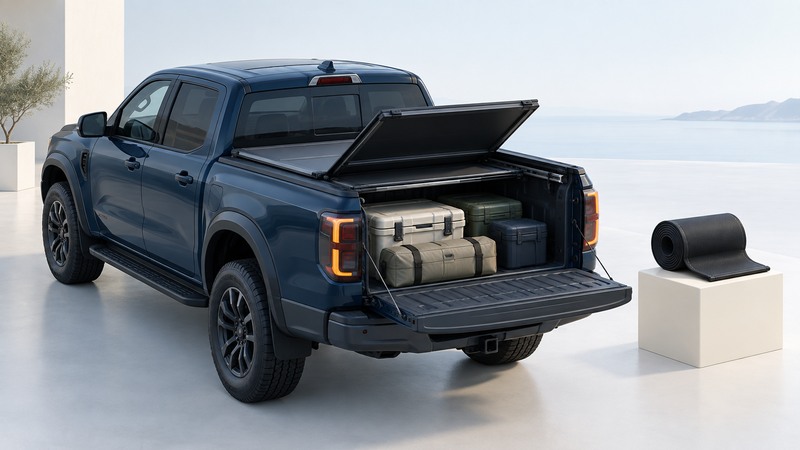
Choose a truck bed cover around the cargo you carry and how you reach it. A low-profile cover may suit bags below the rails, while tall equipment changes the decision. First identify the exact truck bed and existing accessories, then compare access, weather management and documented installation limits.
Measure the truck and the load
Record model year, cab and bed configuration, manufacturer bed designation and measured interior dimensions. Include rail caps, liner, tie-down tracks, toolboxes, bed outlets and any rack already installed. A model name and an approximate bed length are insufficient for a fitment order; trucks can have multiple bed configurations within one year.
Measure the largest regular load and how it enters the bed. Height under a closed cover, width between rails and the space occupied by a retractable canister can matter more than overall bed length. Ask the seller for usable clearance dimensions for the exact part number. If your cargo barely fits on paper, request a demonstration or a written fit confirmation before ordering.
Compare cover mechanisms by daily use
On a narrow screen, scroll the table horizontally. Keyboard users can focus its region and use the arrow keys.
| Type | Typical use advantage | Check before choosing |
|---|---|---|
| Soft roll-up | Opens toward the cab for changing cargo sizes | How fabric and bars stow; latch access; material care and security expectations |
| Hard folding | Rigid panels with staged access | Bed space covered when folded; rear visibility; approved support/travel positions |
| Retractable | Sliding panels with adjustable opening | Canister intrusion, drain routing, cold-weather care and lock positions |
| Raised cap or topper | Enclosed space above bed rails | Overall height, side access, visibility, attachment and removal needs |
These are comparison prompts, not promises for every product. Test opening and closing with the tailgate as you normally use it. Check reach, lifting effort, pinch points and whether a second person is required for removal. If you often switch between covered cargo and tall loads, include that changeover in the demonstration.
Get evidence for the complete accessory combination
A rack and cover must be compatible with each other as well as with the truck. Record both part numbers and ask how they share the bed rails or attachment points. Read the current installation instructions before purchase so that any drilling, liner trimming, drain holes or special brackets are known in advance.
For example, RealTruck’s BAKFlip MX4 TS listing describes a specific folding-cover system with T-slot rails and product-specific load information. Its details apply to that selected product and fitment; they do not establish limits for another MX4 generation, cover or rack. Use the selected product’s current installation document and written fit confirmation.
Keep cover-panel load, rack load and the truck’s payload as separate limits. Distinguish evenly distributed and concentrated loads, and static versus travel ratings where specified. Count the cover, rack, accessories and cargo within the truck’s applicable limits from its manual and labels. Do not stand on a cover or carry a roof load unless the relevant system explicitly permits it.
Plan for water, dust and security
Look at the actual seals, tailgate interfaces, rail channels and drain routing. Ask how water is intended to exit and how those paths are maintained. Describe your use: highway rain, dust, snow or outdoor storage. Request the manufacturer’s water-resistance wording and exclusions instead of assuming every enclosed bed is waterproof.
For valuable or moisture-sensitive cargo, decide whether a separate suitable locked or weatherproof container is needed. A soft cover can conceal items but the fabric remains accessible to cutting; hard panels also have locks, joints and truck interfaces to assess. Ask what must be locked for the system to latch securely. Keep cargo restrained to approved truck anchors; a cover is not a substitute for load securement.
Compare complete quotes and inspect delivery
Request the exact part number, compatible truck configuration, included rails and accessories, installed price, expected changes to the bed and written warranty. Ask who handles a fit error, leak concern or replacement latch. If a fuel-economy claim influences the purchase, request evidence for the relevant truck and conditions; omit an assumed saving from your budget when it remains unverified.
At delivery, ask the installer to demonstrate latching, supported open positions, approved driving configurations and care. Confirm that drains, tie-downs and needed bed features remain usable. Photograph the installed system and retain instructions. Reinspect fasteners and seals as the maker directs, especially after removal or accessory changes.
Save a practical worksheet
Download the truck bed covers worksheet (plain text). Open it in any text editor, save a private copy, and fill in the prompts while you work. It includes the article link and supporting references. Record “unknown” when a question still needs evidence.