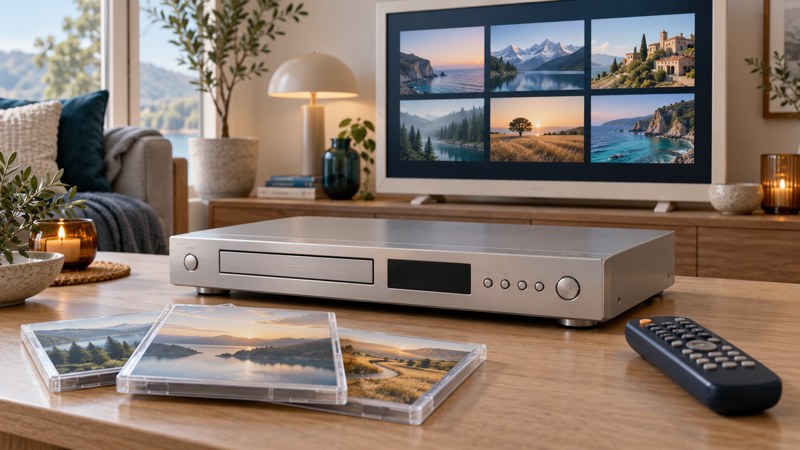
Older TiVo DVD combinations unite a DVR, a disc player and, on some models, a DVD writer. Identify those functions separately. If you own one with valuable recordings, document its current working state before changing setup; if you are buying one, resolve its exact service status before paying.
Identify a writer, a player or a DVR
| Equipment family | Example model numbers | Distinction to verify |
|---|---|---|
| Humax DVD writer with TiVo | DRT400, DRT800, DRT2000 | The DRT writer family differs from Humax’s T-series DVRs. |
| Toshiba DVD writer with TiVo | RS-TX20, RS-TX60 | DVD writing is an explicitly identified function. |
| Other TiVo/DVD combinations | Pioneer recorder and Toshiba player families | Read the exact table entry; a DVD player function alone does not imply writing. |
TiVo’s Series 3-and-earlier model table distinguishes these families. Use the rear label and TiVo Service Number (TSN) to resolve the exact device. Keep the full TSN private when posting public photographs or asking a public forum for help.
A successful disc-playback demonstration does not establish working program-guide downloads, a transferable service plan or the ability to burn recordings. Ask for the particular function you intend to use.
Resolve service status with the exact device
TiVo’s activation guidance asks buyers to establish the existing service status and describes ownership-transfer arrangements. Its general instructions do not promise that every legacy model or inactive TSN is eligible for a new plan.
Before a used purchase, ask the owner for the displayed model/service information and ask TiVo support to confirm the proposed ownership change for that device. Resolve these questions:
- Is the device currently associated with an active plan, and what precisely transfers?
- Can this TSN be activated or transferred under the current rules?
- Which functions depend on a successful service connection?
- Will the intended TV provider/source work with the recorder’s inputs and control method?
- What happens to existing recordings if setup or ownership is changed?
Record the answer and date. An old advertisement’s “lifetime” language is insufficient evidence of a particular transaction’s eligibility. This guide makes no blanket claim that all Series2 recorders are fully usable or unusable.
Understand the historical Save to DVD workflow
The archived HUMAX DVD Recorder user guide, reproduced by Manualzilla, documents saving completed, eligible programs from Now Playing to DVD-R or DVD-RW. It describes automatic finalization at the end of recording and warns that reusing a DVD-RW erases its existing content. Check the guide against your recorder before applying it.
- First verify the recording on the HDD and retain a note of its title and duration.
- Use a new blank of a format listed for the exact recorder, with sufficient capacity.
- For the documented HUMAX interface, open the program’s information and choose Save to DVD or VCR → Save to DVD.
- Review the selected program, disc title and capacity on the confirmation screen before starting.
- Allow the operation to finish, then test the resulting DVD in a compatible second player.
That manual describes restrictions on which recordings can be saved. Treat an unavailable command or restriction message as a reason to consult the model’s instructions, not as a prompt to reset the DVR.
Keep a preservation record
For each important home recording, note the title, duration, source, current playback condition, attempted transfer method and where a checked copy exists. The recording inventory worksheet can be used with any recorder; its blank fields keep device-specific decisions explicit.
Check the new disc’s menu, a later chapter, the ending and sound. If you also create a computer copy through a documented permitted workflow, open the file and check its duration and synchronization. Retain originals while practical and keep separate copies of irreplaceable personal material.
For recordings that play but cannot be written to disc, investigate the exact model’s documented output or export options, or consult a transfer specialist. A USB connector can have an accessory or networking purpose; it does not establish that recordings appear on a computer as ordinary files.
Use a symptom-led checklist
| Observation | Next step |
|---|---|
| Plays DVDs but guide/recording functions fail | Record the service status, last successful connection and exact error; check that function with TiVo support. |
| No Save to DVD choice | Confirm a DVD-writer model, eligible completed recording and the exact manual’s menu route. |
| Disc writing fails | Check supported blank format, capacity, drive behavior and the displayed error. Keep the HDD recording. |
| Recorded disc fails in another player | Check completion/finalization and that player’s support; compare a known-good compatible disc. |
| Setup suggests clearing information | Pause until the effect on recordings and service configuration is understood. |
The most useful next action is often a precise inventory and support question. Preserve the current state so a later repair or transfer has the best available starting point.