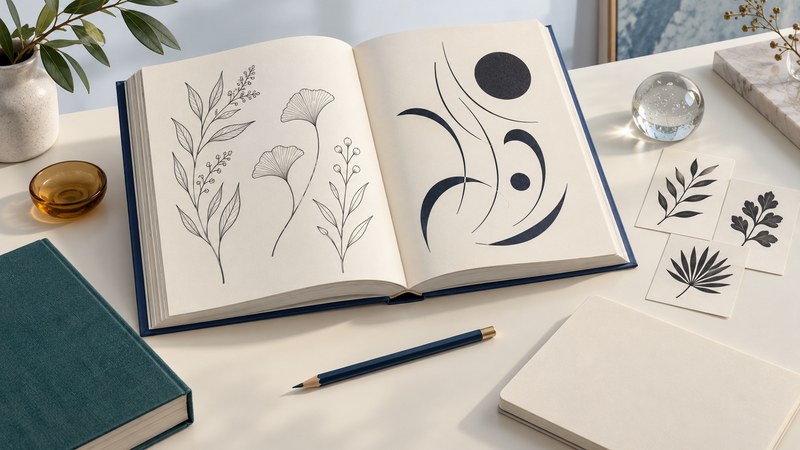
A useful tattoo reference tells an artist what you respond to: a subject, a sense of movement, a balance of dark and open areas, or a relationship to the body. Books help you slow down, compare examples, and put those preferences into words.
Start with the question you want a book to answer. Historical understanding, a survey of an artist's work, and a sheet of available designs call for different kinds of reference. Bring the resulting brief to a consultation so the artist can discuss what is practical at your intended size and placement.
Choose the kind of reference you need
| Reference | Useful for | Inspect before choosing |
|---|---|---|
| History or museum study | Understanding a practice in its place and period | Named authors, source notes, dates, communities, and image captions |
| Artist monograph | Following one maker's visual decisions | Clear attribution and enough complete works to see recurring choices |
| Flash collection | Studying a set of prepared designs | Who made the designs and what permission or booking terms apply |
| Photographic survey | Comparing scale, placement, and composition | Consistent images, captions, and a distinction between fresh and healed work |
One identifiable starting point is 1000 Tattoos, edited by Henk Schiffmacher and Burkhard Riemschneider. TASCHEN identifies the multilingual hardcover as ISBN 9783836549929, with historical designs and photographs. Use it to compare visual approaches and ask historical questions. It is a broad survey; follow a culturally specific question into sources from the relevant community.
A different route is TASCHEN's introduction to Henk Schiffmacher's private collection, covering tattoo artifacts and designs from the 1730s to the 1970s. Check the exact edition, dimensions, language, and sample pages when borrowing or buying: books with similar titles can have different formats. These are research starting points, not a ranking of the best books.
A library copy can be especially useful at this stage. Read the introduction and several captions before choosing images. Ask whether the book explains how it knows what it claims, whose perspective it represents, and where the reader can learn more.
Read a picture beyond its subject
For each reference, record the maker, book title and page or original URL, and the specific quality you like. “The open space around the leaves” gives an artist more direction than “something like this.” Keep source information even when a picture is saved into a private mood board.
- Scale: look for enough of the body to understand the design's size. Ask for dimensions if a tightly cropped image makes them unclear.
- Placement: notice how a composition follows a curve or changes with posture. Treat a flat drawing as an idea to adapt.
- Image conditions: compare light, saturation, contrast, and retouching. Ask for ordinary photographs when dramatic editing makes the result hard to judge.
- Time: ask whether a photograph shows newly completed or healed work, and how long after the session it was taken.
- Context: preserve explanations of names, symbols, and community connections. Ask a knowledgeable practitioner when a design carries significance beyond its appearance.
A printed picture gives you something to discuss; it does not establish permission to reproduce a design. Ask the artist about the use of their own flash and about creating a new composition from your references. For lettering in a language you do not know, arrange independent checking by a fluent reader before final approval.
Build a brief with choices and flexibility
- State the subject. Describe the main idea in one sentence, including any meaning you want to share.
- Describe placement and size. Give a body area and a rough height and width, with units. Mark these as starting points for the artist's advice.
- Choose visual qualities. Name two or three priorities such as spacious composition, a strong silhouette, or restrained color.
- Explain each reference. Say what to learn from it and what should be different.
- Identify constraints. Mention existing tattoos, clothing considerations, a budget with currency, and scheduling limits.
- List open questions. Ask what size, detail, and placement changes the artist recommends and why.
Separate essentials from preferences. That distinction lets an artist propose a stronger composition while preserving what matters to you. The first tattoo consultation guide covers portfolio assessment, appointment questions, and agreeing on the next step.
Worked example: a botanical reference brief
This brief makes the reference useful without demanding a tracing. The measurements are invented planning inputs, not a technical recommendation about a minimum tattoo size. The artist's response should explain the choices for this particular design.
Take a one-page brief to the conversation
Download the printable tattoo design brief (PDF, one page), or use the plain-text version. Fill it in after choosing a few references. Leave space for the artist's suggestions and record the next step before you leave.
The worksheet is a planning aid. Keep personal health details for the studio's appropriate intake process and a clinician when needed. For another way to explore design and tradition, read the mehndi guide, or return to Body Art.
Reviewed October 6, 2026. Sources are linked beside the topics they support.