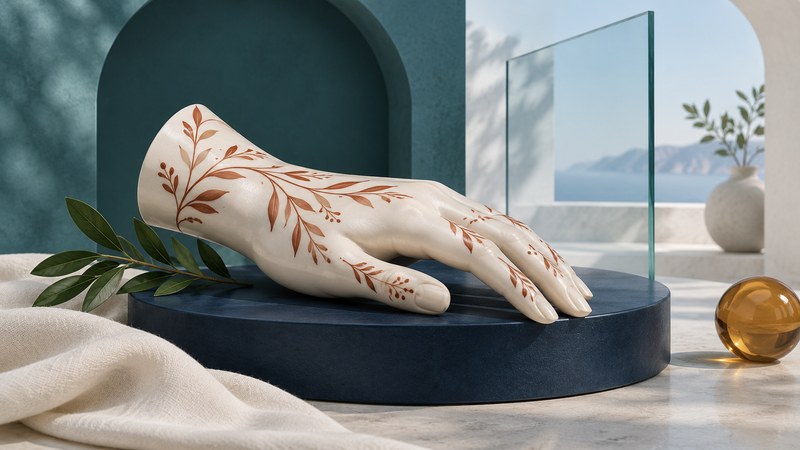
Mehndi brings together a material, an artist's skill, and the meaning of an occasion. Begin with the tradition you want to understand and the design you want to discuss; then establish exactly what product would touch your skin.
This guide helps you prepare for a conversation with an artist. It covers cultural context and planning, with U.S. regulatory information identified separately. A beautiful portfolio and a familiar ingredient name answer different questions.
Start with a place, community, and occasion
Henna is a plant-derived colorant; mehndi commonly refers to the adornment made with it, particularly in South Asian contexts. Designs can carry family associations as well as visual appeal. Ask an artist how they learned, which traditions inform their work, and which elements are their own contemporary interpretation.
The Smithsonian's introduction to Indian wedding henna describes both decorative and symbolic roles. Treat such an example as a view into a particular setting. A motif's meaning can depend on the people and occasion; a caption that says only “traditional” leaves much to discover.
UNESCO's 2024 henna inscription documents rituals and social practices across participating communities in North Africa and the Middle East. Its account connects adornment with celebration and the passing of knowledge between generations. That record offers one substantial regional perspective within a wider subject.
For a more personal view, the Smithsonian's account of the Emirati Lest We Forget project shows how a wedding henna pattern can become a way of sharing memory. When collecting references, keep the artist's name, place, and explanation with the image.
Ask what is in the product
According to the FDA's henna and temporary-tattoo fact sheet, henna usually produces brown, orange-brown, or reddish-brown color. Products sold as “black henna” may contain p-phenylenediamine (PPD), which can cause dangerous skin reactions. Even brown products can contain added ingredients.
Before booking, request the full ingredient information and the product's maker. If a paste is mixed by the artist, ask about every ingredient and the source of the materials. A claim about color or speed is less useful than a clear answer about composition. If those answers are unavailable, choose another way to mark the occasion.
Discuss previous reactions to hair dye, temporary tattoos, or cosmetics with a clinician before considering a product. A home trial cannot establish that an unknown mixture is safe. This guide does not provide a paste recipe or recommend testing black-henna products.
Turn inspiration into a workable design
Bring a small group of references and explain what interests you in each: open space, a flowing arrangement, dense detail, a border, or an asymmetrical composition. Ask for an original interpretation that suits the chosen area and the artist's practice.
- Placement: describe what should be visible with your event clothing and in photographs. Discuss both the resting position and ordinary movement of the hands or feet.
- Detail: ask to see a design at approximately its intended size. A close-up image on a phone can make a very small detail appear much larger than it will be.
- Meaning: ask about motifs connected to a specific community or ceremony. Use the maker's explanation rather than assigning a universal meaning from an image search.
- Timing: give the artist the event and photography schedule. Ask when application would occur, what the expected color changes are, and how long the visible design may remain.
Request photographs taken at identified stages after application. A photograph of paste still on the skin answers a different question from a photograph of the resulting stain. Ask which stage the sample shows and how conditions compare with your plans.
Bring these questions to the appointment
- What are all the ingredients, and who made the product?
- Which parts of the design are traditional, personal, or newly invented?
- Can I see examples with the time since application identified?
- How much appointment time does this design need, and what will it cost?
- What care instructions and contact details will I receive in writing?
- May I decide separately whether photographs of me are taken or shared?
Record the answers with the event date. If you need the decoration to disappear at a precise time, discuss that requirement before choosing a stain-based approach. The temporary body art comparison helps distinguish paint, transfers, and henna.
If the skin reacts
Seek medical advice for a concerning rash, blistering, or worsening discomfort. Trouble breathing, chest tightness, dizziness, or a severe reaction needs immediate medical care. The American Academy of Dermatology's reaction guide explains warning signs. Keep product details and photographs of the reaction to share with the clinician.
For more ways to understand the subject, explore the body as an art medium or return to the Body Art guides.
Reviewed October 6, 2026. Sources are linked beside the topics they support.