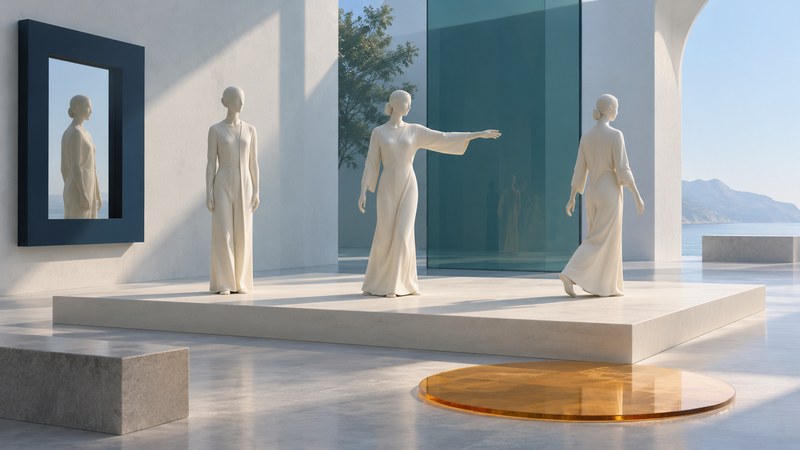
When an artist works with the body, posture, movement, stillness, sensation, and encounters with other people can become artistic materials. Time matters because a gesture develops, repeats, or ends.
Body art can also mean adornment such as tattoos and henna. This guide focuses on art in which bodily action or experience helps constitute the work. It offers a way to look at a live event, a photograph, a recording, or a museum account without assuming that each gives the same access to the experience.
Start with what happens
Before deciding what a work means, describe what you can observe. Who is present? What changes? Which actions repeat? How close can a viewer come? Is the audience watching, moving, making a choice, or helping create the event?
Use five questions to organize your attention:
- Action: what does a person do, and what makes that action noticeable?
- Duration: how long does it continue, and what would change if it lasted only a moment?
- Space: how do the room, landscape, objects, and distance between people affect it?
- Participation: what choices are offered to performers and viewers, and what boundaries govern them?
- Record: how is the event preserved or described, and what can you learn from that form?
A work can use an ordinary gesture to make attention itself visible. Another may use objects to change how a participant senses space. These questions help you compare the choices before reaching for a broad label such as “provocative” or “interactive.”
Three ways to look
Presence and duration: Marina Abramović
MoMA's 2010 retrospective The Artist Is Present brought live performance together with photographs, recordings, and re-performances of earlier work. The museum's audio discussion of the title performance provides the artist's perspective on the encounter with a visitor.
Use this example to ask what sustained attention does. Consider the difference between watching a brief clip and sharing a room for an extended period. An interpretation might focus on intimacy, discomfort, patience, or the social expectation to respond; connect your reading to an observable feature and distinguish it from the artist's stated intention.
Participation and touch: Lygia Clark
MoMA's account of Lygia Clark describes her Bichos as movable metal sculptures whose forms change through handling. Her later participatory propositions developed the relationship between objects, action, and bodily experience. This gives a different entry point into the subject: a participant's choices can help make the work happen.
Ask how a change in orientation changes your understanding of an object. In a museum, follow the current display's instructions: a history of participation does not give visitors permission to handle every object. A replica, a demonstration, and an original sculpture can have different roles.
Body and place: Ana Mendieta
In its discussion of Ana Mendieta's Silueta works, MoMA connects the body-shaped forms with landscape. The museum's artist record provides dated works and further viewing.
Look at the relationship between a bodily outline and the material around it. Ask how the impression of presence changes when the person is absent. A reading about belonging or impermanence should grow from a particular image and its documented context; the same outline can produce different effects in different settings.
These examples open different questions. They offer starting points for close looking, rather than a complete history or a claim that all body-based art follows one tradition.
Read the record as carefully as the action
| What you encounter | What it lets you inspect | What to establish |
|---|---|---|
| A photograph | One viewpoint, a gesture, a spatial arrangement | Photographer, date, caption, and the moment selected |
| A recording | Sequences, repetition, sound, and visible reactions | Duration, camera position, edits, and whether it is an excerpt |
| Instructions or a score | The proposed conditions and choices | Which realization you are studying and what varied |
| A live presentation | Your own position in time and space | Who performs, the participation rules, and the relation to earlier versions |
Check the medium in the catalog record. A photograph may be an artwork in its own right, a record of an action, or part of a larger installation. Read the artist and curator's account before deciding which role it has. Likewise, a later performance can interpret a set of instructions under new circumstances.
Use museum image links to inspect the actual works. The conceptual illustration at the top of this guide is a visual introduction, separate from the historical works discussed here.
Try a short looking exercise
Choose one museum-linked work above and spend a few minutes with its image or recording. Make three short notes:
- Observation: one thing you can point to in the image, sequence, or catalog record.
- Interpretation: a possible meaning connected to that observation.
- Question: one detail you need another source to establish.
Then read the museum text and revise one note. Keep your observation separate from an inference about a person's emotions. This small distinction makes discussion more precise while leaving room for more than one supported interpretation.
Follow the question that interested you
For gesture and audience relationships, follow the MoMA exhibition and artist records. For adornment and cultural occasions, explore henna traditions and design. For another route into close looking, browse the Art collection.
Return to Body Art for all six guides to personal expression, practical choices, and interpretation.
Reviewed October 6, 2026. Sources are linked beside the topics they support.