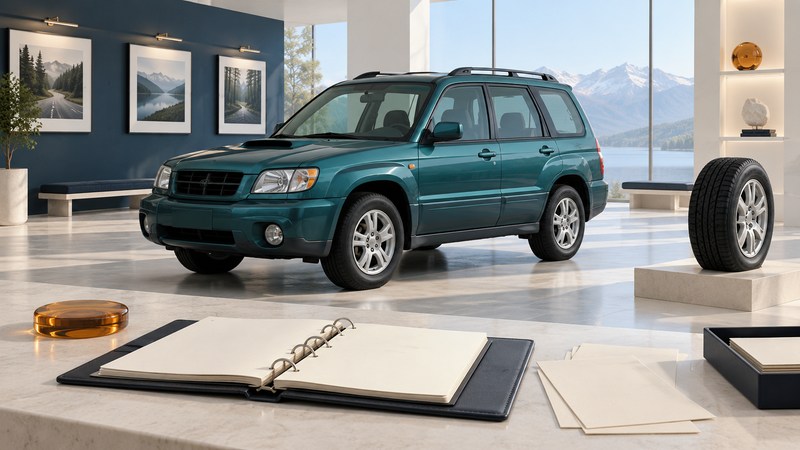
Start a 2006 Forester assessment by distinguishing the naturally aspirated 2.5 X family from the turbocharged 2.5 XT Limited, then identify the transmission and equipment. Use that identity to organize the right maintenance records and commission an inspection of the actual car.
This guide concerns U.S.-market 2006 Foresters. Other markets use different trim names and specifications. For a vehicle of this age, a clear service timeline is often more useful than a long list of original accessories.
Identify the version before comparing listings
Subaru's U.S. 2006 full-line brochure (archived original publication) separates the main Forester versions as follows. Verify the VIN, transmission and installed equipment against the individual vehicle.
On a narrow screen, scroll the table sideways. Keyboard users can focus the table region and use the arrow keys.
| Version | Factory distinction | Evidence to request |
|---|---|---|
| 2.5 X, including Premium Package | Naturally aspirated 2.5-liter engine; five-speed manual or four-speed automatic. | Exact package, transmission, maintenance file and fitted accessories. |
| 2.5 X L.L.Bean Edition | Naturally aspirated 2.5-liter engine; four-speed automatic. | Equipment condition, transmission history and documented repairs. |
| 2.5 XT Limited | Turbocharged 2.5-liter engine; five-speed manual or four-speed automatic. | Turbo/engine service, any software or hardware changes and the correct maintenance references. |
Confirm major replacement assemblies and modifications separately. A hood, badge or interior can be changed; the inspection and records should establish what is fitted now. Assess the features you will use, including air conditioning, windows, locks and any fitted sunroof.
Build one maintenance timeline
Collect invoices, owner notes and available workshop history. Sort them by date and odometer reading, keeping miles and kilometers explicit. Separate completed work from recommendations and parts purchases. Record the source of every entry so another person can check it.
The 2006 Forester owner manual's maintenance chapter (archived copy) directs oil/filter and several other replacement intervals to the separate Warranty and Maintenance Booklet and identifies conditions requiring more frequent oil service. Obtain the matching U.S. 2006 booklet and any applicable updates through Subaru's owner resources or a retailer. If the online documents are unavailable, request the correct publication using the VIN, year and engine version.
With the booklet in hand, copy each applicable service item's time and mileage requirement, conditions and footnotes into the record. Ask a Subaru-qualified provider to resolve unclear applicability. Use the actual schedule's basis for calculating the next due point; a service based on vehicle age or total mileage can differ from one measured since replacement. Record both date and odometer, then act on whichever applicable limit comes first.
Include oil and filter, cooling-system service, spark plugs, transmission and differential fluids, brakes and timing-belt history in the document review. Have the provider identify the correct schedule and any catch-up work for this engine. A modern Subaru schedule or a generic shop menu leaves the 2006 requirements unverified.
Turn missing records into answerable questions
Use three statuses: documented, claimed and unknown. “Documented” needs an invoice or other useful evidence identifying the work and date. “Claimed” preserves what a seller reports while you seek support. “Unknown” becomes a task for the inspector or servicing provider.
For past engine or cylinder-head work, ask what problem prompted it, which operations and parts are itemized, and what follow-up occurred. Let the current inspection establish leaks, cooling behavior or other findings. A repair label alone gives too little information to value the work.
Brief an inspector familiar with this Forester
Arrange an independent inspection and written report, as recommended in the FTC's used-car guidance. Give the provider the timeline and ask for particular attention to:
- Tires and AWD: identify all four fitted tires and measure condition. Subaru's 2006 manual's tire guidance (archived copy) requires matching specified tire characteristics. Have the provider assess the set against that guidance and explain any replacement plan.
- Engine and cooling: document leaks, coolant-loss or overheating history and any tests justified by symptoms. For the XT, include the fitted turbo system and modification evidence.
- Transmission and chassis: assess clutch or automatic operation as fitted, driveline behavior, steering, brakes, suspension, corrosion and prior collision repair.
- Equipment and changes: check restraints, warning indicators, cabin functions and the compatibility of altered wheels, suspension, exhaust or electronics.
Check Subaru's recall resources and NHTSA's lookup, then ask Subaru to reconcile older campaigns and completion history. NHTSA's VIN search has limits for older and already-repaired recalls; keep the manufacturer's follow-up in the file.
Convert the findings into an ownership plan
Ask the provider to distinguish immediate safety concerns, diagnosed repairs, scheduled maintenance and unresolved questions. Assign a next action and estimate to each. Record the manual or service-document reference behind the maintenance plan so a later owner can understand the decisions.
Compare candidates on their condition, service support and the work required to make them suitable for your use. An inexpensive car with a large unverified maintenance gap may need more investigation before its total cost is clear. A detailed file helps you decide what to do next and gives future service visits a reliable starting point.
Download the Forester maintenance-evidence worksheet. Use the inspection guide to arrange the appointment, the motor-oil guide to compare specifications, and the sunroof guide when that equipment is fitted.
Explore Autos: vehicle guides, technology and design · Cars: buying, maintenance and ownership