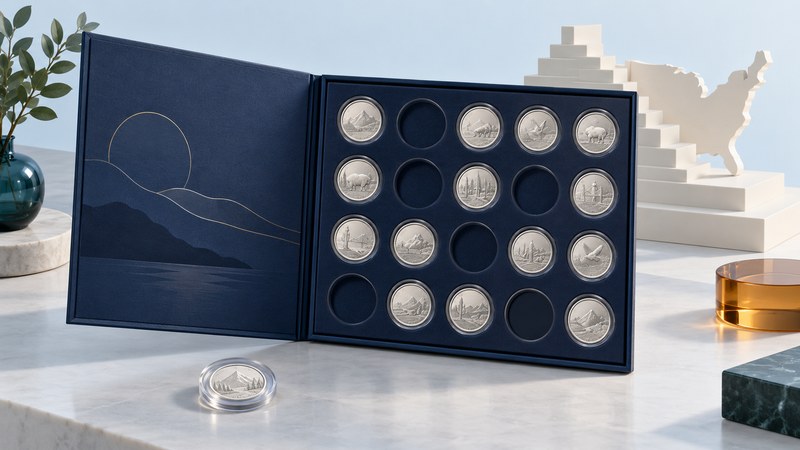
A complete State Quarters collection begins with a definition: one coin for each state, or separate examples from particular mints and finishes. Use the 1999–2008 issue sequence below to track progress and keep later quarter programs in their own groups.
Define what “complete” means for your collection
The U.S. Mint's 50 State Quarters program issued five state designs per year, beginning with Delaware in 1999 and ending with Hawaii in 2008. The sequence followed constitutional ratification or admission to the Union. Washington, DC and the five U.S. territories received a separate six-design program in 2009.
For a first collection, one circulated example of each of the 50 designs creates a clear goal. A Philadelphia-and-Denver set adds a mint-mark requirement and needs 100 coins. Proof and other collector versions introduce additional distinctions; choose those deliberately after learning their issue specifications.
The complete issue sequence
This is the order of the state designs, grouped by issue year. The full checklist provides separate spaces for a one-per-state goal and optional P/D tracking.
| Year | State designs in order |
|---|---|
| 1999 | Delaware, Pennsylvania, New Jersey, Georgia, Connecticut |
| 2000 | Massachusetts, Maryland, South Carolina, New Hampshire, Virginia |
| 2001 | New York, North Carolina, Rhode Island, Vermont, Kentucky |
| 2002 | Tennessee, Ohio, Louisiana, Indiana, Mississippi |
| 2003 | Illinois, Alabama, Maine, Missouri, Arkansas |
| 2004 | Michigan, Florida, Texas, Iowa, Wisconsin |
| 2005 | California, Minnesota, Oregon, Kansas, West Virginia |
| 2006 | Nevada, Nebraska, Colorado, North Dakota, South Dakota |
| 2007 | Montana, Washington, Idaho, Wyoming, Utah |
| 2008 | Oklahoma, New Mexico, Arizona, Alaska, Hawaii |
Open the printable 50 State Quarters checklist. It contains all 50 states on two print pages, instructions, and the Mint source. Save it for offline use or print it; use the “Any” column for a one-per-state collection and the P/D columns only if that is your chosen goal.
Identify the issue and mint mark
Read the state name and issue date on the reverse, then examine the obverse for the mint mark. The designs include statehood dates as well as their issue years, so copy the correct date into your record. Confirm an unfamiliar example against the Mint's design illustrations rather than relying on a seller's abbreviated title.
A worn circulation coin, an uncirculated example, and a proof can show the same state design while belonging in different comparisons. For a proof or silver offering, match the coin to its official set information and original packaging. Surface brightness by itself is a poor shortcut for identifying a finish or metal composition.
Use a magnifier to describe visible marks. If you suspect an error or variety, retain clear photographs of both sides and the feature in question, then seek a series-specific reference or professional opinion. A scratch, displaced metal, or worn color can have several explanations. Label your observation before labeling its cause.
Fill gaps without losing track of the goal
- Sort existing coins by state, keeping duplicates in a separate group.
- Check mint marks only to the level your collection requires.
- Choose the example you prefer for each slot and record its condition.
- Make a short missing-state list before trading or buying.
- Record any paid acquisition, including currency and delivery costs.
When trading, agree on the exact state, mint mark, and acceptable condition beforehand. For a mailed purchase, ask for photographs of the actual coin if its condition matters to you. A generic design image identifies a type, while an item photograph documents the offered example.
Buying a complete set can be convenient, but check the inclusion list against your own definition. A “50-state set” may satisfy one-per-design collecting while leaving a P-and-D album half empty. Count the slots and the coins before comparing offers.
Keep price comparisons specific
Compare the same issue, mint mark, finish, condition, and packaging. Use completed sale evidence and record the sale date, fees, and currency. A very high listing price tells you little about what buyers actually paid. A claimed error premium needs evidence identifying the particular variety and its condition.
For example, an ordinary circulated quarter and a certified proof are different objects for valuation even when both show the same state. Separate your acquisition cost from an estimated resale value in your records. A hobby collection can be worthwhile because of the history and search, without a forecast of appreciation.
Store the collection so you can enjoy it
Choose an album or individual holders that fit your goal and protect the coins. Follow the Mint's storage guidance on acid-free materials, PVC-free plastics, and a stable, dry environment. Handle coins by the edges and leave them unpolished. Keep proof-set cases and documentation with the set.
Record where duplicates and better-condition replacements are stored. A completed checklist should describe a collection you can actually locate and review. Continue with the beginner coin-collecting guide for an item record, or explore Canadian poppy coins for a different commemorative collecting theme.