Start a coin collection with one clear idea, a few coins you already own, and a record of what you learn. A small, well-documented collection can teach you more than an expensive assortment bought without a plan. This guide walks from choosing a theme to making a considered first purchase.
Choose a collection you can describe in one sentence
Try “one quarter from each state,” “coins showing birds,” or “coins from places my family has visited.” Decide what counts as a complete item: one design, each date, or each date and mint mark. That boundary gives you a useful want list and makes it easier to pass on unrelated purchases.
The U.S. Mint's starting guide describes themes based on country, denomination, mint mark, finish, period, design, and artist. Choose a subject you enjoy researching. You can expand the boundary after learning what is available.
- Gather five to ten coins you can examine without buying anything.
- Choose a theme and write its completion rule.
- Set a hobby spending limit that includes holders, postage, and references.
- Make a list of what you have and what you still need.
A 50 State Quarters collection is a manageable example: a one-per-state goal and a Philadelphia-and-Denver goal produce different shopping lists.
Read a coin before assigning a value
Use good light, a magnifier, and a soft work surface. Record the country or issuing authority, denomination, date, and any mint mark. Photograph both faces and the edge where it can be seen safely. The obverse is the principal face, often bearing a portrait; the reverse carries the other main design. A mint mark identifies a mint, while a designer's initials identify a different part of the coin's history.
Compare the coin against an official issue page or a specialist reference for that series. A coin's date may commemorate an event, so read the full design and reference description. If a feature is unclear, record “unread” and keep the photograph. A question mark preserves useful uncertainty.
| Distinction | What to record | Why it matters |
|---|---|---|
| Identity | Issue, date, denomination, mint mark, variety if established | Similar designs can belong to different issues. |
| Manufacture | Circulation strike, proof, or other documented finish | A proof is a production category; a shiny surface alone does not establish it. |
| Condition | Visible wear, scratches, spots, damage, and any professional grade | Two examples of the same issue may have different collector appeal. |
Give each coin a record that stays with it
Assign a simple item ID, such as C-001. Put that ID on the holder or storage label, never on the coin. Link it to photographs and receipts. Record the acquisition source and date, price and currency, observed condition, and storage location. Keep a seller's claim separate from your own observations or a grading-service result.
Open the printable coin inventory record. Save the page for offline use or print one record per item. It includes a completed example and a blank form. Review your records before buying another example so an intentional upgrade stays distinct from an accidental duplicate.
Protect the surface and the accompanying evidence
Handle coins by their edges over a soft surface. Leave potentially collectible coins unpolished and seek specialist advice before attempting treatment. Store them individually in holders intended for coins; the U.S. Mint's care guidance recommends acid-free materials, PVC-free plastic, and a cool, dry environment. Keep original cases, information cards, and certificates together with the item's record.
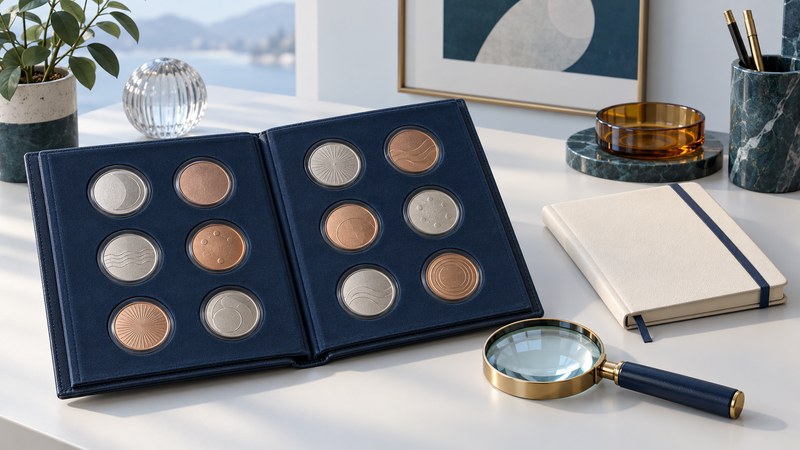
Choose storage for how you use the collection. An album makes a defined series easy to review; individual holders suit mixed sizes or a collection arranged by theme. Check that the coin fits without pressure, and inspect stored pieces periodically for changes. Record any change before deciding on a response.
Make a first purchase you understand
Take your want list and reference to a dealer or club meeting. Ask the seller to identify the exact issue, explain condition concerns, show both sides, and state the return terms. Compare completed transactions for matching items when considering price, including fees and differences in condition. An advertised price is one seller's request.
Professional grading has costs and a defined service scope. Before submitting a modest coin, compare the complete fees and shipping with your purpose: authentication, protection, sale, or personal study. For unusual rarity claims, follow the evidence approach in the 1913 Liberty Head nickel guide. The ANA collecting FAQ offers further education and storage guidance. A successful early purchase is one you can identify, explain, record, and comfortably afford.