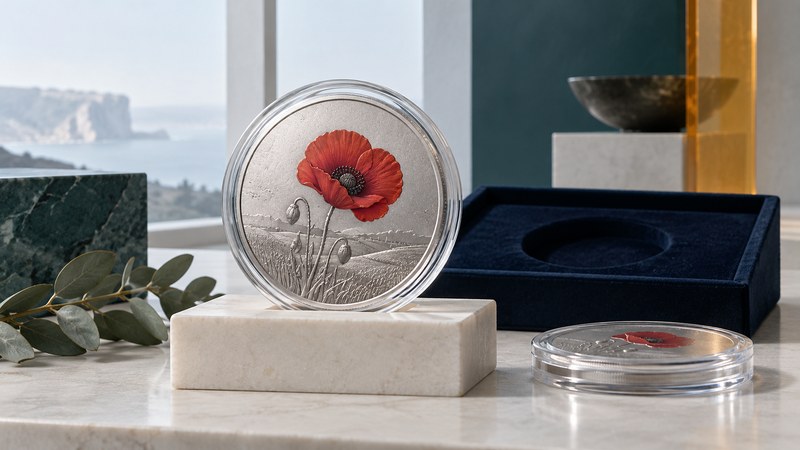
Canadian poppy coins combine a remembrance symbol with several distinct collecting formats. Identify the date, denomination, metal, finish, and packaging before comparing two examples. A red poppy alone is not enough to establish which issue you have.
The 2004 circulation milestone
The Royal Canadian Mint describes the 2004 25-cent poppy as the world's first coloured circulation coin. Its 2004 annual report records the issue's introduction and distribution partnership with Tim Hortons. This history explains why a coin designed for everyday change also became a saved commemorative object.
The red poppy links the design to remembrance. The collector's first task is to distinguish that design story from the identity of a particular product. A circulated quarter, a specially packaged example, and a precious-metal collector coin can share a theme while having different specifications and collecting appeal.
Read the whole item
- Photograph both faces and record the date and denomination exactly.
- Describe the poppy design and any visible color loss or surface marks.
- Record whether the coin is loose, in a capsule, or in original packaging.
- Copy the product number and certificate information where supplied.
- Compare against the Mint record for that exact issue and product.
Keep separate fields for the coin and the package. Packaging can identify a particular offering, but a loose coin needs evidence from the coin itself. If a seller supplies only a stock image, ask for photographs of the actual item and all accompanying material before comparing condition.
| Mint product | Recorded specifications | How to use the record |
|---|---|---|
| Official First Day Poppy Coin, product 1095 | 25 cents; multi-ply plated steel; 4.4 g; circulation finish; specially packaged first-day production coin | Compare the coin and its cover as a complete product. |
| Annual Report, Selectively Gold Plated Poppy, product 1053 | 25 cents; 92.5% silver and 7.5% copper; 5.9 g; proof finish | Keep this collector product distinct from the steel circulation issue. |
Sources: the Mint's first-day product record and silver proof product record. These archived listings document specifications; they are not current purchase offers.
Keep edition size, production, and rarity separate
The first-day packaged product record lists 67,672, while the silver proof product record lists 15,000. Those numbers belong to those offerings. Applying either number to every 2004 poppy quarter would mix different populations.
A production figure can also describe a calendar year's output, coins bearing a date, or a packaged edition. Copy the source's definition along with the number. A small announced edition does not establish how many survive in a particular condition or how much demand exists for them.
The Mint's 2008 annual report includes a later poppy circulation issue. Check the date on the coin before using a 2004 reference. For a collection spanning several issues, make a separate entry for each dated design and product format.
Describe the color and surface without altering them
Photograph the poppy under even light and again at a slight angle. Record missing color, wear, scratches, discoloration, and holder damage as observations. A patch of missing color alone cannot establish a mint error; the cause requires additional evidence and specialist evaluation.
Avoid rubbing the colored area or applying cleaners to improve its appearance. Keep a sealed collector product intact while researching it. For general handling and holder selection, the U.S. Mint's coin-care guidance provides a useful starting point, including edge handling and appropriate storage materials. Ask a conservation or numismatic specialist about an already damaged colored surface.
Make a small, coherent remembrance collection
Choose a scope such as one 2004 circulation example, one documented packaged version, or one example from each poppy issue you can verify. Record the source, cost and currency, condition, and storage location. Save certificates and receipts under the same item ID.
The printable coin record works for both circulation and collector products. Add the product number to its identity field and put packaging details in the notes. Continue with provenance and authentication when a sale depends on an exceptional rarity claim.