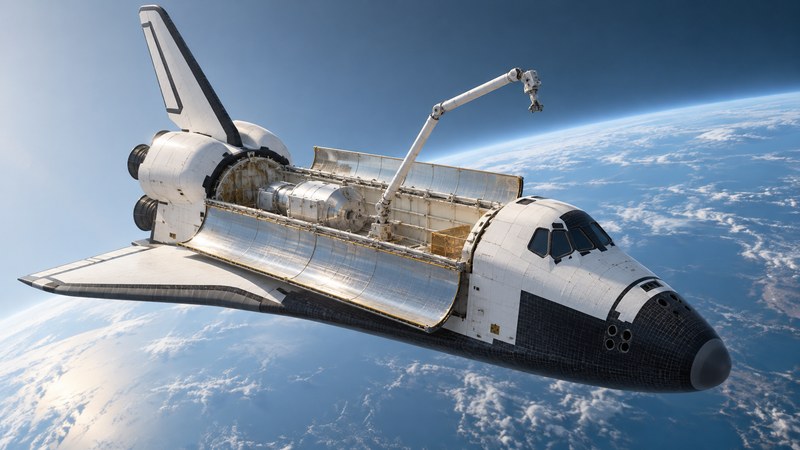
The Space Shuttle combined a launch vehicle, an orbital workplace and a gliding spacecraft. Its defining capability was carrying people and large equipment together, then giving a crew the tools to deploy, assemble, study or repair that equipment in Earth orbit.
NASA's fleet flew 135 missions between the first launch on April 12, 1981, and the final landing on July 21, 2011. The program's historical record includes scientific work, satellite servicing, station construction, and two disasters that are central to understanding its legacy.
Recognize the Shuttle's main parts
The winged orbiter carried the crew, payload bay and three main engines. The large external tank supplied liquid hydrogen and oxygen to those engines during ascent. Two solid rocket boosters provided additional thrust at liftoff. NASA's Shuttle reference describes these components and their roles.
“Reusable” applied to important parts of the system. Orbiters returned to a runway for inspection and preparation for another mission; the boosters were recovered after parachuting into the ocean. The external tank was discarded. Reflight depended on extensive work by people on the ground.
On the orbiter, distinguish the crew cabin at the front from the long payload bay behind it. The bay made large cargo accessible to astronauts and, on equipped flights, the robotic arm. Thermal protection covered the vehicle with different materials suited to different heating conditions. The black underside is a recognizable part of that protection, not a separate propulsion system.
Follow a mission from pad to runway
| Stage | What happens | What to look for in footage |
|---|---|---|
| Launch and ascent | Main engines and solid boosters accelerate the stack; the boosters separate before the orbiter finishes using the external tank's propellants. | The full stack on the pad, then a different vehicle configuration after booster separation. |
| Entering orbit | The main engines shut down, the external tank separates, and orbital maneuvering completes the required trajectory. | The orbiter operating without its launch tank and boosters. |
| Orbital work | Crews operate experiments, deploy or handle payloads, perform spacewalks, or rendezvous with another spacecraft. | Payload bay contents, arm movements and the mission's particular worksite. |
| Deorbit and entry | An engine burn changes the orbit to bring the vehicle into the atmosphere; aerodynamic forces slow it while thermal protection manages entry heating. | A controlled orientation and banking trajectory, followed by increasingly airplane-like control. |
| Approach and landing | The orbiter glides to a runway without powered airplane-style thrust. | A steep approach, landing-gear deployment and touchdown. |
NASA's aeronautics explanation connects these changing flight regimes. In orbit, small thrusters and maneuvering engines controlled motion; during atmospheric flight, aerodynamic surfaces became useful. The wings did their principal work on the return through air.
At landing, the crew managed the vehicle's remaining energy and selected trajectory. A Shuttle was a glider at this stage, as NASA Glenn's glider explanation shows. This is a helpful distinction when comparing a runway landing with an ordinary airliner's approach.
What the crew could accomplish in orbit
Service a telescope. Shuttle crews could meet a satellite, secure it and work on it with specialized tools. Hubble servicing illustrates why carrying astronauts, replacement hardware and an orbital work platform together mattered: servicing could improve or restore capabilities after launch.
Build and supply a station. The payload bay carried major hardware, while robotic operations and spacewalks helped put it into place. Station assembly was a sequence of missions with dependencies: the usefulness of a delivered component could depend on earlier structures, power and connections.
Run experiments. Some flights emphasized laboratory work and observations. Reading the payload list reveals whether a mission's main purpose was science, deployment, assembly or logistics. A photograph of an open bay alone leaves that purpose unclear.
NASA's Shuttle overview provides an accessible account of these uses. The program operated in Earth orbit; lunar landings and robotic exploration of Mars required different vehicles and mission designs.
Achievement, risk and the end of the program
Challenger and its seven crew members were lost during launch on January 28, 1986. Columbia and its seven crew members were lost during reentry on February 1, 2003. NASA's Challenger history and Columbia mission record give the events and their human context.
The accidents involved different physical failures. Challenger's loss followed failure of a booster joint seal; Columbia's loss followed launch damage to the wing's thermal protection. The investigations also examined organizational decisions, communication and how warning evidence was handled. Those dimensions matter alongside the hardware: a program's previous successful flights do not measure every risk in its next flight.
The Shuttle program ended in 2011. Its legacy includes the work it enabled and the demands of maintaining a complex reusable system. When comparing it with another spacecraft, specify the job: delivering a large payload, carrying a crew, returning equipment, servicing an observatory or providing access to a station. Different vehicles answer different combinations of those needs.
How to read a Shuttle mission record
- Record the STS designation and orbiter. A mission identifier is more precise than a photograph caption that just says “the Shuttle.”
- Check the dates. Separate scheduled dates in a press kit from the actual launch and landing in the final mission record.
- State the main job in one sentence. Identify the payload, destination or experiment.
- Identify the working methods. Note robotic-arm operations, spacewalks, rendezvous and onboard experiments where applicable.
- Compare goals with results. A preflight plan describes intended work; a postflight account tells you what was accomplished.
Begin with the mission links and oral histories in NASA's Shuttle history collection. Oral histories add the perspective of participants; mission documentation supplies the chronology and technical context needed to interpret those recollections.
Use a model to explain the real vehicle
With a model or diagram, identify the launch stack, then remove the tank and boosters to show the orbiter configuration. Locate the payload bay and describe one task a crew could perform there. Finish by explaining why the return vehicle needed both thermal protection and wings.
The library also retains older product descriptions for a Shuttle toy, a construction model and a book of astronaut experiences. These describe historical products, with availability and suitability requiring separate checks.
Continue through Space Exploration, or compare crewed Earth-orbit work with the methods used in robotic Mars exploration.