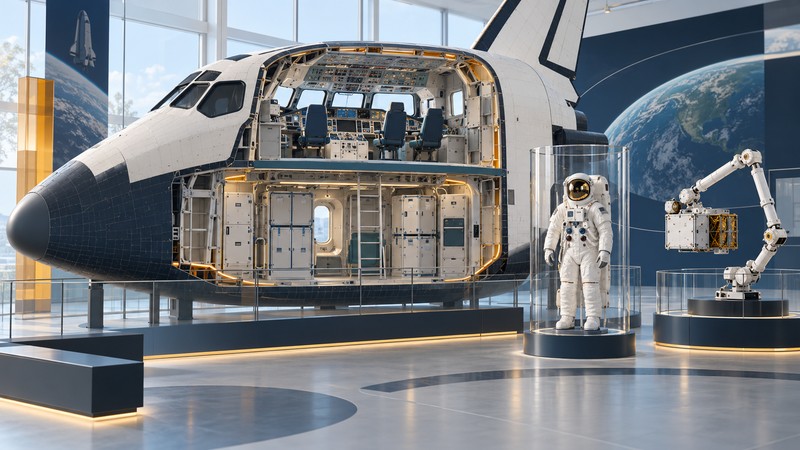
A Space Shuttle crew operated a spacecraft, conducted a mission and shared a compact workplace. Flight duties, experiments, robotics, spacewalks and everyday care of the cabin depended on different skills and carefully coordinated schedules. To understand a mission, follow who was doing each job and what the rest of the team made possible.
The Shuttle flew from 1981 to 2011. Crew arrangements varied with the mission, so a roster is more useful than a single “typical astronaut” description. NASA's Shuttle history resources provide mission records and personal accounts that let you connect roles with actual work.
Read a roster as a division of responsibilities
| Role | Main responsibility | What to look for in a mission record |
|---|---|---|
| Commander | Leadership and responsibility for the vehicle, crew and conduct of the flight. | Flight decisions, rendezvous and the coordination of crew activity. |
| Pilot | Second-in-command duties and assistance with operating the Shuttle. | Vehicle systems and flight tasks assigned alongside the commander. |
| Mission specialist | Mission-specific operations such as experiments, payload handling, robotics or spacewalks. | The actual assignment: several specialists could have very different jobs. |
| Payload specialist | Specialized work associated with a particular payload or experiment program. | The sponsoring organization, experiment and training for that flight. |
NASA's historical astronaut training and assignments overview explains these categories. Its Shuttle-era selection details belong to that period. The table here describes historical flight work, rather than current astronaut application requirements.
Additional labels can describe assignments within a crew. A payload commander coordinated a complex payload program; a flight engineer supported vehicle operations. A person's role in one flight is best read from that mission's documentation, even if a biography highlights a different specialty.
Training rehearsed the handoffs between people
Individual proficiency was one part of preparation. Crews also needed to practice the sequence of work with the flight control team: who would read a procedure, operate a system, confirm a result and communicate a problem. NASA's training overview describes aircraft experience, spacecraft mockups and mission simulations as parts of the Shuttle program.
For demanding spacewalk tasks, rehearsal helped crews discover where a tool, restraint or body position would make the job difficult. The history of the first Hubble servicing mission describes extensive training, including underwater simulations. Buoyancy supported rehearsal of tasks and movement, while real orbital work still had its own physical conditions and constraints.
When you watch a training clip, ask what is being practiced. A cockpit simulator can rehearse responses to vehicle events. A payload mockup can establish reach and tool access. A team exercise can test the timing and clarity of communications. Each activity supplies evidence about a different part of readiness.
STS-61: one repair mission, several linked jobs
During STS-61 in December 1993, Endeavour's crew serviced the Hubble Space Telescope through five spacewalks. Richard Covey commanded the flight and Kenneth Bowersox was pilot. Claude Nicollier operated the robotic arm. Jeffrey Hoffman and Story Musgrave formed one spacewalking pair; Kathryn Thornton and Thomas Akers formed the other.
This division made it possible to coordinate the orbiter, telescope, replacement hardware and people outside. The arm operator positioned equipment and supported the spacewalkers; the flight crew managed the vehicle; the two pairs alternated external work. NASA's mission history traces the tasks and their outcomes.
Try reading one servicing task as a chain of dependencies: the telescope must be secured before an instrument can be removed; the replacement must be accessible; a spacewalker needs a stable work position; the team must confirm installation and restore the work area. A photograph captures one point in that sequence. The full accomplishment belongs to the coordinated crew and ground teams.
The cabin was also a home for the duration of the flight
The orbiter's flight deck held the main flight controls and workstations. The middeck provided living and storage space, with arrangements that depended on the mission. NASA's Shuttle diagrams show the cabin and sleeping locations; its STS-60 account describes the practical routines of life aboard.
Food preparation used a galley, packaged food and available hot or cold water. Trays and restraints helped keep items where crew members needed them. Sleeping arrangements also supported rest in microgravity. The useful question is how the crew organized objects and time when an unsecured item could float away and several people needed the same small area.
Routine work made the scientific work possible. Finding a stowed item, cleaning up after a meal, preparing equipment and protecting time for sleep all competed for attention. Read the mission schedule alongside the dramatic footage to see how much preparation surrounded a brief experiment, arm movement or spacewalk.
A Shuttle flight and a long space-station expedition also differ in duration and work setting. When an astronaut's memoir covers both, note which spacecraft and mission the passage describes before treating it as an example of Shuttle life.
Use personal accounts alongside mission records
- Identify the flight. Record its STS number, orbiter, dates and main objective.
- Map the crew. Pair each person with the role and task discussed in the account.
- Locate the event. Distinguish training, planned activity and what happened in orbit.
- Compare perspectives. A recollection explains experience; a mission record can establish sequence and completed tasks.
- Keep the human context. Workload, teamwork and risk belong alongside the technical achievement.
Start with the history collection linked above and follow a mission that interests you. For the vehicle and flight sequence, read how the Space Shuttle worked. Find related mission and engineering guides in Space Exploration.