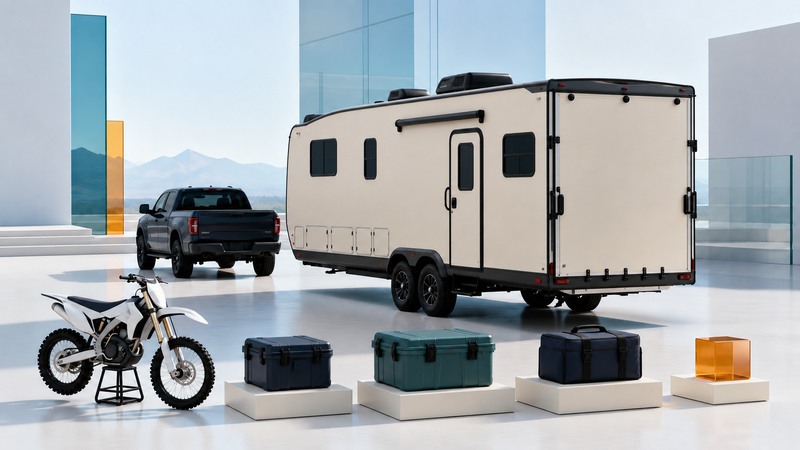
Plan a race-weekend support vehicle around the people, machines, supplies, and facilities the trip requires. Then verify the loaded tow vehicle and trailer against their actual ratings. Garage space, sleeping capacity, and an advertised towing maximum answer different questions.
The examples below concern a pickup and a bumper-pull toy hauler. A motorhome or fifth wheel needs the matching loading and towing documentation. Have the tow-vehicle manual, trailer manual, rating labels, hitch information, and event instructions available before making a load plan.
Define what the support vehicle must do
List the riders, traveling companions, motorcycles, spare wheels, tools, riding equipment, food, water, and overnight needs. For each item, record its mass, where it will travel, and when it needs to be accessible. Include aftermarket equipment that has been added since the vehicle’s original weight information was prepared.
Check the event’s requirements before packing: site dimensions, vehicle passes, arrival windows, hookups, water supply, waste disposal, generator hours, and any restrictions on fuel handling or pit activity. Distinguish a spectator campsite from an authorized service or fueling area. Record the organizer’s contact and the date of any clarification.
This turns “a trailer large enough for two bikes” into a useful requirement: space for the bikes, a supported method of securing them, sufficient rated capacity, and a workable plan for everyone staying at the event.
Read the ratings as separate limits
On a narrow screen, focus this table and scroll sideways to read all columns.
| Limit | Meaning | Evidence to collect |
|---|---|---|
| GVWR | Maximum total loaded weight of the individual vehicle or trailer. | Its certification label and applicable manual. |
| GAWR | Maximum load on an individual axle. | Each axle rating and corresponding scale measurement. |
| GCWR | Maximum weight of the complete loaded combination. | Tow-vehicle documentation for the exact configuration. |
| Tow-vehicle payload | Allowance consumed by occupants, cargo, added equipment, and hitch-supported trailer load. | Vehicle-specific payload label and a complete load inventory. |
| Hitch and trailer limits | Assembly ratings and permitted loading for the components in use. | Receiver, hitch, coupler, trailer, tire, and wheel documentation. |
Ford’s 2024 RV and Trailer Towing Guide explains the distinction between actual weights and ratings and includes trailer tongue load in tow-vehicle cargo. Use the guide for your own vehicle’s year and configuration to obtain the applicable limits. A model-range maximum cannot determine a particular truck’s remaining payload.
Read the trailer’s cargo label definitions too. Water, fuel, batteries, dealer-installed equipment, and later modifications can affect what remains available. Record what your starting weight already includes so each item is counted once.
Worked example: the trailer fits, but the truck is over its payload allowance
Resolve the limiting condition by changing the load or choosing a suitable vehicle, then repeat the checks. Moving weight around can alter axle loads and trailer balance; a revised arrangement needs verification. A larger hitch rating does not increase the truck’s payload rating.
The July 2024 Momentum G-Class travel-trailer manual is a documented example of loading, weighing, and garage guidance and uses approximately 8.3 lb per gallon for water. Apply the instructions and labels for your own trailer.
Verify the configuration you will actually tow
Use a suitable scale and the vehicle, trailer, and hitch manufacturers’ weighing instructions. Record the travel configuration, occupants, supplies, tank levels, and hitch setup with the readings. Obtain the measurements needed to assess each axle and total vehicle weight, as well as the complete combination.
When totaling a combination, count each supported load once. A truck axle reading with the trailer attached already includes the load transferred through the hitch. Adding that reading to the trailer’s entire weight can count the hitch-supported portion twice. Use the scale’s documented procedure and ask for help interpreting the readings.
A combined axle-group reading can also conceal an uneven load between individual axles or tires. Resolve those distribution questions with the equipment documentation and qualified weighing support. Save the accepted load arrangement, and reassess it when a machine, water load, accessory, or storage location changes.
Treat the garage and campsite as working spaces
Use the trailer’s designated securing points, suitable restraints, and the vehicle manufacturer’s transport instructions. Confirm the ratings and permitted use of the ramp, floor, anchors, and any patio arrangement independently. Having room to roll in a motorcycle does not establish those capacities.
The cited Momentum manual warns against sleeping in its vehicle-storage area while motorized vehicles are present and gives explicit fuel, ventilation, appliance, and electrical restrictions. Read the corresponding labels and manual for your trailer before transporting machines or converting the garage for occupancy. Keep fuel handling and generator operation within the equipment instructions and event rules.
Make two plans: the transport arrangement and the parked event arrangement. Name who verifies restraints and loading before departure, who checks the site rules on arrival, and where the crew will meet if plans change. Budget return-trip supplies and waste-tank contents as carefully as outbound cargo.
Use the race-weekend load and event record. It includes the worked example, blank rating and weight fields, and a departure checklist. Complete unknown ratings before treating a load plan as ready.
Related planning
The desert racing tire selection guide helps define the spare-wheel and service requirements you may need to transport. See the rest of the motorsports library.
Researched and updated September 7, 2026. Model, market, equipment, and rule details should be rechecked against the linked documentation.