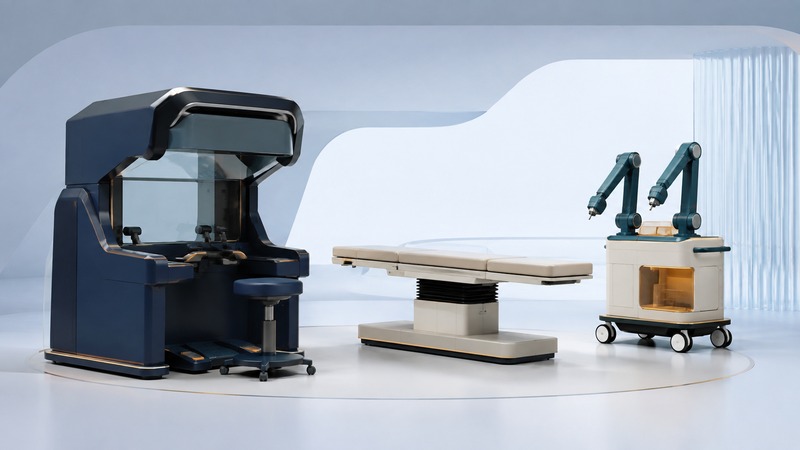
In robot-assisted surgery, the surgeon controls instruments through a computer-assisted system. The equipment can change how the surgeon sees and reaches the operating area. Whether that approach is a good choice depends on the operation, the patient, and the team—not simply on whether a robot is available.
The surgeon remains in control
A typical system includes a surgeon’s console, instruments mounted on arms near the operating table, and a camera view. The surgeon directs the instruments; these systems do not independently decide which operation to perform or conduct it without human control. The FDA explains computer-assisted surgical systems and their intended role.
The console is one part of a larger operating team. Ask who will be at the bedside, who is responsible for anesthesia, and what happens if the planned approach needs to change. Describing the hardware is useful only when it helps you understand the care you will receive.
Robotic assistance is not the same as autonomous AI
The word “robotic” does not establish that a system makes independent clinical decisions. If a hospital describes an AI feature, ask what that particular software does, how it has been evaluated for the intended use, and who checks its output. Do not infer better outcomes from the presence of software alone. The FDA’s description of surgeon-controlled systems is a useful starting point for separating instrument assistance from claims about autonomy.
Compare options for the same operation
On a small screen, scroll the table sideways to read all columns.
| Approach | How it is performed | What the comparison needs to address |
|---|---|---|
| Open surgery | The surgeon works through a larger incision providing direct access. | Why direct access may be appropriate, and the expected recovery for this operation. |
| Conventional laparoscopy | A camera and instruments pass through small incisions; the surgeon manipulates the instruments at the patient. | Whether it offers a suitable minimally invasive option without the robotic system. |
| Robot-assisted laparoscopy | The surgeon controls system-mounted instruments through a console or interface. | Whether the system adds a meaningful benefit over the other suitable approaches. |
The NHS explains laparoscopy, its risks, and the possibility of conversion to open surgery. Small incisions are a feature of both conventional and robot-assisted laparoscopy. Comparing a robotic procedure only with open surgery can leave out another relevant option.
Ask whether treatment without surgery, observation, or another procedure is appropriate for your condition. A discussion of surgical equipment should follow the decision about whether an operation is needed. The American College of Surgeons consultation guide recommends questions about the reason for surgery, alternatives, and the consequences of waiting or declining.
Technical advantages need an outcome that matters
A description such as improved instrument movement or a detailed camera view is a technical claim. A patient benefit is something different: fewer important complications, better function, an appropriate cancer outcome, or a recovery improvement that matters to you. Ask which outcome was measured, over what period, and in people undergoing the same operation.
Study design also matters. If a hospital reports its experience, ask how patients were selected and whether the comparison groups had similar conditions and complexity. A short hospital stay is useful information, but does not by itself answer questions about readmission, persistent symptoms, or longer-term function. Results from one operation or age group should not become a promise for another.
Why procedure-specific evidence can change the answer
For early-stage cervical cancer requiring radical hysterectomy, the National Cancer Institute describes evidence of worse survival outcomes with a minimally invasive approach than with open surgery and identifies open surgery as the standard approach in that setting. This is a specific cancer operation, not a conclusion about every hysterectomy or every robotic procedure. Read the NCI cervical cancer treatment evidence summary. It illustrates why the evidence for your diagnosis must carry more weight than a general claim about smaller incisions.
Invented consultation example: a brochure highlights small incisions, while the alternative offered by another surgeon is conventional laparoscopy. Both may use small incisions. A productive follow-up is: “For this operation, what difference should I expect in complications, recovery, and the outcome we are trying to achieve?” The brochure alone cannot resolve that comparison.
Ask about the team, the fallback plan, and follow-up
Discuss the surgeon’s experience with the exact operation and approach, the team’s training, and what outcome information the service can share. Device training does not replace judgment about the condition being treated. The FDA recommends discussing experience, risks, and alternatives with the surgeon.
Ask about risks from the operation and anesthesia as well as equipment-related problems. Understand when the team might convert to conventional laparoscopy or open surgery, who makes that decision, and how it could change recovery. A conversion plan is part of preparation, not proof that the original choice was necessarily wrong.
- What is the goal of this operation, and what happens without it?
- Which approaches are suitable for me, and why do you recommend this one?
- What evidence supports a benefit for people with my condition?
- What experience does this team have with this exact procedure?
- What could change the plan during surgery?
- What help will I need at home, and whom do I contact about problems?
- What costs, equipment charges, or follow-up services should I clarify with the hospital and insurer?
Request recovery instructions for the actual operation rather than relying on a generic “robotic recovery” timetable. Before deciding, make sure you can explain the expected benefit, the main risks, and the alternatives in your own words. Download surgical-options consultation questions (plain text).
Related resources
- Prepare a portable health summary
- Understand endoscopic examinations and treatment
- Explore the medical category
General educational information, researched September 5, 2026. Use your care team’s instructions for your own health, treatment, and devices.