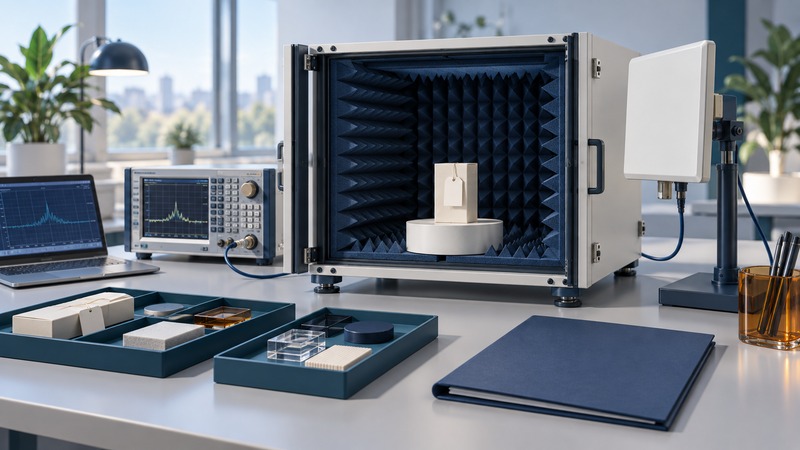
Choose an RFID test lab by the decision its report must support. Selecting an inlay, checking a tagged package, accepting a moving workflow and demonstrating radio conformity are different assignments. Write the decision and the required evidence before requesting a price.
The useful deliverable is a traceable report that another qualified person can interpret: what was tested, how, under which conditions, against which criteria, and with what failures or uncertainty. A pass statement separated from those details has limited purchasing value.
Match the test to the decision
On a small screen, scroll sideways to read all columns.
| Scope | Question it answers | Boundary to preserve |
|---|---|---|
| Inlay performance | Which exact inlay meets a specified performance profile? | Construction, frequency range and stated specification. |
| Tagged product | How does this tag placement behave on this product or package? | Materials, contents, placement, orientation and sample variation. |
| Workflow acceptance | Does the complete process deliver the intended events? | Reader/settings, motion, population, software and operating conditions. |
| Radio conformity | Does specified transmitting equipment meet applicable requirements? | Jurisdiction, test method, configuration and approval process. |
Auburn’s ARC program provides a concrete example of inlay evaluation: end-user requirements are expressed as Specs and tested inlay profiles are matched to them. Its approved-inlay information belongs to that defined scope. Ask the receiving customer which current Spec and playbook apply to your product.
When a requirement names a specification, record its revision. For example, ARC Spec S version 1.1 is a named document, not a substitute for checking the customer’s current requirement. Keep performance selection, production quality evidence and finished-product acceptance distinct in the brief.
Write a brief a laboratory can quote
Describe the decision, objects, intended environment, relevant standard or customer requirement and the evidence you need to retain. State whether the lab should recommend a method or execute one already agreed. Request its relevant capabilities, any applicable accreditation scope and a sample report with confidential information removed.
Define sample quantities and selection together with the lab. Include variation that could alter the result: product size, liquid content, packaging, tag construction, attachment and orientation. Identify which samples are production-representative and which are prototypes. Arrange replacement samples and return or disposal instructions.
- Assign unique sample IDs and photograph the received condition and tag placement.
- Freeze the reader, antenna, cables, firmware and software versions used for comparison.
- State the success metric and denominator, including missing observations and failed attempts.
- Agree how repeats, damaged samples, exclusions and deviations will be reported.
- Specify raw-data access, configuration files, report format, schedule and a technical review meeting.
Read the report from its scope outward
First match the sample and configuration to the item you intend to buy. Then match the method and revision to the question in your brief. Read the result alongside measurement uncertainty, repeatability and any limits the lab identifies. A result close to a threshold deserves a discussion of the decision rule used to declare conformity.
Inspect failed runs and excluded observations before accepting an average. Ask whether a repeat replaced a failure or supplements it. For field workflows, check how missed objects, duplicate events and out-of-zone reads were counted. Require a clear distinction between measured observations and the lab’s recommendations.
Turn findings into an acceptance decision
Create a short gap list: requirement, evidence, result, remaining uncertainty and owner. A strong inlay result can justify a finished-product trial; a successful site trial can justify acceptance within its tested conditions. An unresolved radio-approval question belongs with the responsible regulatory process and qualified test provider.
Record what would invalidate the conclusion. Typical triggers are a different inlay, package, placement, antenna, firmware, site geometry or customer specification. Ask the lab which changes need retesting. Preserve the final report, source data and configuration with the procurement record so later substitutions can be assessed against the same evidence.
Keep a working record
Download the editable working record (plain text). It includes purpose, instructions, evidence fields and this guide's source links. Save a separate copy for each evaluation and record unresolved issues with their owner.
Related reading
Researched and updated September 20, 2026. Recheck source documents when equipment, software or applicable requirements change.