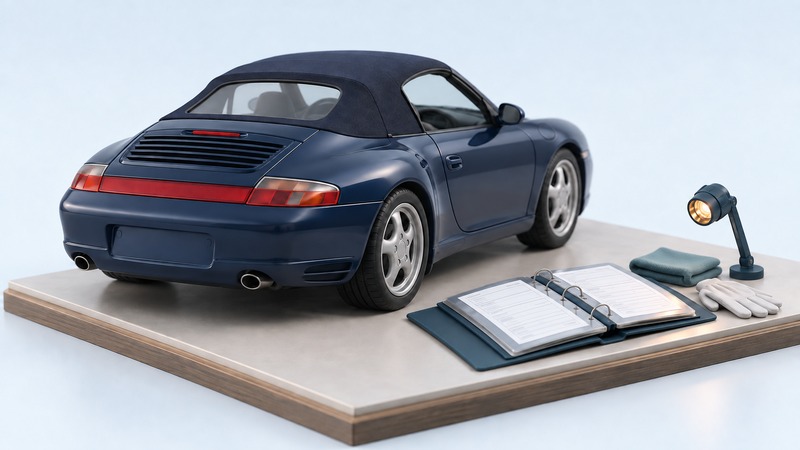
A 996 Carrera 4S buying decision needs a clear picture of the particular car: what it was built as, what has been repaired or changed and what an inspection finds today. Begin with the records, then arrange a Porsche-experienced inspection. Keep the purchase price separate from the cost of bringing the car to the condition you require.
Confirm the generation and factory specification
The Carrera 4S name appears across several 911 generations. This guide concerns the water-cooled 996, including the Cabriolet introduced for the 2004 model year. Porsche’s 996 buying guide describes the 4S’s broad rear body, all-wheel drive and upgraded brakes. Those visible features are useful context, while the VIN and factory records establish the identity of the example for sale.
Record body style, transmission, model year, market, mileage and major options. Compare the VIN and identifying information with the title, service invoices and any replacement-engine documentation. Distinguish factory equipment from later appearance or performance changes. A badge, brake color or wheel design can be changed.
Build a chronology of work and use
Request itemized invoices as well as service-book stamps. For each significant job, record date, mileage, workshop, parts and the problem it addressed. Look for an understandable sequence across periods of ownership and storage. Ask about accident repairs, track use and long periods off the road; the purpose is to identify inspection needs, not to assign a verdict from one answer.
For a claimed engine replacement, rebuild or intermediate-shaft bearing upgrade, ask for the exact invoice and the installed engine or component details. Have the inspector explain what that evidence covers and what remains unexamined. A seller’s shorthand such as “IMS done” leaves the date, method, parts and scope unresolved. Avoid treating one documented intervention as a warranty for the whole engine.
Porsche’s guide emphasizes service history and calls attention to suspension wear and front-radiator condition. Use those as inspection prompts alongside the technician’s own assessment. Ask for findings supported by observations or measurements and a written explanation of any additional tests recommended.
Agree on the specialist’s scope
On a narrow screen, scroll the table horizontally. Keyboard users can focus its region and use the arrow keys.
| Area | Ask the inspector to establish | Useful output |
|---|---|---|
| Identity and prior repairs | Consistency of records, structure and installed equipment | Photos and specific discrepancies to resolve. |
| Engine and cooling | Observed condition, leaks, cooling components and justified further tests | Findings, test limits and repair or diagnostic recommendations. |
| Driveline and chassis | Transmission, all-wheel-drive components, suspension, steering and brakes | Wear, symptoms and itemized work priorities. |
| Tires and wheels | Correct fitment and suitable condition for the vehicle | Sizes, condition findings and replacement scope if needed. |
| Cabin and electrical functions | Operation of fitted controls, warning systems and accessories | A list of functioning, faulty and untested items. |
Ask what the inspection includes and excludes before the appointment. If engine condition warrants additional investigation, let the specialist explain the purpose and limits of the proposed tests. A short visual inspection and a detailed mechanical investigation answer different questions. Preserve both findings and uncertainty.
Give a Cabriolet its own inspection brief
Have the owner demonstrate the roof with the vehicle stationary and in the conditions required by its exact manual. Observe a full opening and closing cycle, latch completion, window alignment and any abnormal movement. Keep clear of the mechanism. Inspect fabric, seams, rear glass, seals and accessible interior areas for signs of moisture.
Ask about roof repairs, leak diagnosis and any supplied hardtop or wind deflector. Verify promised accessories and fittings physically. A coupe and Cabriolet comparison should include your actual storage, noise, weather protection and roof-service needs. Price any identified roof work separately from routine mechanical maintenance.
Understand what factory documentation adds
Porsche’s U.S. vehicle-documentation service distinguishes Production Specifications from the Classic Technical Certificate. The latter combines historical information with a technical evaluation through an eligible dealer or Classic Partner. Confirm current availability, scope and price for the car and location directly.
Use that documentation alongside a purchase-focused inspection that addresses your specific concerns. Also check NHTSA recall information and Porsche’s VIN-specific records; an older car can sit beyond the VIN lookup’s usual 15-year recall coverage.
Compare complete ownership cases
Decide whether each concern is resolved, priced with an acceptable repair plan or still open. Agree on purchase conditions in writing. The strongest result is a car whose specification, maintenance and current condition you can explain—and a realistic plan for the next work it needs.
Save a working record
Download the Porsche 996 Carrera 4S working record (plain text). Open it in a text editor, save a private copy and fill in the relevant prompts. Record unknowns explicitly and attach the evidence that supports each conclusion. The file includes instructions, source links and this article’s address.