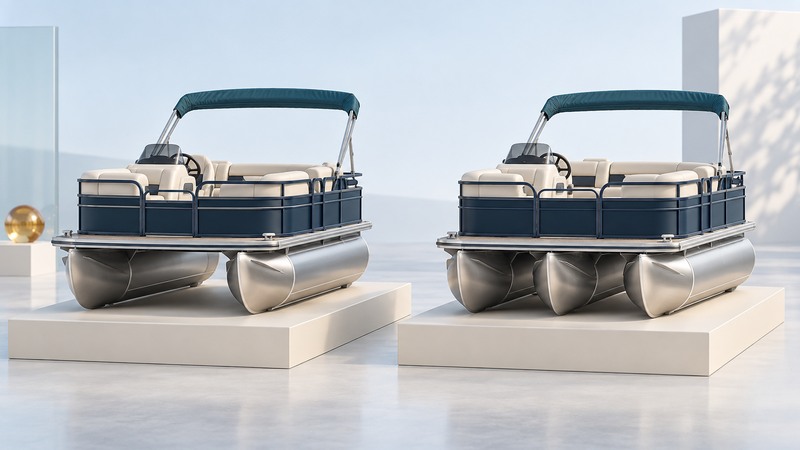
Start with your passenger group, home waters and storage plan. A third tube changes the pontoon arrangement, but the choice becomes useful only when you compare the exact boat, engine, capacity and equipment package. Select for the trips you will actually make.
For recreational buyers comparing pontoons and tritoons. Capacities, permitted activities and operating limits must come from the manufacturer’s information for the actual boat.
Understand what the tube count tells you
A conventional pontoon boat has two main flotation tubes supporting a deck. A tritoon uses three. Bennington’s design overview describes that basic distinction. Tube size and shape, lifting surfaces, deck structure, engine installation and steering can differ within either category.
A third tube may be part of a wider performance package. Compare the resulting rated capacities and equipment, not an assumption that every three-tube boat has the same benefit. A two-tube boat with one floorplan and engine is a different package from a tritoon with different seating, weight and power.
The manufacturer’s current model specifications are a starting point for comparing configurations. Request the exact model-year specification and order sheet. A series-wide range of horsepower or passenger capacity does not identify the limit of an individual boat.
Choose the layout around the people
Write down the normal and largest intended passenger groups, the gear they bring and any boarding or mobility needs. Check both the number-of-persons limit and the relevant weight limits in the boat’s capacity information. Confirm what each weight figure includes; never infer capacity by counting places on a sofa.
Walk the deck with an ordinary outing in mind. Can everyone board, reach a suitable seat, access stored gear and move as instructed? Consider shade, the boarding ladder, space for life jackets and whether fishing equipment conflicts with passengers. Confirm which seats and deck areas may be used while underway.
On a narrow screen, scroll the table sideways. Keyboard users can focus the table and use the arrow keys.
| Decision | Compare | Evidence to request |
|---|---|---|
| Passenger and load capacity | The actual group, gear and installed equipment | Capacity information for the exact configuration |
| Comfort and access | Seating, gates, shade, boarding and circulation | An onboard walk-through with the intended users |
| Activity | Cruising, fishing, swimming or permitted towing sports | Manufacturer guidance and approved attachment points |
| Performance | Handling and fuel use with representative load | Documented trial conditions and engine/propeller details |
| Storage and trailering | Full width, length, height and loaded weight | Measured rig dimensions and compatible support arrangement |
| Ownership cost | Boat, motor, trailer, storage, insurance and service | Complete comparable quotations |
For towing sports, verify that the boat and tow point are approved for the intended activity and follow the equipment instructions and local rules. A visible rail, arch or lifting point is not evidence of a tow rating. Establish the operator, observer and passenger arrangements before making that activity part of the purchase brief.
Assess water conditions and handling
Describe the lake, river or coastal area realistically, including wake traffic, wind exposure, current and access to shelter. Ask the builder and a qualified local operator how the candidate fits those waters. Tube count alone does not establish offshore suitability or a safe wave limit.
Check the appropriate National Weather Service marine products or the local inland forecast before demonstrations and outings. The decision should consider the boat, loading, operator experience and changing conditions. Postponing a trial gives more useful evidence than forcing a demonstration in unsuitable weather.
Arrange a trial with a competent operator and agree representative loading. Observe boarding, visibility from the helm, low-speed control, acceleration, turning, ride and noise at the speeds you expect to use. Ask whether the installed propeller, engine mounting and steering match the quoted package.
Record conditions beside every number. A lightly loaded speed result and a loaded family cruise should not be compared as though they describe the same use. Engine-maker performance bulletins can help identify test configurations, but your boat’s actual equipment and load still matter.
Check the complete rig before choosing length
Measure available storage against the boat on its trailer with the engine, tongue, guide posts and folded or raised structures in their specified positions. Confirm gate width, turning space and any height restriction. Nominal hull length leaves out parts of the rig that can prevent it fitting.
Ask the boat and trailer suppliers about approved tube support and the exact trailer configuration. A trailer suitable for one pontoon arrangement may need a different setup for another. Compare carrying capacity, loaded trailer weight and all vehicle and hitch limits using the trailer guide.
For marina storage, confirm berth dimensions, access, cover handling and service availability. Get insurance and storage quotations before committing. Include routine cleaning, engine care, winter preparation where relevant and the work involved in fitting a cover after each outing.
Decide with a short requirements brief
Keep a one-page comparison with the exact model, engine, tube package, floorplan, limits, quote and unresolved questions. For a used pontoon, obtain inspection of the tubes, deck, structure, systems and repair history appropriate to its condition. The used-boat buying guide explains how to arrange that process.
At handover, practice the gates, canopy or bimini, cover, ladder and transport arrangements with the dealer. Obtain the manuals and learn which items must be stowed or secured during operation. Those ordinary routines shape ownership long after the first showroom visit.