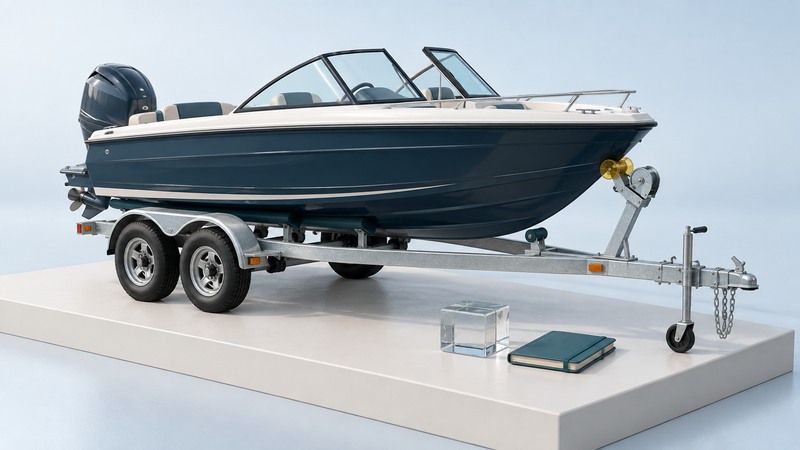
Choose a trailer around the boat’s actual loaded weight and approved hull support, then check the complete tow vehicle and hitch combination. The boat’s advertised dry weight is only one part of the load you take to the ramp.
A preparation guide for recreational boat owners. Obtain the manuals for the boat, trailer, hitch and tow vehicle; traffic and ramp rules vary by location.
Fit the hull and the load
Record the boat’s model, hull shape, bow-eye-to-transom dimensions, engine and normal equipment. Ask the boat manufacturer which bunk or roller support is appropriate and have the trailer supplier set it up for that hull. Pay attention to support around the transom and heavy machinery. Length alone does not establish fit.
Load Rite’s fitting guidance distinguishes trailer carrying capacity from the trailer’s own weight and identifies dimensional checks. Its overview also contains differing tongue-weight percentages in different sections. Resolve the requirement for the specific trailer using its applicable manual and manufacturer guidance before setting the load position.
Add the boat, installed engines, batteries, fuel, water and carried gear, taking care to identify what the published boat weight already includes. Then add the trailer’s empty weight to estimate the fully loaded trailer. Weigh the real combination to verify the estimate; a missing battery bank or a full water tank can change it materially.
On a narrow screen, scroll the table sideways. Keyboard users can focus the table and use the arrow keys.
| Check | Meaning | Where to verify |
|---|---|---|
| Trailer carrying capacity | Permitted load carried by the trailer, excluding its own empty weight | Trailer identification plate and manual |
| Trailer GVWR | Maximum permitted total trailer weight including its load | Trailer certification label |
| Tow-vehicle GVWR and axle ratings | Limits for the loaded vehicle and individual axles | Vehicle labels, manual and scale measurements |
| GCWR and towing limit | Combination and trailer limits for the exact vehicle configuration | Manufacturer’s model-year towing guide |
| Tongue load and hitch ratings | Downward hitch load and component limits | Applicable manuals, component labels and measurement |
Work through the complete weight check
The weight definitions in Ford’s towing guide show why passengers, cargo and hitch load belong in the vehicle calculation. Use the guide for your own model year and configuration; headline maximum towing figures may assume equipment or loading different from yours. Confirm the ratings of the receiver, ball mount, ball and coupler as well.
On a combined scale ticket, axle weights already include weight transferred through the hitch. Avoid adding tongue load a second time to the total of all axle readings. Ask the scale operator or a qualified towing professional for the measurements needed to check each axle, the loaded vehicle and the complete combination.
If any rating is exceeded, reduce the relevant load or choose a suitable combination. Moving weight aft merely to reduce tongue load can create a different problem. Have load distribution and support adjustments checked together.
Build a repeatable departure check
Use the trailer operator’s manual for the correct coupling, securement, tire, wheel, bearing and brake checks. Write the actual specification or procedure reference beside each item on your checklist. Torque, pressure, service method and brake-controller settings depend on the installed equipment.
- Confirm compatible coupling components, a correctly engaged and secured latch, and the specified safety-chain and breakaway connections.
- Check tires, wheel fasteners, bearings, lights and fitted brakes by the applicable instructions. Resolve damage or faults before travel.
- Secure the boat with its specified transport tie-downs. The winch line serves a different purpose from independent road securement.
- Stow loose equipment and set the motor, supports, covers and folding components to their approved transport positions.
- Check mirror visibility, route restrictions and local trailer requirements. Confirm the roadside assistance plan covers the combination.
Arrange low-speed towing and reversing practice with a qualified instructor before a busy ramp visit. Carry suitable spares and tools only for tasks you can perform safely; a roadside service contact is part of the preparation.
Prepare away from the launch lane
Inspect the ramp from a safe location before committing the rig. Look at slope, surface traction, tide or water level, available depth, current, queue space and where the ramp ends. Ask the operator about restrictions and retrieval arrangements. Choose another ramp or time if conditions exceed the equipment or driver’s capability.
In the staging area, allocate roles and agree clear stop signals. Transfer gear, prepare lines, check the boat’s drain closures and complete the manufacturer’s launch preparation. Keep the boat controlled throughout the transition from road securement to floating; follow the trailer’s method for when to release the winch and safety connection.
Use the specified immersion and launch technique for the trailer. Ramps and hull supports differ, so an arbitrary “back in until the fenders disappear” rule is a poor substitute for the correct procedure. Observe local restrictions on power loading. Keep people clear of the moving vehicle, trailer, winch line and propeller.
After recovery, move to the designated area to restore road securement and transport positions. Follow local cleaning, drainage and aquatic-invasive-species rules before leaving; the US Fish and Wildlife Service’s Clean, Drain, Dry guidance explains the purpose of these steps. Recheck the hitch, lights and load before joining traffic.
Keep a trailer service record
Record exposure to salt or brackish water, mileage, bearing and brake service, tire condition and any change in towing behavior. Follow the specified rinsing and storage procedures. Ask the supplier about approved bunk materials for an aluminum hull; support and corrosion compatibility belong in the same conversation.
Unexpected vibration, sway, brake trouble or heat warrants stopping safely and investigating with appropriate help. Treat the cause before the next trip. Revisit the weight and fit checks after repowering, adding batteries or changing major equipment.
Take the worksheet with you
Boat-trailer preparation worksheet — editable plain text. Save a copy, open it in a text editor and fill in the blanks as you collect evidence. Keep unresolved items visible.