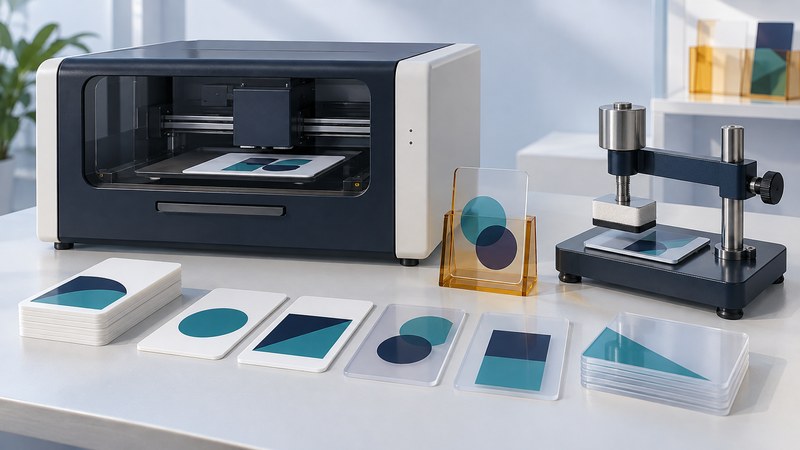
Successful printing on plastic depends on the combination of substrate, surface condition, ink and processing. Specify the exact material and the intended use, then agree how adhesion, appearance and durability will be tested. A trial becomes informative when each specimen can be traced to the conditions that produced it.
Give the printer a material-and-use brief
Identify the resin and grade, sheet or molded-part supplier, lot, texture, color and relevant additives or recycled content. “Plastic” leaves too many variables open. State whether the print will be bent, abraded, washed, exposed outdoors, contacted by a chemical or covered by another layer. Include the real viewing and handling conditions behind the appearance requirement.
Ask the ink supplier to confirm suitability for that substrate and application. Marabu's Mara Poly P technical data sheet, for example, identifies particular substrates and pretreatment requirements and calls for preliminary trials because printability can vary within a substrate type. Its mixing and processing instructions belong to that ink system; carry the applicable sheet into the job record.
Keep any packaging-contact requirements in the specification and obtain the relevant supplier documentation for the complete construction and intended use. Technical printability and contact suitability require separate evidence.
Measure surface condition near printing
Record cleaning, treatment method, time since treatment, storage and handling. Surface contamination or a change in treatment history can explain why a familiar material behaves differently. Use the substrate and treatment suppliers' procedures, including sample preparation and interpretation.
Enercon's dyne-test guidance describes checks used to assess treated surfaces. Record the test method and result at representative locations; a wetting result is one indicator to investigate alongside finished-print tests. The required level depends on the substrate and printing system. Use the supplier's target rather than a universal dyne value.
A treatment reading taken when a roll was received may differ from its condition when printed. Check the actual printing surface and retain the timing. For a molded part, also consider locations that differ in texture, geometry or handling exposure.
Turn defects into testable questions
On a narrow screen, scroll the table horizontally. Keyboard users can focus it and use the arrow keys.
| Observation | Investigate | Evidence to retain |
|---|---|---|
| Ink beads or withdraws | Wetting, contamination, substrate/ink compatibility | Location, surface test and treatment history |
| Print lifts in adhesion test | Test execution, surface, mixing and cure/dry state | Test timing, failure pattern and processing record |
| Print rubs or transfers | Drying/cure, film deposit and actual contact conditions | Exposure method, time and individual specimen results |
| Print cracks after forming | Ink flexibility, strain and forming conditions | Before/after images and location on the formed part |
These are investigation paths, not diagnoses. Hold the known conditions steady while changing one clearly identified factor or using a documented experiment design. Retain failed and satisfactory specimens so the supplier can compare the actual failure interface.
For UV systems, a lamp setting alone leaves exposure uncertain. Use the related UV irradiance and dose guide to document measurement context, then confirm the ink's required performance through the appropriate product tests.
Agree on the trial before counting passes
Define the adhesion procedure, conditioning interval, sample locations and acceptance criterion before testing. Include the relevant rub, chemical, flex or weathering exposure for the end use. Record the apparatus and consumables specified by the chosen method so results from different operators remain comparable.
Fictional trial: 12 of 100 control cards and 3 of 100 candidate cards show the same defined adhesion failure. The observed failure proportions are 12% and 3%, a reduction of 9 percentage points.
The candidate warrants further evaluation. Repeat across relevant material lots and production conditions before claiming a stable long-run result. Check whether another requirement, such as rub resistance or color, became worse.
Release the combination of material, ink and documented process that passed the agreed tests. Define which changes require another trial, including a new substrate grade, additive package, ink formulation or treatment route.
Use the working record
Download the editable plastic print trial. Save a copy, complete the actual requirements and evidence fields, and review open issues with the responsible owner. The plain-text record includes instructions, units where needed, the fictional example, and source references.