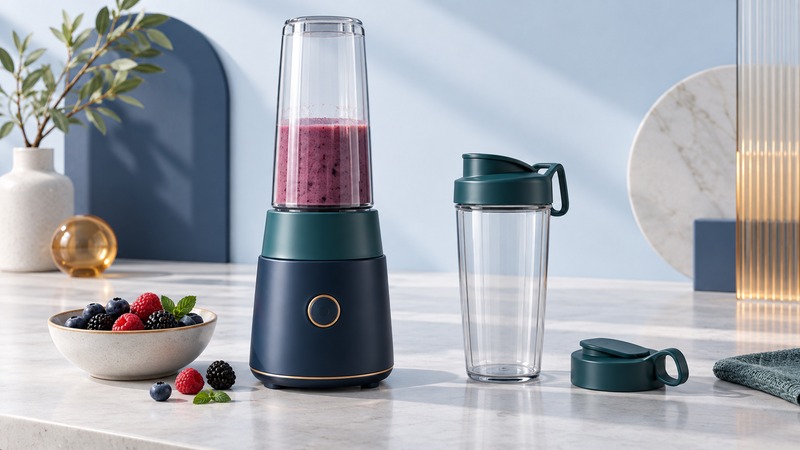
A personal blender suits someone who regularly makes a single drink and wants to carry it in the same cup. Choose the cup system before the motor headline: working volume, lid comfort, replacement parts and washing access determine much of the daily experience. Then test the ingredients you actually use.
Check the complete cup system
Measure the serving you normally make and compare it with the fill line, leaving the space required by the manual. A cup's total volume can be larger than its allowed blending volume. Check that the cup fits where you plan to carry or store it and that you can comfortably reach inside for cleaning.
Record the exact base, cup and blade identifiers. Nutribullet's FAQ explains that cups and blades are designed for particular models. A threaded part that appears to fit is not proof of an approved combination. Check replacement availability before buying a used or incomplete machine.
For a secondhand unit, compare its model and serial information with the CPSC recall database and the manufacturer's notices. Read any applicable notice in full; the required response may change over time.
Build within the ingredient limits
Follow the exact manual for ingredient order, liquid, maximum run time and cooling intervals. Inverted cups and upright pitchers have different arrangements around the blade. An ingredient order copied from another design may not produce the same movement.
Nutribullet's getting-started guide warns against hot or carbonated ingredients in its sealed cups and against filling beyond the maximum line. For a sealed personal-blender cup, use cool ingredients and observe the model's restrictions. A vented full-size pitcher on a combination machine can have different instructions.
Decide whether ice, frozen fruit, dry grinding or dense nut mixtures are essential to you, then verify each task explicitly. Watts alone do not establish that a blade and cup are intended for it. For chopping or shredding solid ingredients, compare a food processor.
Make one recipe repeatable
Choose a simple combination you already enjoy. Record the ingredients by a consistent measure, their fresh or frozen condition, the liquid amount and the program used. Keep the total beneath the allowed fill line. The first goal is a mixture that circulates and reaches the texture you want within the permitted run time.
If the mixture stops moving, stop the blender using its controls. Follow the manual before removing the cup or correcting the mixture. Avoid running repeated long cycles to force a stalled blend. If a sealed cup feels hot or is difficult to open, stop and follow its specific pressure and cooling instructions; do not force it open.
Use the symptom to choose the next check
| Symptom | Check while stopped and disconnected as instructed |
|---|---|
| Leakage | Fill level, correct approved parts, thread alignment and visible damage. |
| Pieces remain | Ingredient limits, starting size, liquid and permitted load. |
| Recurring smell or residue | Cleaning access around the blade assembly and the approved washing method. |
| Unusual noise or damaged cup | Stop use and seek the correct replacement or manufacturer advice. |
Clean promptly using the model's instructions. Dishwasher permission can differ for the cup, lid and blade assembly. Do not pry out a seal unless the manufacturer describes it as removable for cleaning. Keep the motor base out of water and inspect contact surfaces before reassembly.
Reassess after several ordinary uses: is the serving adequate, does the lid work for your journey, and is cleanup easy enough that you keep using it? Those observations are more useful than an elaborate demonstration with ingredients you rarely blend.