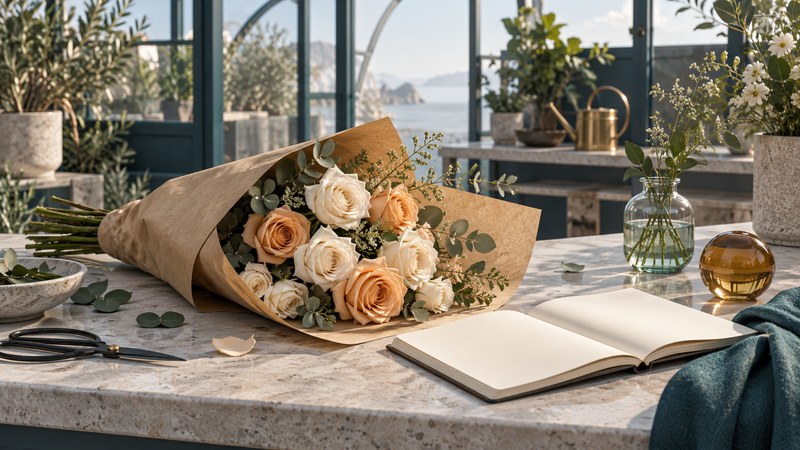
When buying organic roses, ask which flowers are covered by the claim, who grew or supplied them and which standard and certifier support it. Then compare the bouquet's freshness, availability, packaging and total cost with what matters to you and the recipient.
This guide uses the United States organic system as its starting point. For flowers sold elsewhere, check the applicable local standard. Certification, growing location and worker-related claims answer different questions, so inspect each claim separately.
What does organic tell you?
USDA organic labeling guidance describes production under defined agricultural standards and oversight by authorized certifying agents. Those standards address practices and allowed inputs. An organic claim should identify a verifiable production system; it should not be read as a promise that every environmental or social outcome has been measured.
USDA permits specified substances within its organic rules. Consequently, “organic” and “grown without any pesticide” are different claims. Ask the seller to explain the particular claim being made. Certification also does not make an ornamental rose an edible flower: choose ingredients specifically sold for food use if you intend to eat them.
On a small screen, swipe the table sideways or focus it and use the arrow keys.
| Claim | Useful question | What else to establish |
|---|---|---|
| Certified organic | Which standard, operation and certifier cover these roses? | Whether the claim applies to these stems, other flowers and any greenery in a mixed bouquet. |
| Local or seasonal | Where and when were the flowers grown? | The stated growing practices. Location alone does not verify organic certification or a total environmental footprint. |
| A named worker-related certification | What does the program require and how is compliance checked? | Its current scope and connection to this supplier; read its actual standards rather than relying on a general “ethical” label. |
| Recyclable, reusable or reduced packaging | Which materials are included, and what can the recipient actually reuse or recycle? | Local collection rules and whether a simpler wrapping or a vase you already own is available. |
For example, Fairtrade describes standards addressing workers' rights, agricultural production and trade relationships, with a specific standard for flowers and plants. Read that scope separately from a USDA organic claim; one program's name should not be used as a substitute for checking the other.
Trace the claim to the flowers you are buying
- Ask for the grower or supplier's certified business name. A bouquet's shop name may differ from the operation named on the certificate.
- Ask which product is covered. Identify the roses and any other stems that are being represented as certified. A mixed arrangement may contain flowers with different sourcing.
- Use USDA's official lookup route. The USDA Farms and Operations page links to the Organic INTEGRITY Database for finding certified operations and products. Check the business name, current status and relevant product information.
- Resolve gaps with the seller or certifier. If the name differs or the product information is unclear, request documentation connecting this bouquet to the certified supply. A certificate for an unrelated product does not answer that question.
Retailers and certain other operations can qualify for exemptions from certification. USDA explains which operations need certification and the limits of exemptions. A missing retail shop entry alone does not settle whether the flowers are organic; seek the supplying operation and the evidence behind the claim.
Compare what matters for this gift
Pick your priorities before comparing offers. If verified organic production is essential, start with the documentation and consider a smaller bouquet that fits your budget. If the date is fixed, ask what is actually available for that day. If your priority is the recipient's enjoyment, consider favorite colors, scent preferences, vase space and the work the gift will require.
Record the total price, including delivery and any vase, and ask what happens if the advertised stems are unavailable. Decide whether substitutions need your approval. Photos illustrate a style; the florist should explain the quantity, flowers and terms included in your order.
For environmental comparisons, ask about the growing setting, transport and packaging where the seller has information. Avoid assigning a total footprint from distance alone. If comparable evidence is missing, describe the choice honestly: you selected verified organic production, less packaging or a locally grown option, rather than declaring it the best in every respect.
Illustrative comparison, without a universal winner
One florist can document certified organic roses but offers only a large wrapped bouquet. Another has a smaller locally grown seasonal arrangement with clear growing information but no organic certification. If organic certification is your priority, ask the first florist for fewer stems and simpler wrapping. If size and local sourcing matter most, the second option may suit the occasion—describe it using those verified qualities.
If suitable roses are unavailable, ask about other certified flowers, choose a modest seasonal bouquet with accurately described sourcing, or make a different gesture. The tulip gift and care guide can help with one alternative. Keep the recipient's preferences central.
Five questions to take to the florist
- Which flowers and greenery in this exact bouquet are covered by the organic claim?
- What are the certified operation's name, certifier and applicable standard?
- What can you tell me about the growing location and the date these flowers became available?
- What wrapping, vase and substitution options can I choose?
- What is the full cost for my date and destination, and what care instructions come with it?
On arrival, check the delivery against the agreed order, follow the supplied flower-care instructions and keep any claim documentation with your receipt. If the bouquet differs, contact the seller with the order details and a clear photograph.
Related reading
For an occasion built around personal attention, see Free and Low-Cost Marriage Proposal Ideas. Return to the Love guides for flowers and shared meals.