An optical vector analyzer is a test instrument for characterizing the linear optical behavior of fiber-optic components, photonic modules, and short optical assemblies. Instead of measuring only optical power or a single reflection point, it measures how a device changes an optical signal across wavelength, polarization, phase, delay, and loss.
The word "vector" matters. A scalar optical measurement may tell how much light comes out. A vector measurement also captures phase and polarization relationships, allowing the instrument to derive the device's transfer function. For passive and linear optical components, that makes it possible to measure many important parameters in a single scan.
What an Optical Vector Analyzer Measures
- Insertion loss: how much optical power is lost through the device under test.
- Return loss: how much light is reflected back toward the source.
- Polarization dependent loss: how loss changes with the polarization state of the input light.
- Group delay: how long different wavelengths or signal components take to pass through the device.
- Chromatic dispersion: wavelength-dependent delay that can broaden high-speed optical signals.
- Polarization mode dispersion: differential delay caused by polarization effects in fiber or components.
- Jones matrix elements: the polarization transfer behavior of a linear optical device.
- Optical phase and time-domain response: derived views that help locate internal features and understand component behavior.
How It Differs from Other Optical Test Gear
An optical power meter and light source can certify basic loss. An optical spectrum analyzer shows power versus wavelength. An OTDR or optical backscatter reflectometer locates reflections and loss along a fiber path. A coherent optical modulation analyzer measures complex modulated communication signals, such as those used in coherent 400G, 800G, 1.2T, and 1.6T systems.
An optical vector analyzer sits in a different place. It is primarily a component characterization tool. It answers questions such as: What is the transfer function of this filter, mux/demux, interleaver, coupler, delay line, waveguide, fiber Bragg grating, photonic integrated circuit, or DWDM module? How do loss, delay, phase, and polarization change across the band?
Why Single-Scan Measurement Matters
Optical components often have coupled impairments. Loss, phase, polarization, and delay are not independent in the way a production test spreadsheet might wish they were. Measuring them with separate instruments takes time and can introduce setup variation. A single-scan instrument reduces handling, speeds production test, and helps engineers see relationships between impairments.
Luna's optical vector analyzer approach uses swept-wavelength interferometry. The current OVA 5100 product page describes single-measurement, all-parameter analysis, including simultaneous measurement of loss, polarization, dispersion, phase, and time-domain response. Luna lists wavelength options for C and L bands or O band, 1.6 pm wavelength resolution, 80 dB dynamic range, and device lengths up to 150 m in transmission or 75 m in reflection.
The 2004 Luna OVA-MP Story
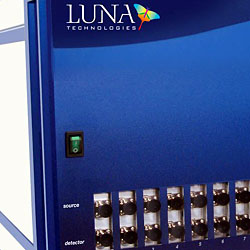
In 2004, Luna Technologies announced an enhancement of its Optical Vector Analyzer platform with the OVA-MP for multi-channel testing of optical components and subassemblies. Designers and engineers of optical components gained the ability to perform volume all-parameter testing of single-channel and multi-channel DWDM devices. The initial offering provided up to 128-port capability.
Luna's multi-channel solution provided simultaneous and independent verification of each channel of a multi-channel component, with fast measurements of insertion loss, group delay, chromatic dispersion, polarization dependent loss, and polarization mode dispersion. At a time when optical-component manufacturers were under cost pressure, the OVA-MP was positioned as a way to reduce test budgets, accelerate production schedules, and improve time to market.
The OVA-MP leveraged Luna's interferometric all-parameter analysis technique, providing speed, accuracy, and integration in optical component test.
"Luna's new OVA-MP analyzer can significantly reduce your cost of test and help bring your product to market faster," said John Goehrke, President of Luna Technologies. "It can also assure your product is more reliable than your competitor's by providing complete, all-parameter testing."
The OVA-MP was a compact, small-footprint system that scaled from the entry-level single-port OVA. Luna planned to introduce it at the 2004 Optical Fiber Communications Conference in Los Angeles with immediate availability and 4 to 6 week delivery.
What Changed Since 2004
The need for detailed component characterization did not fade. It became more important. DWDM filters, ROADMs, coherent modules, silicon photonics, photonic integrated circuits, co-packaged optics, sensing systems, and high-speed data-center interconnects all depend on optical components whose loss, phase, dispersion, and polarization behavior must be known precisely.
Luna later introduced the OVA 5000 in 2009, describing it as a faster tool for loss, dispersion, and polarization measurements that could complete full C and L band characterization of linear optical parameters in less than three seconds. Luna now offers the OVA 5100 as a direct replacement for the OVA 5000 with equivalent functionality in a smaller package.
At the same time, another test category grew around coherent transmission. Coherent optical modulation analyzers from companies such as Keysight focus on modulated optical signal quality, measuring metrics such as error vector magnitude, Q-factor, phase error, and transmitter behavior for high-speed coherent systems. That is complementary to optical vector analysis. One characterizes components and transfer functions; the other characterizes complex communication waveforms.
Where Optical Vector Analysis Is Used
- DWDM mux/demux modules, interleavers, filters, and wavelength-selective devices.
- Passive optical components, couplers, splitters, circulators, isolators, and delay elements.
- Silicon photonics and photonic integrated circuits during design verification and production test.
- Components used in coherent optical modules, ROADM line systems, and high-speed data-center optics.
- Research labs studying polarization, dispersion, transfer functions, and optical phase response.
- Manufacturing environments where one fast scan can replace several slower parameter-specific tests.
Planning a Measurement
- Match wavelength band to the device: O band, C band, L band, or another range.
- Control connector cleanliness, launch conditions, polarization handling, and temperature.
- Calibrate the measurement path and use appropriate reference standards before comparing devices.
- Choose transmission or reflection mode based on the component and the failure mode being investigated.
- Record settings with the data: wavelength range, resolution, sweep speed, port map, connector type, and calibration state.
- Use a modulation analyzer, BERT, or system test set when the question is live signal quality rather than passive component transfer behavior.
Optical vector analysis is valuable because it makes hidden component behavior visible. As optical networks move toward denser wavelength plans, coherent signaling, silicon photonics, and tighter manufacturing tolerances, measuring only power is not enough. The phase, delay, and polarization response of the component can be just as important as its loss.
References
- Luna: OVA 5100 Optical Vector Analyzer
- Luna: OVA 5100 versus OVA 5000
- Luna: OVA 5000 launch announcement
- Luna: communications test and photonic control products
- Applied Optics: optical vector network analyzer for single-scan measurements
- Keysight: photonic and optical test products
- Keysight: coherent transmission test instruments